Table of Contents
The Central Sector Scholarship supports meritorious students. It helps students pursue higher education. The scheme targets economically weaker families. Class 12 merit affects scholarship selection. Family income also affects eligibility.
Only renewal applications for the PM-USP Central Sector Scheme of Scholarship (CSSS) are open on the National Scholarship Portal right now. Existing beneficiaries can renew until 31 October 2026. Institute verification closes on 15 November 2026, and L2 verification on 30 November 2026.
NSP has not opened fresh CSSS applications for 2026-27 as of this date. Keep your OTR ready and check scholarships.gov.in regularly for an announcement. We will update this page when the fresh window opens.
The scholarship provides yearly financial assistance. Undergraduate students can receive ₹12,000 yearly. Higher study levels can receive ₹20,000 yearly.
Looking for Certification Courses Online? Learn with Entri and Build your Dream Career!
Central Sector Scholarship 2026: Quick Facts
| Particular | Details |
|---|---|
| Scheme name | Central Sector Scholarship |
| Academic year | 2026-27 |
| Managed by | Ministry of Education |
| Application portal | National Scholarship Portal |
| Main selection basis | Class 12 merit |
| Income limit | Up to ₹4.5 lakh yearly |
| Initial scholarship | ₹12,000 yearly |
| Higher study benefit | Up to ₹20,000 yearly |
| Application mode | Online |
Students should check current dates carefully. Fresh and renewal dates can differ.

What is the Central Sector Scheme of Scholarships?
The Central Sector Scholarship is a government scheme. It supports students pursuing higher education. The scheme is commonly called CSSS.
It operates under the PM-USP initiative. PM-USP supports higher education access. The scheme combines merit with financial need.
What is the Main Purpose?
The scheme aims to reduce financial barriers. Higher education can create significant expenses. Scholarships can reduce this financial pressure.
The scheme focuses on several objectives.
- Encourage higher education.
- Support meritorious students.
- Assist economically weaker families.
- Reduce education expenses.
- Encourage academic continuation.
- Improve access to college education.
- Support professional course students.
The scheme rewards strong academic performance. It also considers family financial conditions.
How does CSSS Selection Work?
Selection begins with Class 12 performance. Students must achieve the required merit position. Board-wise merit lists influence selection.
The process considers several factors.
- Class 12 examination results.
- Board-wise merit position.
- Scholarship availability.
- Reservation provisions.
- Family income.
- Course eligibility.
- Institution eligibility.
Meeting one condition does not guarantee selection. Students must satisfy all applicable requirements.
Where is the Scholarship Application Submitted?
Applications use the National Scholarship Portal. Students complete the process online. The portal hosts several government scholarships.
Students must complete One Time Registration. OTR creates a unique student profile.
The application process includes several stages.
- OTR registration.
- Scholarship selection.
- Personal information.
- Academic information.
- Document details.
- Application submission.
- Verification.
Students should save their application information. It may help during later tracking.
Central Sector Scheme of Scholarships 2026 Eligibility
Eligibility depends on several conditions. Students should check every requirement carefully.
Who can Apply?
The scheme targets meritorious students. Applicants must complete Class 12 successfully. They must then enter eligible higher education courses.
Important conditions include:
- Strong Class 12 academic performance.
- Required merit position.
- Eligible course admission.
- Recognised educational institution. (recognised by AICTE and the relevant regulator)
- Family income within limits.
- Compliance with scheme requirements.
The scheme uses an 80th percentile benchmark. Students must satisfy the prescribed merit conditions.
What Merit Requirement Applies?
Class 12 performance plays a major role. Selection uses board-specific merit lists. Students should check their board position.
The merit process considers:
- Class 12 marks.
- Board examination performance.
- Stream-wise merit.
- Available scholarship slots.
- Category-based allocation.
High marks do not guarantee selection. Scholarship slots remain limited.
What Income Limit Applies?
The scheme targets economically weaker families. Family income must remain within the prescribed limit.
The commonly applicable limit is ₹4.5 lakh. Income includes relevant family income sources.
Applicants need valid income proof. Incorrect income details can affect eligibility.
Which Courses are Covered?
CSSS supports eligible higher education courses. Both general and professional courses can qualify.
Examples include:
- Arts courses.
- Science courses.
- Commerce courses.
- Engineering courses.
- Medical courses.
- Other professional courses.
The course must meet scheme requirements. The institution must also meet recognition rules.
Which Courses are Usually Excluded?
Certain study modes do not qualify. Diploma courses are generally outside CSSS coverage.
Other exclusions can include:
- Distance learning courses.
- Correspondence courses.
- Ineligible diploma programs.
- Unrecognised institutions.
- Courses outside scheme conditions.
Students should verify course eligibility beforehand.
Who May Not Qualify?
Several conditions can cause ineligibility.
Students may not qualify because of:
- Low merit position.
- Excess family income.
- Ineligible courses.
- Unrecognised institutions.
- Incorrect application details.
- Conflicting scholarship benefits.
- Failed renewal conditions.
Eligibility should be checked before applying.
Does CSSS have Reservation Benefits?
Yes, reservation rules apply under CSSS. Government reservation policies guide scholarship allocation.
Eligible categories can include:
- Scheduled Castes.
- Scheduled Tribes.
- Other Backward Classes.
- Persons with disabilities.
Female students also receive reserved allocation. The remaining scholarships follow prescribed distribution rules.
Can Students Receive Another Scholarship?
Students should check scholarship combination rules. Certain overlapping scholarships may not be allowed. Students should avoid submitting conflicting claims. They should carefully review scheme conditions.
Expore Free Courses
Ready to take your career to the next level? 🚀 Explore Entri's complete range of online courses, from competitive exam prep to in-demand skilling programs.
Join Now!Scholarship Benefits
CSSS provides annual financial assistance. The amount depends on study level.
How much Scholarship is Provided?
The initial benefit is ₹12,000 yearly. Higher study years receive larger assistance.
| Study LevelAnnual Scholarship | Study LevelAnnual Scholarship |
| First three undergraduate years | ₹12,000/year |
| Postgraduate level | ₹20,000/year |
Five-year or integrated professional courses get ₹20,000 in years 4 and 5.
B.Tech and B.E. students get ₹12,000 for years 1-3 and ₹20,000 only in the 4th year.
The amount can support several education expenses. Payment continues only after renewal.
What Can the Scholarship Support?
The scholarship provides financial assistance. Students can use it toward academic needs.
It may help with:
- Books.
- Study materials.
- College expenses.
- Travel expenses.
- Accommodation costs.
- Other education-related needs.
The scholarship may not cover everything. Students should plan additional expenses separately.
How is the Scholarship Paid?
The scholarship uses Direct Benefit Transfer. Funds reach eligible student bank accounts.
Students should keep bank information accurate.
Check these details carefully:
- Account number.
- Account holder name.
- IFSC code.
- Bank status.
- Aadhaar linkage.
Incorrect banking details can delay payments. Students should resolve errors quickly.
Why is CSSS Beneficial?
Higher education can create financial challenges. CSSS provides recurring financial assistance.
Key benefits include:
- Supports higher education.
- Rewards academic merit.
- Helps low-income families.
- Supports professional courses.
- Reduces financial pressure.
- Encourages continued education.
- Provides support across study years.
The scheme combines merit and financial need. Students should check both requirements carefully.
Important Dates for CSS Scholarship 2026
The application schedule has several stages. Students should track every important deadline.
| Application Stage | Date |
|---|---|
| Application opening | June 1, 2026 |
| Student application deadline | October 31, 2026 |
| Institute verification deadline | November 15, 2026 |
| Higher-level verification | November 30, 2026 |
Dates can change through official notices. Students should check updates regularly.
Verification: Applications are checked at two levels, first by the institute and then by the State Higher Education Department or nominated state agency.
Why are these Dates Important?
Late applications can miss scholarship consideration. Verification must also finish within deadlines. Students should avoid last-minute submissions.
Keep these dates saved safely.
- Application opening date.
- Final submission date.
- Institute verification date.
- Final verification date.
- Renewal deadline.
Documents Required
Students need several documents during application. Requirements can vary between applicants.
Which Documents are Usually Required?
Common documents include:
- Aadhaar details.
- Class 12 marksheet.
- Income certificate. (It is required only for fresh applicants)
- Bank account details.
- Admission proof.
- College identification details.
- Category certificate, if applicable.
- Disability certificate, if applicable.
- Passport-size photograph.
- Previous scholarship details.
Students should keep documents clearly readable. Information should match application records.
Why is Each Document Important?
Class 12 marksheet:
It confirms academic performance.
Income certificate:
It verifies family income eligibility.
Bank details:
They support scholarship payment.
Category certificate:
It supports reservation benefits.
Admission details:
They confirm current course enrollment.
Aadhaar details:
They support identity verification.
How Should Documents be Prepared?
Check every document before uploading. Make sure names remain consistent.
Follow these simple checks:
- Use clear document copies.
- Check spelling carefully.
- Verify certificate dates.
- Match academic information.
- Confirm bank details.
- Keep original documents safely.
Incorrect documents can delay verification. Missing documents can also cause rejection.
Expore Free Courses
Ready to take your career to the next level? 🚀 Explore Entri's complete range of online courses, from competitive exam prep to in-demand skilling programs.
Join Now!How to Apply Online for Central Sector Scheme of Scholarships 2026
The application process happens through NSP. Students should complete each step carefully.
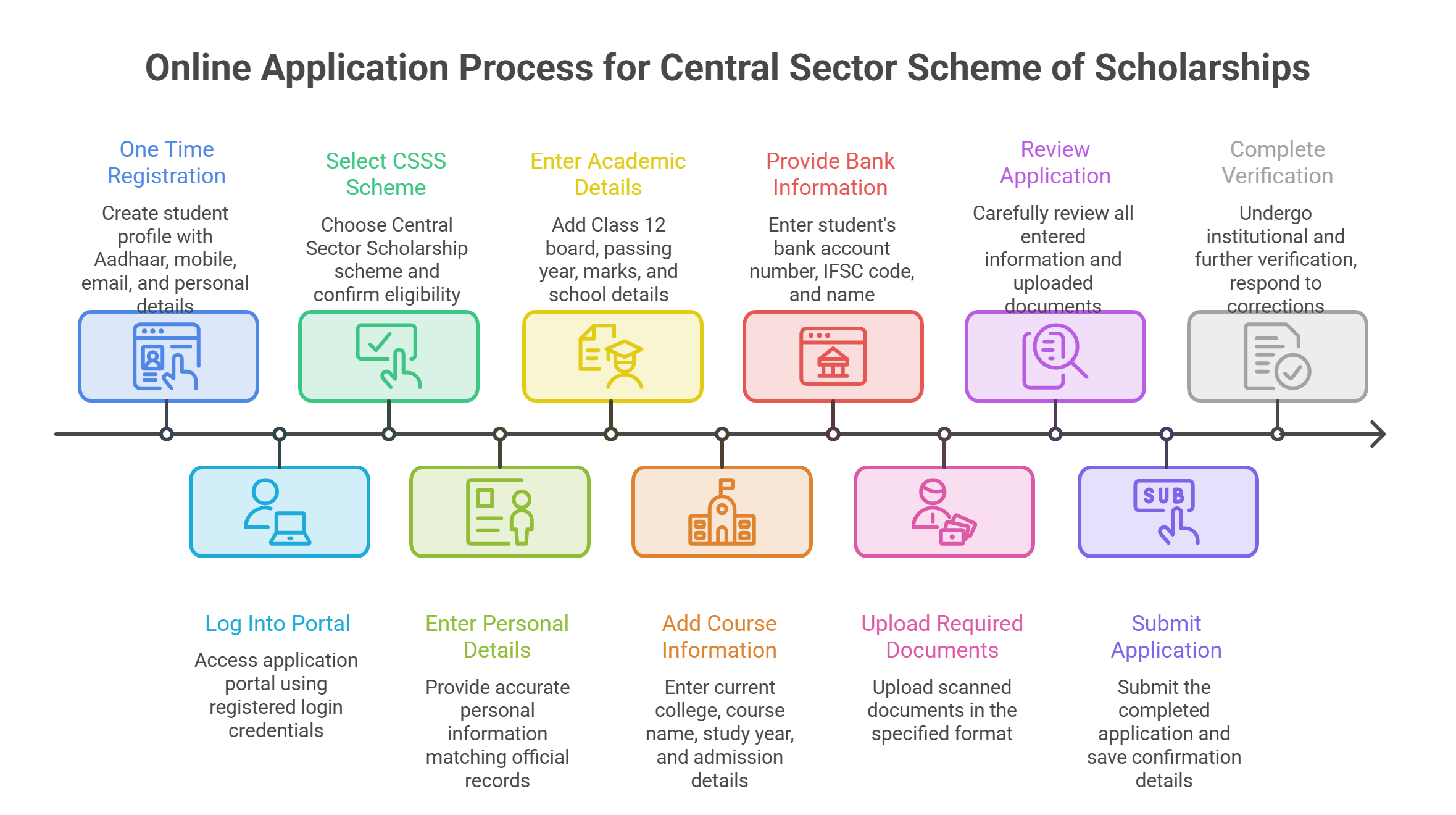
Step 1: Complete One Time Registration
Start with One Time Registration. OTR creates the student’s profile.
Keep these details ready:
- Aadhaar information.
- Mobile number.
- Email address.
- Personal information.
- Basic identity details.
Check every detail before completing registration.
Step 2: Log into the Portal
Use the registered login details. Enter the required verification information.
Keep login credentials safely stored. Avoid sharing them with others.
Step 3: Select the CSSS Scheme
Open the scholarship application section. Select the Central Sector Scholarship scheme.
Read the eligibility information carefully. Confirm eligibility before continuing.
Step 4: Enter Personal Details
Provide accurate personal information.
This may include:
- Student name.
- Date of birth.
- Gender.
- Address.
- Category.
- Contact details.
Details should match official records.
Step 5: Enter Academic Details
Add Class 12 information carefully.
Enter details such as:
- Board name.
- Passing year.
- Roll number.
- Marks obtained.
- Percentage.
- School details.
Check marks before submitting the information.
Step 6: Add Course Information
Enter current college details. Provide the correct course information.
Include:
- Institution name.
- Course name.
- Study year.
- Admission details.
- Course duration.
Incorrect course details can affect eligibility.
Step 7: Provide Bank Information
Enter the student’s bank details carefully.
Check:
- Account number.
- Bank name.
- IFSC code.
- Account holder name.
Payment depends on accurate bank information.
Step 8: Upload Required Documents
Upload documents in the required format. Ensure every file remains readable.
Avoid unclear photographs and incomplete documents. Check uploaded files before proceeding.
Step 9: Review the Application
Review the complete application carefully.
Check:
- Personal information.
- Academic information.
- Income details.
- Course details.
- Bank information.
- Uploaded documents.
Correct mistakes before final submission.
Step 10: Submit the Application
Submit the application after verification. Save the application confirmation details.
Keep a copy for future reference. These details can help during tracking.
Step 11: Complete Verification
The application undergoes institutional verification. Further verification may follow.
Students should respond to correction requests quickly. Delays can affect scholarship processing.
Scholarship Renewal Process
CSSS requires renewal after initial selection. Students must satisfy renewal conditions.
Who can Renew the Scholarship?
Existing beneficiaries can apply for renewal. They must continue eligible higher education.
Renewal generally requires:
- Continued course enrollment.
- Satisfactory academic performance. (at least 50% marks in the annual exam and at least 75% attendance.)
- Required attendance.
- Successful academic progression.
- Valid application information.
Students should check current renewal conditions.
Important Note:
- Complaints of indiscipline or ragging can lead to forfeiture.
- A student who misses the deadline is not permanently debarred, but renewal for that year isn’t allowed. They can renew for the next year if they still meet the conditions.
- Changing college is allowed if the new institution has a valid AISHE code.
How does Renewal Work?
The renewal process uses the scholarship portal. Students must log into their account.
The basic process includes:
- Log into the portal.
- Select the renewal option.
- Check existing information.
- Update required details.
- Provide academic information.
- Verify documents.
- Submit the renewal application.
- Complete institutional verification.
Renewal should be completed before deadlines. Missing renewal requirements can stop payments.
What can Affect Renewal?
Several issues can affect renewal.
- Failed academic progression.
- Insufficient attendance.
- Course discontinuation.
- Incorrect information.
- Missing renewal application.
- Incomplete verification.
- Bank account problems.
Students should monitor renewal status regularly.
Common Reasons for Application Rejection
Applications can fail for different reasons. Many problems are easily preventable.
1. Incorrect Personal Information
Names and dates must match records. Small errors can create verification issues.
2. Wrong Academic Details
Marks must match official records. Incorrect marks can affect merit verification.
3. Invalid Income Certificate
Income proof must meet requirements. Outdated documents can create problems.
4. Incorrect Bank Details
Wrong account details can affect payment. Students should verify every number.
5. Missing Documents
Incomplete applications can face rejection. Upload every required document carefully.
6. Eligibility Problems
Students must meet every eligibility condition. Ineligible courses can also cause rejection.
7. Duplicate Scholarship Claims
Conflicting scholarship claims can create problems. Students should check applicable scholarship rules.
8. Late Submission
Late applications may not receive consideration. Submit well before the deadline.
9. Verification Failure
Institutional verification is important. Unverified applications may remain incomplete.
Central Sector Scholarship vs Other Popular Government Scholarships
Government scholarships target different student groups. Eligibility and benefits vary across schemes.
| Scholarship | Main Target | Main Focus |
|---|---|---|
| Central Sector Scholarship | Meritorious students | Higher education support |
| NMMS | School students | Merit-based school support |
| Post-Matric Scholarships | Eligible reserved groups | Higher education assistance |
| PM-YASASVI | Eligible OBC and others | Educational support |
| Minority Scholarships | Eligible minority students | Education assistance |
CSSS mainly combines merit and income. Other schemes use different selection criteria. Students should compare eligibility before applying. Multiple benefits may also have restrictions.
Learn with Entri and Build your Dream Career. Enrol Now!
Tips to Improve Your Chances of Approval
Careful preparation can prevent common mistakes. Students should complete every step carefully.
Follow these Practical Tips
- Check eligibility before applying.
- Complete OTR early.
- Keep documents ready.
- Use accurate academic details.
- Check income information carefully.
- Verify bank details.
- Upload clear documents.
- Review everything before submission.
- Submit before the deadline.
- Complete institutional verification.
- Track application status regularly.
- Respond to correction requests quickly.
Why Should Students Apply Early?
Early applications provide correction time. They also reduce last-minute technical problems. Institution verification can take additional time. Early submission makes the process easier.
Expore Free Courses
Ready to take your career to the next level? 🚀 Explore Entri's complete range of online courses, from competitive exam prep to in-demand skilling programs.
Join Now!Frequently Asked Questions
Can I apply for CSSS 2026-27 as a fresh applicant?
Not at the moment. NSP lists only renewal applications as open for this scheme. Fresh applicants should generate their One Time Registration (OTR) now and watch the National Scholarship Portal for the fresh application window.
Who can apply for the Central Sector Scholarship 2026?
Students who perform well in Class 12 and meet the required merit criteria can apply for this scholarship. They must also satisfy the family income, course, institution, and other eligibility conditions.
What is the last date to renew for CSSS 2026?
The student application renewal deadline for the 2026-27 cycle is October 31, 2026. Students should submit their applications before the deadline and allow enough time for verification.
How much scholarship is provided under CSSS?
Eligible students can receive ₹12,000 annually during the initial undergraduate years, while higher study stages can receive ₹20,000 annually. The actual benefit depends on the student’s course, study year, and applicable scheme provisions.
Where can students apply for the Central Sector Scholarship?
Students must submit their applications through the National Scholarship Portal. They must complete the required registration, select the Central Sector Scholarship, provide accurate details, upload documents, and submit the application online.
What is the income limit for the Central Sector Scholarship?
The commonly applicable annual family income ceiling is ₹4.5 lakh. Students should provide valid income proof and ensure that their family income meets the current scheme requirements.
Can professional course students apply for CSSS?
Eligible students pursuing recognised professional courses can receive the scholarship if they satisfy all other conditions. The course and institution must meet the requirements prescribed under the scheme.
Is the Central Sector Scholarship renewable?
Yes, selected students can renew the scholarship for subsequent study years. Renewal depends on meeting academic, attendance, course continuation, application, and other prescribed requirements.
Why can a Central Sector Scholarship application be rejected?
Applications can be rejected because of incorrect information, missing documents, income-related issues, eligibility problems, or failed verification. Incorrect bank details, late submission, and failure to meet renewal requirements can also affect scholarship approval.
Can students receive CSSS along with another scholarship?
Students should check the rules regarding overlapping scholarships before accepting another benefit. Certain merit-based scholarships may not be combined, while some welfare-based assistance can follow different conditions.