Table of Contents
Preparing for a job at Cognizant can feel a bit confusing at first, especially if you don’t know the interview process. This guide helps you understand everything in a simple and clear way. It explains each step like aptitude tests, technical rounds, and HR interviews using easy words and real examples.
Cognizant is a large IT services and consulting company, started in 1994 by Kumar Mahadeva and Francisco D’Souza. Its main office is in Teaneck. The company earns around $19+ billion and has more than 350,000 employees worldwide.
Work Culture & Growth
- Clean and professional work environment
- Focus on new technologies like cloud and AI
- Good training and learning programs
- Stable career growth, especially for freshers
- Hiring programs like GenC for beginners
Cognizant is known for helping employees learn and grow. It is a good option for freshers and experienced people who want a stable job and career growth
Experience the power of our web development course with a free demo – Enroll now!
Key Takeaways:
- Know the interview steps clearly (test, technical, HR)
- Learn simple basics (OOP, DBMS, SQL, coding)
- Practice every day (aptitude and coding)
- Give answers using simple real examples
- Stay calm, confident, and honest in all rounds
Cognizant Interview Process (2026 Updated)
The interview process at Cognizant is designed to check both your technical skills and your overall personality. The full process usually takes 2–4 weeks, has a moderate difficulty level, and an estimated selection rate of 10–20%. With proper preparation, it becomes much easier to handle.
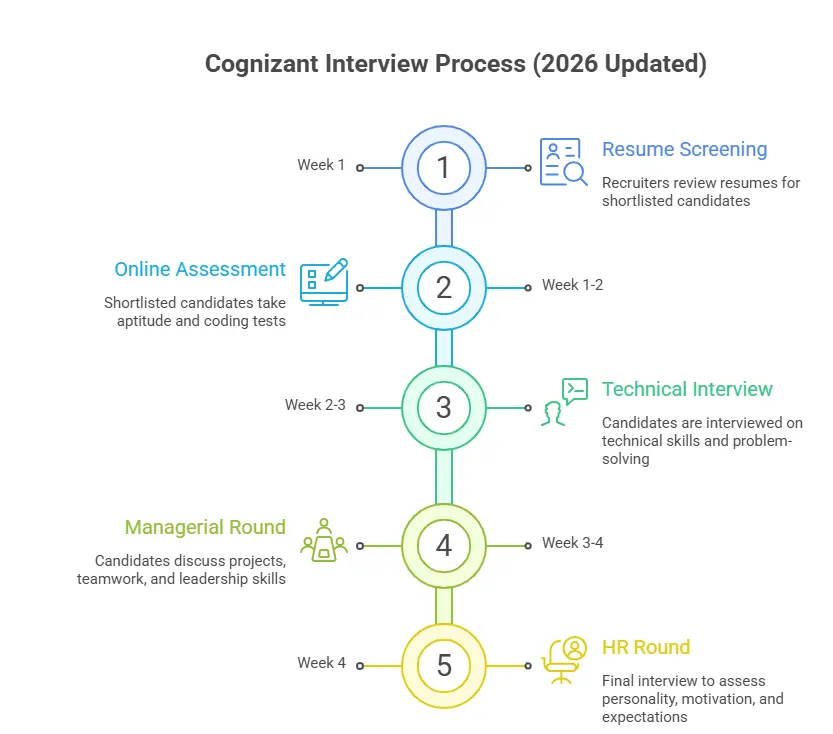
1. Resume Screening
This is the first step where your resume is checked
- Keep your resume simple and neat
- Show your main skills (coding, tools, certificates)
- Add your projects with clear results
- Freshers should focus on college projects and internships
A good resume helps you get selected for the next round
2. Online Assessment (GenC / Experienced Roles)
Selected candidates will take an online test
- Test has aptitude (math, reasoning, English)
- There may be simple coding questions (for tech roles)
- The test has a time limit, so be fast and careful
Practice old questions to feel more confident
3. Technical Interview
This round tests your subject knowledge and problem-solving ability.
- Questions from programming, DBMS, OOPs, and basics
- You may be asked to write code or explain logic
- Scenario-based questions are common
Example: “How would you improve a slow API?”
You can answer by explaining caching, database optimization, etc.
4. Managerial Round
This round checks your practical thinking and behavior.
- Questions about your projects and role in a team
- Situations like handling deadlines or conflicts
- Tests leadership and decision-making skills
Be honest and explain your real experiences.
5. HR Round
This is the last round
- You will be asked simple questions
- “Tell me about yourself”
- “Why do you want to join Cognizant?”
- Questions about salary and relocation
Give answers in simple, clear, and confident way
Cognizant Technical Interview Questions (Role-Based)
1: Which of the following data structures allows elements to be added and removed in a Last-In, First-Out (LIFO) order?
1. For Software Engineers
If you are preparing for a Software Engineer role at Cognizant, focus on basic concepts, clear logic, and simple explanations.
🔹DSA Questions
Q1: Reverse a Linked List
Simple Answer:
- Use three pointers: previous, current, next
- Change the direction of each node step by step
- The last node becomes the new head
Q2: Find duplicate elements in an array
Simple Answer:
- Use a set or hashmap
- Check if an element already exists
- If yes, it is a duplicate
Q3: Check if a string is a palindrome
Simple Answer:
- Check the string and its reverse
- If both are same, it is a palindrome
Scenario-Based Answer:
- In my project, I worked with large data using arrays
- I used hashing to find duplicates quickly
- This saved time and made the system faster
🔹OOP Concepts
Q1: Difference between Abstraction and Encapsulation
Simple Answer:
- Abstraction hides complex details
- Encapsulation hides data using private variables
Q2: What is Inheritance?
Simple Answer:
- One class can use properties of another class
- Helps reuse code
Q3: What is Polymorphism?
Simple Answer:
- Same function behaves differently
- Example: method overloading
👉 Scenario-Based Answer:
“In my project, I used inheritance to reuse code and reduce repetition. Encapsulation helped me protect sensitive data inside classes.”
🔹DBMS Basics
Q1: Find the second highest salary
Simple Answer:
WHERE salary < (SELECT MAX(salary) FROM employees);
Simple Answer:
- A unique value for each row
- Cannot be null
Q3: What is a JOIN?
Simple Answer:
- Used to combine data from two tables
- Based on a common column
Scenario-Based Answer:
“In my project, I used SQL joins to combine user and order data, which helped in generating reports easily.”
🔹Coding Problems
Q1: Reverse a string
Simple Answer:
- Use loop or built-in function
- Store characters in reverse order
Q2: Find the largest number in an array
Simple Answer:
- Compare each element
- Store the maximum value
Q3: Count vowels in a string
Simple Answer:
- Loop through string
- Count a, e, i, o, u
Scenario-Based Answer:
- In my project, I improved a search feature using hashing
- It helped find data faster
- This reduced time and improved performance
2. For Data Analysts
- If you are applying for a Data Analyst role at Cognizant
- Focus on basic tools and clear understanding
- Explain answers in simple words
- Interviewers check how you understand data
- They also check how you solve real problems
🔹SQL Queries
Q1: Write a JOIN query
Simple Answer:
- JOIN is used to combine data from two tables
- It works using a common column
ON customers.id = orders.customer_id;
Scenario-Based Answer:
🔹Excel
Q1: What are common Excel functions you use?
Simple Answer:
- SUM: to add values
- AVERAGE: to find mean
- VLOOKUP/XLOOKUP: to find data
- COUNT: to count entries
Q2: What is a Pivot Table?
Simple Answer:
- It helps to summarize large data
- Easy way to find totals, averages, and trends
Scenario-Based Answer:
“I used Pivot Tables in Excel to summarize sales data and quickly find top-performing products.”
🔹Python Basics
Q1: Why is Python used in data analysis?
Simple Answer:
- Easy to learn
- Good for handling large data
- Has libraries like pandas and numpy
Q2: What is pandas?
Simple Answer:
- A Python library used for data handling
- Helps in reading, cleaning, and analyzing data
Scenario-Based Answer:
“In my project, I used Python pandas to clean and organize data, which made analysis faster and more accurate.”
🔹Data Interpretation
Q1: What are data cleaning steps?
Simple Answer:
- Remove missing values
- Fix errors and duplicates
- Format data properly
Q2: How do you analyze a dataset?
Simple Answer:
- Understand the problem
- Clean the data
- Use charts or tools to find patterns
- Draw conclusions
Scenario-Based Answer:
“In one task, I cleaned messy data and found trends using charts. This helped the team make better decisions.”
3. For Non-Tech / Business Roles
If you are applying for non-technical or business roles at Cognizant, the focus is more on communication, thinking ability, and how you handle real situations.
🔹Communication Skills
Q1: Tell me about yourself
Simple Answer:
- Start with your education
- Talk about your skills
- Mention any experience or projects
- End with your career goal
Q2: Why do you want to join Cognizant?
Simple Answer:
- Good learning opportunities
- Strong company reputation
- Career growth
Scenario-Based Answer:
- In my past experience, I explained ideas clearly to my team
- Good communication helped us finish the project easily and smoothly
🔹Problem-Solving
Q1: Tell me about a time you solved a problem
Simple Answer:
- Explain the problem
- Tell what action you took
- Share the result
Q2: How do you handle pressure?
Simple Answer:
- Stay calm
- Break the problem into small steps
- Focus on solutions
Scenario-Based Answer:
- In my project, we had a tight deadline
- I broke the work into small tasks
- I gave priority to important tasks first
- This helped us finish the work on time
🔹Case-Based Questions
Q1: How would you handle a difficult client?
Simple Answer:
- Listen carefully
- Stay calm and polite
- Understand their problem
- Offer a solution
Q2: What will you do if a client is not satisfied?
Simple Answer:
- Ask for feedback
- Understand the problem clearly
- Give a simple and better solution
Scenario-Based Answer:
- If I deal with a difficult client, I will first listen carefully
- I will understand their problem calmly
- Then I will give a simple and practical solution
- This helps to build trust and good relationship
Top Summer Internships in India in 2026
From Google to top Indian companies, find internships that match your skills and goals. Everything you need to apply is right here.
Explore Internships NowReal Interview Experience (Story Format)
🌟 Story 1: Aptitude Round Experience
“In the first round, I had an aptitude test. I felt a little stressed because the time was very limited.
- The questions were not very difficult
- But managing time was the biggest challenge
- I could not answer all the questions
- This made me feel nervous
Instead of guessing, I stayed calm and focused on accuracy.
- I answered only the questions I was sure about
- I avoided random guesses
- I tried to use time wisely
After the test, I was not confident about the result. But later, I got selected. I learned that accuracy is more important than attempting all questions.”
🌟 Story 2: Technical Interview Experience
“During the technical interview, I felt nervous in the beginning.
- The interviewer asked about DBMS normalization
- I could not remember the exact definition clearly
- I felt confused for a moment
But I did not panic. I stayed calm and explained in a simple way.
- I used an example from my project
- I explained how I organized data into tables
- I showed how it helped avoid duplicate data
The interviewer understood my explanation and seemed happy.
- They asked some follow-up questions
- I answered them with confidence
I learned that real examples are more helpful than memorized answers.”
🌟 Story 3: HR Round Experience
“The HR round was easier than I expected.
- I thought it would be difficult
- But it felt like a normal conversation
The HR asked simple questions.
- About my background and education
- About my interests
- About my willingness to relocate
I answered honestly and stayed calm.
- The HR was friendly
- This made me feel comfortable
- I spoke with confidence
I understood that this round checks your attitude and confidence, not just knowledge. Being honest and positive really helped me perform well.”

How to Crack Cognizant Interview (Step-by-Step Strategy)
Clearing the Cognizant interview becomes easier when you follow a simple plan step by step.
Step 1: Learn Aptitude
- Practice basic maths
- Learn reasoning puzzles
- Improve English (grammar and reading)
Step 2: Strengthen Basics
- Learn OOP concepts
- Understand DBMS basics
- Practice simple SQL queries
Step 3: Practice Coding
- Solve easy and medium DSA questions
- Focus on arrays, strings, and simple logic
- Practice on LeetCode and HackerRank
Step 4: Mock Interviews
- Practice before real interview
- Do mock interviews with friends or online tools
- Improve speaking and confidence
Step 5: Prepare HR Answers
- Prepare strengths and weaknesses
- Know your career goals
- Answer “Why Cognizant?” in simple words
Common Mistakes Candidates Make
Many candidates lose good opportunities because of small mistakes. Here are the most common ones:
❌ Ignoring aptitude preparation
- Thinking aptitude is easy
- Not practicing maths, reasoning, and English
👉 This is the first round, many get rejected here
❌ Weak fundamentals (OOP, DBMS)
- Not clear with basic concepts
- Trouble in answering simple technical questions
Basics are very important for selection
❌ Memorizing instead of understanding
- Learning answers by heart
- Gets confused if question changes
Understand concepts, don’t just memorize
❌ Poor communication skills
- Not speaking clearly
- Feeling nervous while answering
Clear explanation is very important
❌ Not preparing HR questions
- Not ready for basic HR questions
- Giving unclear or short answers
HR checks your attitude and confidence
❌ Not explaining answers properly
- Jumping directly to final answer
- Not explaining your steps
Interviewers want your thinking process
❌ Weak project knowledge
- Cannot explain your own project
- Forgetting tools and work done
Be clear about what you built
❌ Not researching the company
- No idea about the company
- Giving generic answers like “I need a job”
Shows lack of interest and preparation
Top Summer Internships in India in 2026
From Google to top Indian companies, find internships that match your skills and goals. Everything you need to apply is right here.
Explore Internships NowSalary Insights (Optional but High CTR Section)
Here is a simple overview of salary ranges at Cognizant. These are approximate values and may vary based on skills, location, and experience.
| Role | Salary Range (Approx) |
|---|---|
| GenC / Entry-Level | ₹4 – ₹6 LPA |
| Software Engineer | ₹5 – ₹10 LPA |
| Senior Roles | ₹12+ LPA |
- Freshers usually start with GenC roles and basic packages
- With experience and skills, salary increases steadily
- Higher roles offer better pay based on performance and expertise
These salaries are not fixed and can change depending on your skills, interview performance, and job location.
Experience the power of our web development course with a free demo – Enroll now!
Final Verdict Section
Is it Hard?
The interview at Cognizant is not very hard, but not very easy also.
- It is easier than top product companies
- But many students apply, so competition is high
- If you prepare well, you can clear it
👉 So, it is moderate level.
Who Should Apply?
This job is a good choice for:
- Freshers who are starting their career
- Students from IT or Computer Science background
- Candidates who want a stable and safe job
- People who are ready to learn and grow
👉 Even beginners can apply with basic knowledge.
Final Preparation Checklist
Before going for the interview, make sure you are ready:
✔ Practice aptitude every day
✔ Learn basic concepts (OOP, DBMS, SQL)
✔ Prepare 1–2 projects and explain them clearly
✔ Practice common HR questions
✔ Take mock interviews with friends or online
| Related Article | |
| Tech Mahindra Interview Process 2026 | IBM Interview Guide 2026 |
| Capgemini Interview Guide | HCL Interview Guide |
Top Summer Internships in India in 2026
From Google to top Indian companies, find internships that match your skills and goals. Everything you need to apply is right here.
Explore Internships NowFrequently Asked Questions
What is the interview process at Cognizant?
The process usually has 4–5 steps:
- Resume screening
- Online aptitude test
- Technical interview
- Managerial round
- HR round
It may take around 2–4 weeks to complete.
Is the Cognizant interview difficult?
No, it is not very hard.
- Difficulty level is moderate
- Easier than top product companies
- With proper preparation, you can clear it easily.
What topics should I prepare for aptitude?
You should focus on:
- Quantitative aptitude (numbers, percentages)
- Logical reasoning (puzzles, patterns)
- Verbal ability (grammar, reading)
👉 Practice daily to improve speed and accuracy.
What are the important technical topics?
Key topics include:
- OOP concepts
- DBMS basics
- SQL queries
- Basic coding (arrays, strings)
👉 Strong basics help you answer confidently.
Do freshers have a chance to get selected?
Yes, freshers have good chances.
- Cognizant hires many freshers through GenC
- Basic knowledge and good communication are enough
- Projects and internships add extra value
How should I prepare for the HR round?
Keep your answers simple and honest.
- Prepare “Tell me about yourself”
- Know your strengths and weaknesses
- Be clear about your career goals
- Answer confidently
What is the salary for freshers at Cognizant?
- GenC / Entry-level: ₹4–₹6 LPA (approx)
- Salary may vary based on role and skills
- With experience, salary increases gradually
What are common mistakes to avoid?
- Ignoring aptitude preparation
- Weak basics (OOP, DBMS)
- Memorizing instead of understanding
- Poor communication skills
- Not preparing for HR questions