Table of Contents
The interview process at Tech Mahindra is simple and easy to follow. It usually takes 1–3 weeks, and the difficulty level is easy to moderate. The selection rate for freshers is around 15–25%, especially during mass hiring. The process mainly checks your aptitude skills and basic technical knowledge.
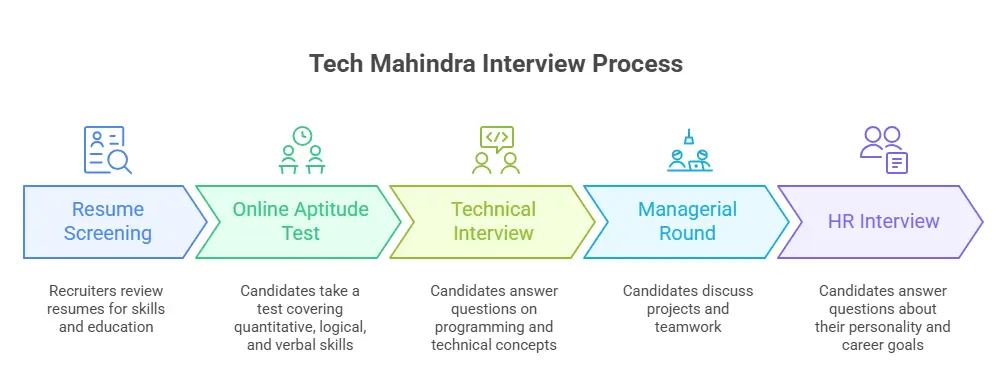
🔹 Resume Screening
- First step in the process
- Recruiters check your resume
- Focus on skills, education, and projects
- Keep your resume simple and clear
🔹 Online Aptitude Test
- First round for most candidates
- Includes:
- Quantitative (basic maths)
- Logical reasoning (puzzles, patterns)
- Verbal ability (English)
- Time-based test, so speed and accuracy matter
🔹 Technical Interview
- Checks your basic technical knowledge
- Questions on programming, DBMS, OOP, etc.
- May include simple coding or logic questions
- Focus on clear understanding, not memorizing
🔹 Managerial Round
- Focus on your behavior and thinking
- Questions about projects and teamwork
- Situations like handling pressure or deadlines
- Checks problem-solving and decision-making
🔹 HR Interview
- Final round of the process
- Questions like:
- Tell me about yourself
- Why Tech Mahindra?
- Strengths and weaknesses
- Focus on communication and attitude
🔹 Important Insights
- Focus more on aptitude and basic concepts
- Do not ignore communication skills
- Be clear while explaining answers
🔹 Mass Hiring vs Lateral Hiring
- Mass hiring (freshers):
- More focus on aptitude and basics
- Easier questions
- Faster process
- Lateral hiring (experienced):
- More focus on technical skills
- Questions based on real work experience
- Slightly tougher interviews
Tech Mahindra Technical Interview Questions (Role-Based)
1: Which of the following data structures allows elements to be added and removed in a Last-In, First-Out (LIFO) order?
🔹 For Software Engineers
1. DSA Basics (Arrays, Strings, Recursion)
Q1: Reverse a string without built-in functions
- Use a loop
- Start from last character
- Store characters one by one in reverse
Q2: Find duplicates in an array
- Use a set or hashmap
- Check if element already exists
- If yes → duplicate
Scenario-Based Answer: “If I need to improve a search function, I will first check time complexity. Then I can use hashing to make searching faster and reduce time.”
2. OOP Concepts
Q1: What are OOP principles?
- Encapsulation: hide data
- Inheritance: reuse code
- Polymorphism: same function, different behavior
Q2: What is inheritance?
- One class uses properties of another class
- Helps reduce code repetition
Scenario-Based Answer: “In my project, I used inheritance to reuse code and make the system simple. Encapsulation helped protect important data.”
3. Basic Coding Questions
Q1: Check if a string is palindrome
- Compare string with its reverse
- If same → palindrome
Q2: Find largest number in an array
- Compare all elements
- Store the maximum value
Scenario-Based Answer: “I solved coding problems step by step and explained my logic clearly, which helped the interviewer understand my thinking.”
🔹For Data Analysts
1. SQL Queries
Q1: Find second highest salary
- Use MAX with condition
Q2: Difference between INNER JOIN and LEFT JOIN
- INNER JOIN: only matching data
- LEFT JOIN: all data from left + matching from right
Scenario-Based Answer: “I used SQL joins to combine data from tables and find useful insights for reports.”
2. Excel Basics
Q1: What is a Pivot Table?
- Used to summarize data
- Helps find totals and trends
Q2: What is VLOOKUP?
- Used to find data from another table
Scenario-Based Answer: “I used Excel to organize data and create simple reports, which helped in quick decision-making.”
3. Python Fundamentals (Optional)
Q1: Why use Python in data analysis?
- Easy to use
- Good for large data
Q2: What is pandas?
- Library used for data handling
Mini Case Scenario: “How would you analyze customer churn?”
- Collect customer data
- Clean the data
- Find patterns (why customers leave)
- Suggest improvements
🔹 For Customer Support / Non-Tech Roles
1. Communication Skills
Q1: Tell me about yourself
- Talk about education
- Skills and interests
- Career goal
Q2: Why do you want this job?
- Learning opportunity
- Career growth
Scenario-Based Answer: “I explain things clearly and listen carefully, which helps in better communication with customers.”
2. Situational Questions
Q1: How would you handle an angry customer?
- Listen carefully
- Stay calm
- Understand the issue
- Give solution
Q2: What will you do if a problem is not solved quickly?
- Inform the customer
- Escalate the issue
- Follow up
Structured Answer: Listen → Empathize → Resolve
- Listen to the problem
- Show understanding
- Provide a solution
Top Summer Internships in India in 2026
From Google to top Indian companies, find internships that match your skills and goals. Everything you need to apply is right here.
Explore Internships NowReal Interview Experience (Story Format)
🌟 Story 1: Fresher Aptitude Round
“In the first round, I had an aptitude test. I thought it would be easy, but I felt a little stressed.
- Questions were simple
- But time was very limited
- I started rushing
I made a mistake at the beginning.
- I tried to solve all questions
- I didn’t manage time properly
- Got stuck on a few problems
Then I changed my plan.
- Skipped difficult questions
- Focused on easy ones first
- Stayed calm
Even though I didn’t attempt everything, I cleared the round. I learned that speed and accuracy are very important.”
🌟 Story 2: Technical Interview
“In the technical round, I was nervous at first.
- The interviewer asked about OOP concepts
- I knew the answer but couldn’t explain clearly
I felt confused for a moment.
- I paused and took a deep breath
- Then I used a simple real-life example (like a car)
- Explained step by step
Slowly, I became more confident.
- I spoke clearly
- Explained my logic in simple words
The interviewer seemed happy with my explanation. I learned that simple examples make answers better and easier to understand.”
🌟 Story 3: HR Round
“The HR round felt like a normal conversation.
- The HR was friendly
- I started feeling relaxed
They asked simple questions.
- About my background
- Willingness to work in shifts
- Career goals
At one point, I felt unsure.
- I was not fully prepared for some questions
- But I answered honestly
I stayed calm and positive.
- Spoke clearly
- Showed interest in learning
The HR appreciated my attitude. I learned that being honest and confident is very important in HR rounds.”

How to Crack Tech Mahindra Interview (Step-by-Step Strategy)
Clearing the interview becomes easy if you follow a simple plan step by step.
Step 1: Master Aptitude
Start with aptitude basics.
- Learn quantitative aptitude (numbers, percentages, time & work)
- Practice logical reasoning (puzzles, patterns)
- Improve verbal ability (grammar, reading)
- Practice daily to improve speed and accuracy.
- Use simple practice sites and previous questions.
Step 2: Strengthen Basics
Focus on basic technical knowledge.
- Learn OOP concepts (inheritance, encapsulation)
- Practice C or Java basics
- Understand SQL basics (SELECT, JOIN)
- Do not go for advanced topics first.
- Clear basics help you answer confidently.
Step 3: Practice Mock Interviews
Prepare before the real interview.
- Take mock interviews with friends
- Use online mock interview tools
- Practice speaking answers
- This helps reduce fear and improve confidence.
Step 4: Prepare HR Answers
Be ready for common HR questions.
- Tell me about yourself
- Why Tech Mahindra?
- Strengths and weaknesses
- Keep answers simple, honest, and clear.
- Practice speaking in front of a mirror.
Step 5: Improve Communication Skills
Very important, especially for support roles.
- Speak slowly and clearly
- Use simple words
- Listen carefully before answering
- Good communication can increase your chances.
Practical Resources
- Practice coding on platforms like HackerRank and LeetCode
- Practice aptitude on basic test platforms
- Use mock interview tools online
Common Mistakes Candidates Make
| Role | Salary Range (Approx) |
|---|---|
| Software Engineer (Fresher) | ₹3 – ₹6 LPA |
| Data Analyst | ₹4 – ₹8 LPA |
| Customer Support | ₹2 – ₹4 LPA |
- Salary depends on your role and experience
- Location can also affect salary
- Skills and performance matter
Growth Opportunities:
- Freshers can grow step by step
- Salary increases with experience
- Promotions and role changes bring better pay
These are approximate values and may change based on company needs and your skills.
Experience the power of our web development course with a free demo – Enroll now!
Top Summer Internships in India in 2026
From Google to top Indian companies, find internships that match your skills and goals. Everything you need to apply is right here.
Explore Internships NowFinal Verdict Section
Is Tech Mahindra Interview Hard?
- The interview is easy to moderate level
- Easier than product-based companies
- Basic preparation is enough to clear it
If your basics are clear, you can do well.
Who Should Apply?
This job is a good choice for:
- Freshers starting their career
- Candidates with basic technical skills
- People with good communication skills
- Anyone ready to learn and grow
Final Preparation Checklist
Before your interview, make sure:
✔ Practice aptitude regularly
✔ Learn basic coding concepts
✔ Prepare HR answers clearly
✔ Improve communication skills
| Related Article | |
| Cognizant Interview Guide | IBM Interview Guide 2026 |
| Capgemini Interview Guide | HCL Interview Guide |
Top Summer Internships in India in 2026
From Google to top Indian companies, find internships that match your skills and goals. Everything you need to apply is right here.
Explore Internships NowFrequently Asked Questions
What is the interview process at Tech Mahindra?
The process usually has multiple steps:
- Resume screening
- Online aptitude test
- Technical interview
- Managerial round (sometimes)
- HR interview
👉 Each round checks your skills, thinking, and communication.
How difficult is the Tech Mahindra interview?
- The difficulty level is easy to moderate
- Questions are mostly basic
- Easier than product-based companies
👉 With good preparation, you can clear it easily.
What topics should I prepare for the aptitude test?
Focus on:
- Quantitative aptitude (basic maths)
- Logical reasoning (puzzles, patterns)
- Verbal ability (English, grammar)
👉 Practice regularly to improve speed.
What technical topics are important?
You should prepare:
- Programming basics (C, Java, or Python)
- OOP concepts
- DBMS and SQL basics
- Simple coding problems
👉 Basics are more important than advanced topics.
Is coding important for Tech Mahindra interviews?
- Yes, for technical roles
- Questions are usually easy to medium level
- Non-tech roles may not need coding
👉 Focus on simple logic and clear explanation.
What happens in the HR interview?
HR round checks your attitude and communication.
Common questions:
- Tell me about yourself
- Why Tech Mahindra?
- Strengths and weaknesses
- Willingness to work in shifts
👉 Be honest and confident.
Do freshers get selected in Tech Mahindra?
- Yes, many freshers are hired through mass hiring
- Basic knowledge is enough
- Good communication helps a lot
👉 Freshers have good chances.
What mistakes should I avoid?
- Ignoring aptitude preparation
- Weak communication skills
- Memorizing instead of understanding
- Not preparing for HR questions
👉 Avoiding these mistakes improves your chances.