Table of Contents
IBM is a well-known global technology and consulting company, founded in 1911 by Charles Ranlett Flint (through the merger of CTR). Its headquarters is in Armonk. The company earns around $60+ billion in revenue and has more than 280,000 employees worldwide.
Work Culture & Focus:
- Strong focus on innovation and research
- Works on enterprise solutions and advanced technologies
- Known for structured work processes
- Moving from legacy systems to modern AI and cloud
- Focus areas include hybrid cloud, AI (Watson), and consulting
IBM has changed over time from hardware manufacturing to modern technology services. It offers good learning opportunities and career growth, making it a strong choice for both freshers and experienced professionals.
Experience the power of our web development course with a free demo – Enroll now!
Key Takeaways:
- IBM is a big company with good learning and career growth
- Interview has many steps (test, technical, HR), so prepare step by step
- Learn basic concepts well (DSA, DBMS, OOP, coding)
- Practice every day and work on simple projects
- Stay confident, speak clearly, and avoid common mistakes
IBM Interview Process (2026 Updated)
The interview process at IBM is designed to test your technical skills, problem-solving, and communication. It may take 2–6 weeks, and the difficulty level is moderate to high depending on the role. The estimated selection rate is 2–5%, so preparation is important.
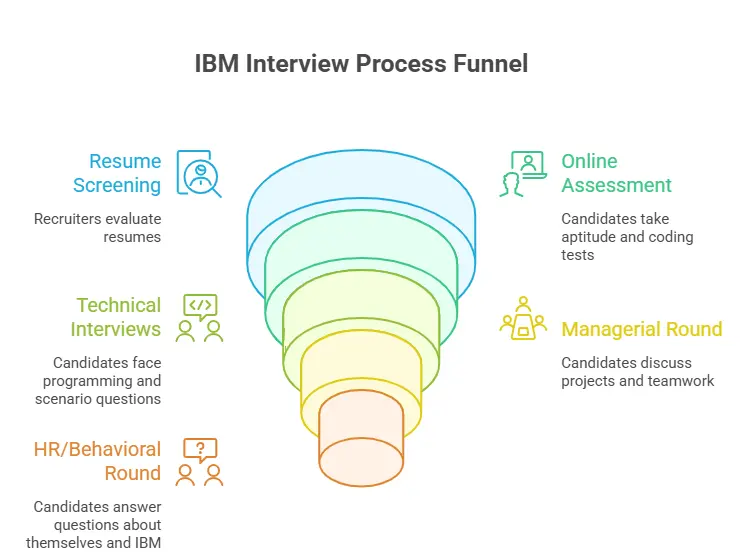
🔹 Resume Screening
- Your resume is reviewed by recruiters
- Focus on skills, projects, and experience
- A clear and simple resume increases chances
🔹 Online Assessment (Aptitude + Coding)
- Aptitude: Quant, Logical, Verbal
- Coding or role-based questions
- Time-based test, so speed matters
🔹 Technical Interviews (1–3 Rounds)
- Questions on programming, DBMS, OOP, and basics
- Coding problems and real scenarios
- Focus on understanding, not memorizing
🔹 Managerial Round
- Questions about projects and teamwork
- Checks problem-solving and decision-making
- Tests how you handle real situations
🔹 HR / Behavioral Round
- Questions about yourself and your goals
- “Why IBM?” and strengths/weaknesses
- Checks attitude and communication
🔹 Offer & Onboarding
- Selected candidates receive offer letter
- Joining process and documentation
- Training and onboarding sessions
IBM Technical Interview Questions (Role-Based)
1: Which of the following data structures allows elements to be added and removed in a Last-In, First-Out (LIFO) order?
🔹For Software Engineers
1. Data Structures & Algorithms
Q1: How to reverse a linked list?
- Use previous, current, next pointers
- Change links step by step
Q2: Find first non-repeating character?
- Count frequency using hashmap
- Return first character with count = 1
Scenario Answer: “In my project, I used hashing to quickly find unique data. It helped improve speed and reduce time.”
2. OOP Concepts
Q1: What do you meant by Encapsulation?
- Hides data inside a class
- Uses private variables
Q2: What is Inheritance?
- One class uses another class properties
- Helps reuse code
Scenario Answer: “In my project, I used inheritance to reuse code and reduce repetition. Encapsulation helped protect data.”
3. DBMS & OS Basics
Q1: What do you meant by Primary Key?
- Unique value for each row
- Cannot be null
Q2: Explain what is an Operating System?
- OS is used to manage hardware and software
- Controls system resources
Scenario Answer: “I used DBMS in my project to store user data properly using keys, which avoided duplication.”
4. Coding Rounds
Q1: How to write a simple program to reverse a string?
- By using loop or built-in function
Q2: Design a scalable logging system (basic idea)
- Store logs in database
- Use queues for handling large data
Scenario Answer: “In my project, I improved performance by using simple logic and better data handling methods.”
🔹For Data Analysts / Data Scientists
1. SQL Queries
Q1: Hoe to find top customers by revenue
- By using GROUP BY and ORDER BY
Q2: What is a JOIN?
- Combines the data from tables
Scenario Answer: “I used SQL queries to find top customers, which helped the team focus on high-value clients.”
2. Python (Pandas, NumPy)
Q1: What do you meant by Pandas?
- Used for data handling
Q2: Why use NumPy?
- Works with numbers and arrays
Scenario Answer: “I used Pandas to clean messy data and make it ready for analysis.”
3. Statistics & Probability
Q1: What is mean?
- Average of values
Q2: What is probability?
- Chance of an event happening
Scenario Answer: “I used basic statistics to understand trends in data and make better decisions.”
4. Case Studies
Q1: Analyze churn prediction
- Check why customers leave
- Find patterns
Q2: How to improve sales using data?
- Study trends
- Suggest improvements
Scenario Answer: “In one project, I analyzed customer data and found reasons for churn, which helped improve retention.”
🔹For Product Managers / Consultants

🌟 Story 1: Coding Round Experience
“In my first round, I got a coding question on arrays. I was a bit nervous and started solving it quickly.
- I rushed without planning
- After some time, I got stuck
- I realized my approach was wrong
Then I paused for a moment and thought again.
- I broke the problem into small steps
- I explained my logic clearly to the interviewer
- Slowly, I found the correct solution
Even though I didn’t solve it perfectly at first, my approach impressed the interviewer. I learned that clear thinking is more important than rushing.”
🌟 Story 2: Managerial Round Experience
“In the managerial round, the interviewer did not ask many technical questions.
- They focused on my past projects
- Asked why I made certain decisions
- Wanted to know my thinking process
At first, I felt unsure.
- But I explained my decisions honestly
- I shared both success and mistakes
- I showed what I learned from them
The interviewer seemed interested and asked more questions. I understood that they care about your thinking, not just correct answers.”
🌟 Story 3: HR Round Experience
“The HR round felt like a normal conversation.
- The HR was friendly and calm
- Questions were simple and personal
- It made me feel comfortable
They asked about:
- My background and interests
- Why I want to join the company
- My future plans
I answered honestly and stayed confident. I realized that this round checks your attitude and personality more than knowledge.
Top Summer Internships in India in 2026
From Google to top Indian companies, find internships that match your skills and goals. Everything you need to apply is right here.
Explore Internships NowHow to Crack IBM Interview (Step-by-Step Strategy)
Clearing the IBM interview becomes easier when you follow a simple plan step by step.
Step 1: Master Core Concepts
Start with strong basics.
- Learn DSA (arrays, strings, linked list)
- Understand DBMS (tables, keys)
- Learn OS basics and OOP concepts
Focus on understanding, not memorizing
Step 2: Practice Coding Platforms
Improve your coding skills daily.
- Practice on platforms like HackerRank and LeetCode
- Start with easy questions, then move to medium
- Focus on logic and problem-solving
Regular practice builds confidence
Step 3: Build Real Projects
Work on practical projects.
- Create projects using cloud, AI, or data
- Try small real-world problems
- Be ready to explain your project clearly
Projects help you stand out
Step 4: Prepare Behavioral Questions
Get ready for HR and managerial rounds.
- Questions on teamwork and conflicts
- “Tell me about a challenge you faced”
- “How do you handle pressure?”
Answer with real-life examples
Step 5: Mock Interviews + Time Management
Practice before the actual interview.
- Take mock interviews with friends or online
- Improve communication skills
- Learn to manage time in tests
Practice reduces fear
Simple Study Timeline
- Week 1–2: Learn basics (DSA, DBMS, OOP)
- Week 3: Practice coding + aptitude
- Week 4: Mock interviews + revise
Common Mistakes Candidates Make
Many candidates lose good opportunities at IBM because of small mistakes. These are very common, so it’s important to avoid them.
1. Over-focusing Only on Coding
- Many students practice only coding questions
- They ignore other important areas
- Interview is not just about coding
Balance coding with other subjects.
2. Ignoring Fundamentals (DBMS / OS)
- Basics are very important in interviews
- Questions are often simple but concept-based
- Weak basics can confuse you
Spend time on DBMS, OS, and core concepts.
3. Poor Communication During Interviews
- Some candidates know the answer but can’t explain it well
- Speaking too fast or unclear creates confusion
- Lack of confidence affects performance
Explain answers in simple and clear words.
4. Not Asking Clarifying Questions
- Jumping into answers without understanding the question
- Missing important details
- Leads to wrong answers
Take a moment and ask questions if needed.
5. Weak Project Explanations
- Not able to explain your own project clearly
- Forgetting what you did or how it works
- Giving very short or unclear answers
Be ready to explain your project step by step.
Salary Insights
| Role | Salary Range (Approx) |
|---|---|
| Software Engineer | ₹6 – ₹18 LPA |
| Data Analyst | ₹5 – ₹12 LPA |
| Product / Consulting Role | ₹10 – ₹25 LPA |
- Salary depends on your experience
- Location can affect salary
- Role and skills also matter
These are only approximate values, not fixed numbers
Experience the power of our web development course with a free demo – Enroll now!
Top Summer Internships in India in 2026
From Google to top Indian companies, find internships that match your skills and goals. Everything you need to apply is right here.
Explore Internships NowFinal Verdict Section
Is IBM Interview Hard?
The interview at IBM is moderate level.
- Not as hard as FAANG companies
- But still competitive because many people apply
- With good preparation, you can clear it
Who Should Apply?
This job is good for:
- Candidates with strong basic concepts
- People interested in enterprise and business technologies
- Freshers and experienced candidates who want growth
Final Checklist
Before your interview, make sure:
✔ You know DSA basics clearly
✔ You have 1–2 strong projects ready
✔ Your communication skills are good
✔ You have practiced mock interviews
✔ Your resume is clear and well-structured
| Related Article | |
| HCL Interview Guide | Cognizant Interview Guide |
| Capgemini Interview Guide | Tech Mahindra Interview Process 2026 |
Top Summer Internships in India in 2026
From Google to top Indian companies, find internships that match your skills and goals. Everything you need to apply is right here.
Explore Internships NowFrequently Asked Questions
What is the interview process at IBM?
The process usually has multiple steps:
- Resume screening
- Online test (aptitude + coding)
- Technical interviews (1–3 rounds)
- Managerial round
- HR round
- Offer and onboarding
Is the IBM interview difficult?
- The difficulty level is moderate to high
- It depends on the role you apply for
- More technical roles may be harder
What topics should I prepare for IBM interviews?
You should focus on:
- DSA (arrays, strings, linked list)
- OOP concepts
- DBMS and OS basics
- Coding practice
How important is coding for IBM interviews?
- Coding is important for technical roles
- Questions are usually easy to medium level
- Focus on logic and problem-solving
What kind of projects should I prepare?
- Real-world projects are better
- Projects related to cloud, AI, or data
- Be ready to explain your work clearly
What questions are asked in the HR round?
Common questions include:
- Tell me about yourself
- Why do you want to join IBM?
- What are your strengths and weaknesses?
Do freshers have a chance to get selected?
- Yes, IBM hires freshers regularly
- Basic knowledge and skills are enough
- Good communication improves your chances
What are common mistakes to avoid?
- Ignoring basics like DBMS and OS
- Only focusing on coding
- Poor communication skills
- Not preparing for HR questions