Table of Contents
HCLTech is one of the leading IT companies in the world. It was founded in 1976 by Shiv Nadar and is headquartered in Noida, India. Today, the company has grown into a global organization with a revenue of around $13+ billion and more than 220,000 employees working across different countries.
HCLTech provides services in IT, engineering, and digital transformation. It works with many global clients and helps businesses improve their technology and operations.
Work Culture Summary:
- Follows “Employees First, Customers Second” approach
- Focuses on employee growth and learning
- Encourages innovation and new ideas
- Provides good opportunities for freshers and experienced professionals
- Supports career development and internal growth
Key Takeaways:
- HCL interview is not very hard, but you need proper preparation. Basics and practice are very important.
- You should understand the full interview process. Each round checks different skills.
- Prepare based on your role. Coding for software, data skills for analysts, and thinking skills for product roles.
- Practice is very important. Solve problems, build projects, and try mock interviews.
- Communication matters a lot. Explain your answers clearly, stay calm, and be honest.
Experience the power of our web development course with a free demo – Enroll now!
HCL Interview Process (2026 Updated)
The HCL interview process is simple and clear, but you need good preparation to succeed. It usually has a few stages, and each stage checks different skills.
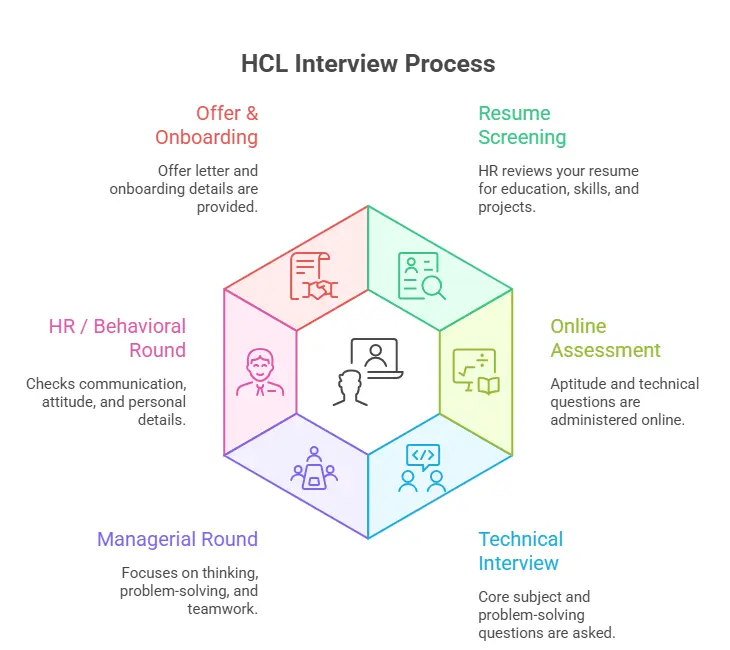
🔷 Resume Screening
- Your resume is the first step
- HR checks your education, skills, and projects
- Make sure your resume is clear and updated
A good resume increases your chances of getting shortlisted.
🔷 Online Assessment (Aptitude + Technical)
- Includes basic aptitude questions (math, reasoning, English)
- Technical questions based on your field (coding, concepts, etc.)
- Usually conducted online
Practice aptitude and basic technical topics before the test.
🔷 Technical Interview
- Questions on your core subjects and skills
- May include coding or problem-solving questions
- Interviewer may ask about your projects
Be clear with basics and explain your answers confidently.
🔷 Managerial Round
- Focus on your thinking and problem-solving ability
- Questions about teamwork and handling situations
- Checks how you work in a team
Give honest and simple answers with real examples.
🔷 HR / Behavioral Round
- Basic questions about yourself
- Salary expectations, strengths, and weaknesses
- Checks your communication and attitude
Be confident, polite, and clear while answering.
🔷 Offer & Onboarding
- If you clear all rounds, you get the offer letter
- HR explains salary, role, and joining details
- Then onboarding process starts
Make sure to check all details before accepting the offer.
🔷 Key Insights
- Average Duration: 2–4 weeks
- Difficulty Level: Moderate
- Acceptance Rate: Around 10–15% (estimated)
HCL Technical Interview Questions (Role-Based)
1: Which of the following data structures allows elements to be added and removed in a Last-In, First-Out (LIFO) order?
HCL technical interview questions based on different roles, covering coding, concepts, and real-world problem-solving scenarios.
1. Software Engineer – HCL Interview Q&A
✅ DSA Topics:
Q1: What is an array?
Answer: A list of items stored in order.
- Easy to access using index
- Fixed size
Scenario: If search is slow →
- Use binary search (if sorted)
- Reduce extra loops
Q2: What is a linked list?
Answer: A chain of nodes.
- Each node points to next
- Size can grow
Scenario: If frequent insert/ delete →
- Use linked list instead of array
Q3: What is recursion?
Answer: A function calling itself.
- Solves smaller problems
- Needs base case
Scenario: If problem repeats →
- Break into smaller parts
- Use recursion
Q4: What is a tree?
Answer: A structure with parent-child nodes.
- Starts with root
- No loops
Scenario: For hierarchy data (like folders) →
- Use tree structure
Q5: What is a graph?
Answer: Nodes connected by edges.
- Can have cycles
- Used in networks
Scenario: For maps or routes →
- Use graph and shortest path
✅ Coding Questions
Q1: Reverse a linked list
Answer: Reverse links step by step.
Steps:
- Use prev, current, next
- Change direction
- Move forward
Scenario: If memory is limited →
- Use iterative method (less space)
Q2: Find duplicates in an array
Answer: Use a set.
Steps:
- Loop array
- Store values
- If repeated → duplicate
Scenario: If array is very large →
- Use hashing for faster check
✅ System Design
Q1: Design a scalable logging system
Answer:
- Collect logs from apps
- Store in database
- Use search tools
- Handle large data
Scenario: If logs increase suddenly:
- Use cloud storage
- Scale servers
- Use log rotation
Q2: Build a notification service
Answer:
- Send email/SMS/push
- Use queue system
- Handle many users
Scenario: If too many users at once:
- Use message queue
- Send in batches
- Retry failed messages
✅ Scenario-Based Questions
Q1: How would you optimize a slow API?
Answer:
- Use caching (store frequent data)
- Add DB indexing
- Reduce extra data
- Use async calls
- Improve queries
Q2: What will you do if your code runs slow?
Answer:
- Check time complexity
- Remove extra loops
- Use better data structure
- Optimize logic
Q3: What if your program crashes?
Answer:
- Check logs
- Find error
- Fix bug
- Test again
Q4: How do you handle large data?
Answer:
- Use efficient structures
- Process in parts
- Use pagination
2. For Data Analysts
✅ SQL Questions
Q1: What is a JOIN?
Answer: It combines data from multiple tables.
- INNER JOIN → common data
- LEFT JOIN → all left + matching right
Scenario: If sales data is in one table and customer data in another →
- Use JOIN to combine both and analyze sales by customer
Q2: What is a window function?
Answer It performs calculations across rows.
- Example: rank, sum
- Keeps all rows
Scenario: If you want top-selling products →
- Use RANK() to find top products without removing rows
✅ Python Questions
Q1: What is Pandas?
Answer: A library to work with data.
- Used for tables (dataframes)
- Easy to analyze data
Scenario: If you have a large sales file →
- Use Pandas to filter, sort, and analyze data
Q2: What is data cleaning?
Answer: Fixing incorrect or missing data.
- Remove null values
- Correct wrong entries
Scenario: If sales data has missing values →
- Fill with average or remove incorrect rows
✅ Case Study /Scenario-Based Questions
Q1: How will you improve sales using data?
Answer:
- Check which products sell more
- Find low-performing areas
- Study customer behavior
- Suggest offers or discounts
Example: Sales are low in one city →
- Check data
- Run discounts there
- Improve marketing
Q2: What will you do if data has missing values?
Answer:
- Remove rows (if less data)
- Fill with average/median
- Use proper method based on data
Q3: How do you find useful insights from data?
Answer:
- Clean the data first
- Analyze trends
- Compare values
- Create simple reports
Q4: What if data is very large?
Answer:
- Use filters
- Process in parts
- Use tools like SQL, Pandas
3. For Product / Business Roles
✅ Product Design Questions
Q: How do you design a product?
Answer: Start with user needs.
- Understand the problem
- Add simple features
- Build and test
Scenario (Banking App): “How would you improve a banking app experience?”
- Make app simple and clean
- Reduce steps for payments
- Improve speed
- Add secure login (OTP/biometric)
✅ Estimation Problems
Q: How do you estimate users of a product?
Answer: Break into small steps.
- Total population
- % using smartphones
- % using the app
- Calculate final number
Scenario (Banking App): Estimate users of a banking app in a city:
- Find total population
- Assume % with bank accounts
- Assume % using mobile banking
- Get rough number
✅ Metrics & KPIs
Q: What are KPIs?
Answer: Numbers to measure success.
- Active users
- Transactions
- Revenue
Scenario (Banking App): To improve app experience, track:
- Daily active users
- Failed transactions
- Time taken per transaction
If failures are high →
- Fix bugs
- Improve system speed
✅ Scenario-Based Question
Q: How would you improve a banking app experience?
Answer:
- Make app simple and clean
- Improve speed
- Add secure login (OTP, biometrics)
- Enable quick payments
- Reduce steps for transactions
- Add 24/7 support
Example Thinking: If users leave the app during payment →
- Reduce steps
- Make process faster
- Fix errors
Top Summer Internships in India in 2026
From Google to top Indian companies, find internships that match your skills and goals. Everything you need to apply is right here.
Explore Internships NowReal Interview Experience (Story Format)
Story 1: Coding Round Struggle
“In the first round, I was asked a coding question on arrays. At first, I felt nervous. I could not find the answer quickly.
I made a small mistake in my logic. But instead of staying quiet, I started explaining my thinking step by step.
The interviewer listened and gave a small hint. That helped me correct my mistake. Slowly, I improved my solution.
I did not get the perfect answer, but I showed my thinking process clearly.”
Learning:
- It is okay to struggle
- Always explain your thoughts
- Interviewers check your approach, not just the final answer
Story 2: Project Failure Question
“In the managerial round, I was asked about a failure. At first, I was confused. Then I shared a real story.
In one project, our team missed a deadline. The reason was poor planning and lack of communication.
I explained how I took responsibility. I started dividing tasks clearly and improved team communication.
In the next phase, we completed work on time.”
Learning:
- Be honest about mistakes
- Show what you learned
- Focus on improvement
Story 3: HR Round Experience
“In the HR round, I was asked simple questions like ‘Tell me about yourself’.
I was a bit nervous, but I stayed calm. I spoke slowly and clearly.
When I did not know one answer, I politely said I am not sure but willing to learn.
The interviewer appreciated my honesty.”
Learning:
- Stay calm and confident
- Be honest
- Clear communication matters a lot
How to Crack HCL Interview (Step-by-Step Strategy)
Step1: Master Core Concepts
Firstly, focus on basics.
- Learn DSA basics (like arrays, strings, linked list)
- Understand OOP concepts (like class, object, inheritance)
- Study DBMS (like tables, queries, joins)
- Learn OS basics (like process, memory, threads)
Daily practice simple coding problems
Resources:
- LeetCode (easy problems)
- GeeksforGeeks
- YouTube tutorials
Step2: Practice Mock Interviews
Practice like a real interview.
- Do mock interviews with friends
- Practice speaking clearly
- Try online platforms
- Learn how to explain your answers
Platforms:
- Pramp
- InterviewBit
- HackerRank
Step3: Build Projects
Show real skills.
- Create 2–3 simple projects
- Use real-world ideas (e.g., to-do app, login system)
- Write clean code
- Upload projects on GitHub
Tip: Explain your project clearly in interviews.
Step4: Prepare Behavioral Answers
Be ready for HR questions.
- Talk about teamwork experience
- Explain how you solve problems
- Share how you handled conflicts
- Be honest and simple
Example: “I faced a bug in my project. I stayed calm, tested step by step, and fixed it.”
Step 5: Time Management Strategy
Improve speed and accuracy.
- Practice timed coding tests
- Solve questions within time limits
- Focus on both speed and correctness
- Learn shortcuts and patterns
Platforms:
- LeetCode (timed contests)
- HackerRank tests
Common Mistakes Candidates Make
1. Over-focusing on theory
Many students only read theory.
- They memorize definitions
- But cannot solve problems
- Interviewers want practical skills
Tip: Practice coding and real examples, not just theory.
2. Ignoring HR / behavioral rounds
Some think HR round is easy.
- They don’t prepare answers
- They get confused during simple questions
- They fail to explain themselves
Tip: Prepare answers about yourself, teamwork, and challenges.
3. Not asking clarifying questions
Candidates jump to coding fast.
- They don’t understand the problem fully
- They make wrong assumptions
- This leads to wrong answers
Tip: Ask simple questions before solving.
Example: “Can you explain input format?”
4. Weak communication skills
Good knowledge but poor explanation.
- Cannot explain logic clearly
- Speak too fast or too less
- Interviewer gets confused
Tip: Practice speaking slowly and clearly.
5. Not explaining projects properly
Projects are important, but many fail here.
- Cannot explain what they built
- Don’t know their own code
- Give very short answers
Tip: Explain in simple way:
- What you built
- Why you built it
- How it works
Top Summer Internships in India in 2026
From Google to top Indian companies, find internships that match your skills and goals. Everything you need to apply is right here.
Explore Internships NowSalary Insights (Optional but Powerful)
| Role | Salary Range (₹) | Simple Description |
|---|---|---|
| Software Engineer (Entry) | ₹3 – 6 LPA | – Freshers start here – Depends on skills and college – Basic coding roles |
| Data Analyst | ₹4 – 8 LPA | – Slightly higher if good in SQL/Python – Work with data and reports – Business insights role |
| Experienced Roles | ₹10 – 25+ LPA | – For 3+ years experience – Depends on skills and role – Includes senior/dev/lead roles |
- Salary depends on skills, experience, and performance
- Good projects and strong basics can help you get higher pay
- Certifications and real-world experience also add value
These are approximate ranges, and can change based on role, location, and company needs.
Experience the power of our web development course with a free demo – Enroll now!
Final Verdict Section
Is it hard to crack HCL Interview?
The HCL interview is not very hard, but not very easy either.
- It is moderate level
- You can clear it with good preparation
- Basic concepts are very important
- Practice makes a big difference If you prepare in a structured way, it is achievable.
Who should apply?
This opportunity is good for:
1. Freshers
- Just completed college
- Want to start IT career
- Have basic coding knowledge
2. IT Graduates
- Students from CS, IT, or related fields
- Know basics of programming
- Ready to learn and grow
3. Experienced Professionals
- Have 1–5+ years experience
- Looking for better roles
- Want career growth
Anyone with basic skills and willingness to learn can apply.
Final Preparation Checklist
Before your interview, make sure you are ready:
✔ DSA basics
- Arrays, strings, linked lists
- Practice simple coding problems
✔ Mock interviews
- Practice with friends or online platforms
- Improve confidence and speaking
✔ Projects ready
- Prepare 2–3 projects
- Know your project well
- Be ready to explain clearly
✔ HR answers prepared
- Tell about yourself
- Focus on your strengths and weaknesses
- Teamwork and challenges
Final Thought
- HCL interview is a good opportunity to start a career in IT field.
- Stay consistent, practice daily, and keep your basics strong.
- Daily effort can lead to big results.
| Related Article | |
| Cognizant Interview Guide | IBM Interview Guide 2026 |
| Capgemini Interview Guide | Tech Mahindra Interview Process 2026 |
Top Summer Internships in India in 2026
From Google to top Indian companies, find internships that match your skills and goals. Everything you need to apply is right here.
Explore Internships NowFrequently Asked Questions
Is the HCL interview difficult?
The HCL interview is moderate. It is not very hard, but you need preparation. If your basics are clear and you practice well, you can clear it.
What is the HCL interview process?
The process usually has multiple rounds:
- Resume screening
- Online test (aptitude + technical)
- Technical interview
- Managerial round
- HR round
Each round checks different skills.
What should I study for the technical interview?
Focus on basic concepts:
- DSA (arrays, strings, linked lists)
- DBMS, OS, OOP
- Coding practice
Clear basics are very important.
Are projects important in HCL interviews?
Yes, projects are very important. Interviewers may ask what you built, how it works, and your role. You should explain clearly in simple words.
What type of coding questions are asked?
Mostly simple to moderate questions like:
- Reverse a linked list
- Find duplicates in an array
- Basic problem-solving
Focus more on logic than difficult questions.
How can I prepare for the HR round?
Prepare answers for common questions:
- Tell me about yourself
- Strengths and weaknesses
- Teamwork experience
Be honest, simple, and confident.
How long does the HCL hiring process take?
It usually takes around 2 to 4 weeks. It can be faster or slower depending on the role.
Can freshers apply for HCL jobs?
Yes, freshers can apply. HCL hires many freshers every year. Basic skills, projects, and good preparation can help you get selected.