
Table of Contents
HR Recruiter Roles and Responsibilities
A professional who is responsible for discovering, attracting, screening, and employing individuals who are suitable for employment openings within a business is known as a human resources recruiter. As a result of their supervision of the entire recruitment process, they guarantee that the firm will be able to acquire the proper individuals at the appropriate time.
Introduction

A human resources recruiter is an essential member of any organization since they serve as the intermediary between potential employers and prospective employees. They are primarily responsible for locating, attracting, and employing the most qualified candidates in accordance with the requirements of the job. Not only do they find and evaluate potential applicants, but they also make certain that the hiring process is streamlined and effective. HR recruiters assist businesses in achieving their business objectives and building powerful teams by selecting workers who are both talented and suited for the position.
Looking for a HR Management Course? Click here to enrol for Entri’s HR Management Course!
Key Takeaways:
- Recruiters in human resources assist businesses in finding the best candidates for open positions.
- Onboarding, applicant sourcing, resume screening, and interview coordination are some of the services that they offer in addition to job advertising.
- To improve the hiring process, skilled recruiters make use of both technology and people skills.
- Human resource recruiters make use of applicant tracking systems (ATS), LinkedIn Recruiter, recruiting portals, and HR management systems.
- It is possible for recruiting to lead to human resource leadership, talent acquisition, and management if it is done correctly.
Become an HR Expert – Enroll in Our HR Management Course Today!
Unlock the secrets to effective Human Resource Management with our expert-led course! Learn recruitment, employee relations, performance management, and more to build a thriving workplace. Start your journey toward a successful HR career today!
Know MoreUnderstanding the Role of an HR Recruiter
In the process of creating a company’s workforce, an HR Recruiter plays a crucial role by connecting employers with individuals who are suited for the position. They are aware of the requirements of the position, hunt for potential candidates, and analyse applicants in order to find the most suitable candidate for the position.
HR recruiters are responsible for more than just hiring; they also represent the company to job seekers, which contributes to the development of a favorable employer image and a seamless recruitment experience.
Core Roles and Responsibilities of an HR Recruiter
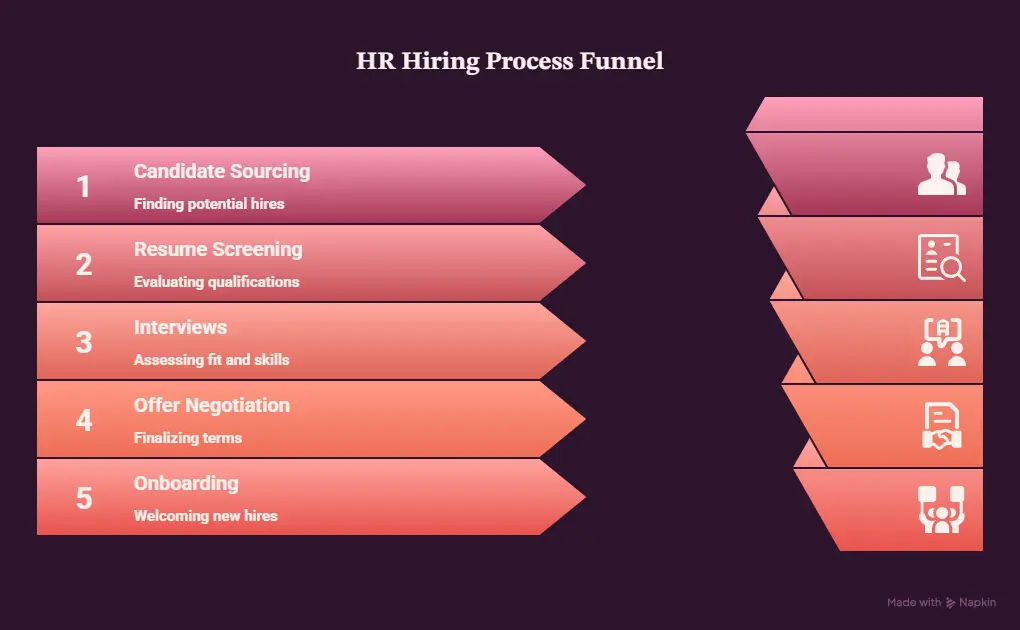
HR recruiters manage the entire hiring process to find top talent. They do more than hire—they establish strong, competent teams for company success.
Key duties:
- Writing accurate job descriptions for job marketplaces and social media
- Finding candidates through databases, LinkedIn, recommendations, and job boards
- Resume screening and candidate selection
- First-time HR interviews and applicant fit evaluation
- Coordinating hiring manager and technical team interviews
- Manage candidate communication throughout the process
- Job offer preparation and release
- Negotiating salary and start dates when needed
- Keeping applicant and recruitment databases current
- Supporting new hire onboarding and documentation
Recruitment Process Managed by an HR Recruiter
The process of recruiting is an organised series of actions that human resource recruiters conduct in order to hire the most qualified individual for a particular job vacancy. Each stage contributes to the process of locating, assessing, and choosing the most qualified staff members for the organization.
Steps in the Process of Recruiting Candidates:
- Understanding the work role, duties, and required abilities
- Advertisement of the position on employment portals, company websites, and social media platforms
- In the process of sourcing candidates, potential applicants are discovered through the use of databases, recommendations, and networking.
- Reviewing resumes and selecting the most qualified applicants
- Participating in HR rounds to evaluate communication and basic appropriateness
- The coordination of skill-based evaluations with hiring managers during technical and final interviews will be discussed.
- Selection Decision: Choosing the best applicant based on the comments received during the interview
- Offer letter: The process of extending an official job offer, including the terms and pay
Onboarding is the process of assisting a new employee in joining and completing legal paperwork.
Become an HR Expert – Enroll in Our HR Management Course Today!
Unlock the secrets to effective Human Resource Management with our expert-led course! Learn recruitment, employee relations, performance management, and more to build a thriving workplace. Start your journey toward a successful HR career today!
Know MoreHR Recruiter vs HR Generalist
Both a Human Resources Generalist and an HR Recruiter are significant professions in the world of human resources, yet the tasks that they focus on are distinct from one another. A generalist is responsible for a larger range of human resource activities inside a business, in contrast to a recruiter, who is primarily responsible for acquiring talented individuals.
| Feature | HR Recruiter | HR Generalist |
|---|---|---|
| The Primary Concentration | Recruiting and the acquisition of talent | Management of employees and overall human resources activities |
| Main Function | Identifying and choosing potential individuals | Human resource management and employee lifecycle management |
| Main Duties and responsibilities | Placement of advertisements, recruitment, screening, interviews, and onboarding | Regulations pertaining to compliance, payroll, employee relations, performance management, and training |
| Work Scope | Exclusively for the purpose of recruitment | Extensive (including a variety of HR activities) |
| Interaction with others | Candidates and those in charge of hiring | REmployees working in each and every area |
| Purpose | Employ the most qualified individuals for the company. | Ensure that human resources processes run smoothly and that employees are happy. |
| Type of Profession | Beginning positions in recruitment at the mid-level | A more comprehensive human resources job with many opportunities for advancement |
Tools Commonly Used by HR Recruiters
In order to streamline the hiring process, enhance applicant sourcing, and effectively manage recruitment efforts, human resource recruiters rely on a wide variety of tools and platforms. Over the course of the hiring process, these technologies assist recruiters in locating qualified prospects, keeping track of applications, and successfully communicating with one another.
Tools That Are Typically Employed by Human Resources Recruiters
1. The Recruiter on LinkedIn
A professional networking tool designed to look for possible candidates, engage with professionals, and establish talent pipelines.
2. Employment websites such as Naukri, Indeed, and Monster
Popular job boards that allow recruiters to attract job seekers from a variety of industries by posting openings, searching for resumes, and posting candidates.
3. (ATS) Applicant tracking systems
In the course of the recruitment process, software that assists recruiters in collecting, organising, tracking, and managing candidate applications is available.
4. Managing Human Resources (HRMS) Software
In addition to other HR-related duties, tools that are utilised for employee onboarding, record administration, recruiting analytics, and other functions.
5. Email and Other Methods of Communication
There are various platforms that promote contact with candidates and hiring managers. Some examples of these platforms are email services, video conferencing tools, and messaging applications.
Career Growth Opportunities for HR Recruiters
The development of good recruiting, communication, and talent management skills is essential for professionals who want to pursue a career in recruitment since it provides exceptional prospects for advancement. It is possible for human resources recruiters to advance into specialised and leadership roles within the field of human resources as they gain more expertise.
Most people advance their professions by:
- HR Executive/Recruiter: Finding, screening, and hiring individuals was the main focus of this entry-level Job
- Senior recruiter: Manages key jobs and hiring and advises junior recruiters.
- Talent Acquisition Specialist: Specializes in strategic hiring, business branding, and talent pipelines.
- Hiring experts: Leads teams, creates hiring strategies, and oversees the entire hiring process.
- HR manager: An HR manager’s duties go beyond hiring. Employee management, training, performance evaluation, and HR processes fall to them.
- HR partner: Helps leaders align HR projects with company goals.
- HR Director: A senior leader who manages talent, plans the workforce, and develops hiring strategy.
Is being an HR your dream? Enrol now for our course on Human Resource!
Conclusion
In order to assist organisations in attracting, evaluating, and hiring the most qualified candidates, human resource recruiters play a critical role. Every step of the recruitment process is under their supervision, from the first stages of applicant sourcing and interviewing to the management of job offers and onboarding. There is a substantial contribution that human resource recruiters make to the success of a business by utilising contemporary recruitment techniques and building strong communication and interpersonal skills. Recruitment provides excellent career progression opportunities and acts as an ideal bridge into larger HR leadership roles. This is something that is becoming increasingly important as the demand for competent recruiting professionals continues to thrive.
| Related Posts | |
| Top Human Resource Blogs to Follow | How to build a remote HR career |
| HR Certification vs HR Degree | Which one to choose? | 15 HR Intern Interview Questions and Sample Answers |
Become an HR Expert – Enroll in Our HR Management Course Today!
Unlock the secrets to effective Human Resource Management with our expert-led course! Learn recruitment, employee relations, performance management, and more to build a thriving workplace. Start your journey toward a successful HR career today!
Know MoreFrequently Asked Questions
What qualifications are required to become an HR recruiter?
Most employers prefer candidates with a bachelor’s degree in Human Resources, Business Administration, Psychology, or a related field.
What skills are essential for an HR recruiter?
Key skills include communication, interpersonal abilities, negotiation, time management, decision-making, and knowledge of recruitment tools.
Is HR recruiter a good career choice?
Yes, HR recruitment offers strong career growth opportunities, competitive salaries, and pathways into senior HR and talent acquisition roles.
What does an HR recruiter do during the recruitment process?
An HR recruiter manages job postings, candidate sourcing, resume screening, interview coordination, offer management, and onboarding activities.
How does an HR recruiter find suitable candidates?
Recruiters use job portals, professional networking platforms, employee referrals, social media, and recruitment databases to source qualified candidates.
What industries hire HR recruiters?
HR recruiters are needed across various industries, including IT, healthcare, finance, aviation, manufacturing, retail, education, and hospitality.