Table of Contents
Humanoid robotics jobs in India are real but rare. They are concentrated at firms like iHub Robotics (Kochi) and Addverb (Noida), with GreyOrange leading the wider warehouse-robotics market.
Most “humanoid” hiring happens in small R&D and deployment teams inside companies that also sell industrial or service robots. So, the larger volume of openings lies in adjacent robotics roles.
India installed about 9,100 industrial robots in 2024 (IFR). iHub has ~75 employees and Addverb ~1,100. Viral demos exaggerate the trend. But the quieter reality is more useful for career planning.
New to Robotics? Start from the Basics. Join Now!
Key Takeaways
- Humanoid robotics jobs in India are real but few, led by iHub (Kochi) and Addverb (Noida).
- GreyOrange isn’t a humanoid maker but hires for the same core skills.
- Elixis‑W is in pilots, so teams are small and specialized.
- Entry skills – ROS 2, Python/C++, controls, simulation, plus one deep specialty.
- Pay – ~₹4 LPA to ₹8 LPA for freshers; ₹25 LPA+ for experienced AI/vision/automation talent.
- Kerala has a local edge with iHub’s humanoid factory and R&D in Kochi.
How Big is India’s Robotics Market Right Now?

India’s robotics market is small by global standards but growing fast. It is led by automotive factories rather than humanoids.
Robot adoption has surged over the past two years. This is driven mainly by carmakers and their parts suppliers. IFR’s World Robotics 2025 report gives the clearest numbers.
| Indicator (2024) | Figure |
| Industrial robots installed | About 9,100 units (+7%, a record) |
| Global rank by annual installations | 6th |
| Operational stock of robots | 52,570 units (10th worldwide) |
| Automotive share of installations | 45% (4,070 units, +15%) |
South Korea, the most automated country, had 1,220 robots per 10,000 manufacturing employees. One caution from IFR is that installations could dip in 2026 as the Production Linked Incentive scheme winds down, so hiring may be uneven in the short term.
Master Robotics and AI!
Ready to build the future? Join our comprehensive robotics course to bridge the gap between complex code and physical motion. You’ll gain hands-on experience giving you the technical edge needed to lead in the age of automation.
Know MoreWhich Companies are Actually Hiring for Humanoid Robotics?
Three companies show the full picture:
- one builds service and industrial humanoids.
- another is adding humanoids to a large automation business.
- The third one shows where the volume jobs are.
| Company | Base | What it builds | Humanoid status |
| iHub Robotics | Kochi (factory in Kalamassery) | Tara service humanoids, Daksha industrial humanoid | Shipping; roughly 65 Tara units deployed in India, the UAE and Saudi Arabia by Q1 2026 |
| Addverb | Noida | Warehouse robots, cobots, Trakr quadruped, Elixis humanoids | Elixis-W launched in 2026, starting with controlled pilots |
| GreyOrange | Atlanta HQ, with India engineering offices in Bengaluru, Chennai and Hyderabad | GreyMatter orchestration software and Ranger robots | Not a humanoid maker |
iHub Robotics (Kochi)
iHub is one of India’s few homegrown humanoid makers. It is small enough that every single hire matters. Two years after it was founded, it launched Tara Gen-1 in 2024. This became the first Indian company selected for NVIDIA’s Humanoid Robotics Program in January 2025. Its co-founder says the team is about 75 people, which is roughly 32 of them in the deep-tech lab.
The entry systems are priced from around $10,000. Public listings show openings across
- Engineering
- AI
- Business development
- Marketing
- Internships
Addverb (Noida)
Addverb pairs a mature automation business with a fresh humanoid bet, which makes it the most stable place to work on legged and wheeled humanoids. Reliance is reported to hold a controlling 54% stake.
The company employs about 1,100 people across two dozen countries. It is raising over $100 million to fund humanoid and quadruped development. Its careers page lists Advanced Robotics roles such as
- Lead Design Engineer
- Robotics Software Engineer
The latter is open to graduates in
- Computer science
- Robotics
- Electrical engineering
GreyOrange (Bengaluru, Chennai, Hyderabad)
GreyOrange is where you find scale rather than humanoids. Founded by two BITS Pilani graduates, it runs the GreyMatter platform that coordinates robots, people and systems inside warehouses.
It serves retailers such as H&M, Adidas and IKEA. Its skill clusters (perception, fleet orchestration, embedded software) are the same ones humanoid teams look for. So it works as a stepping stone.
What Job Roles and Skills do these Companies Need?
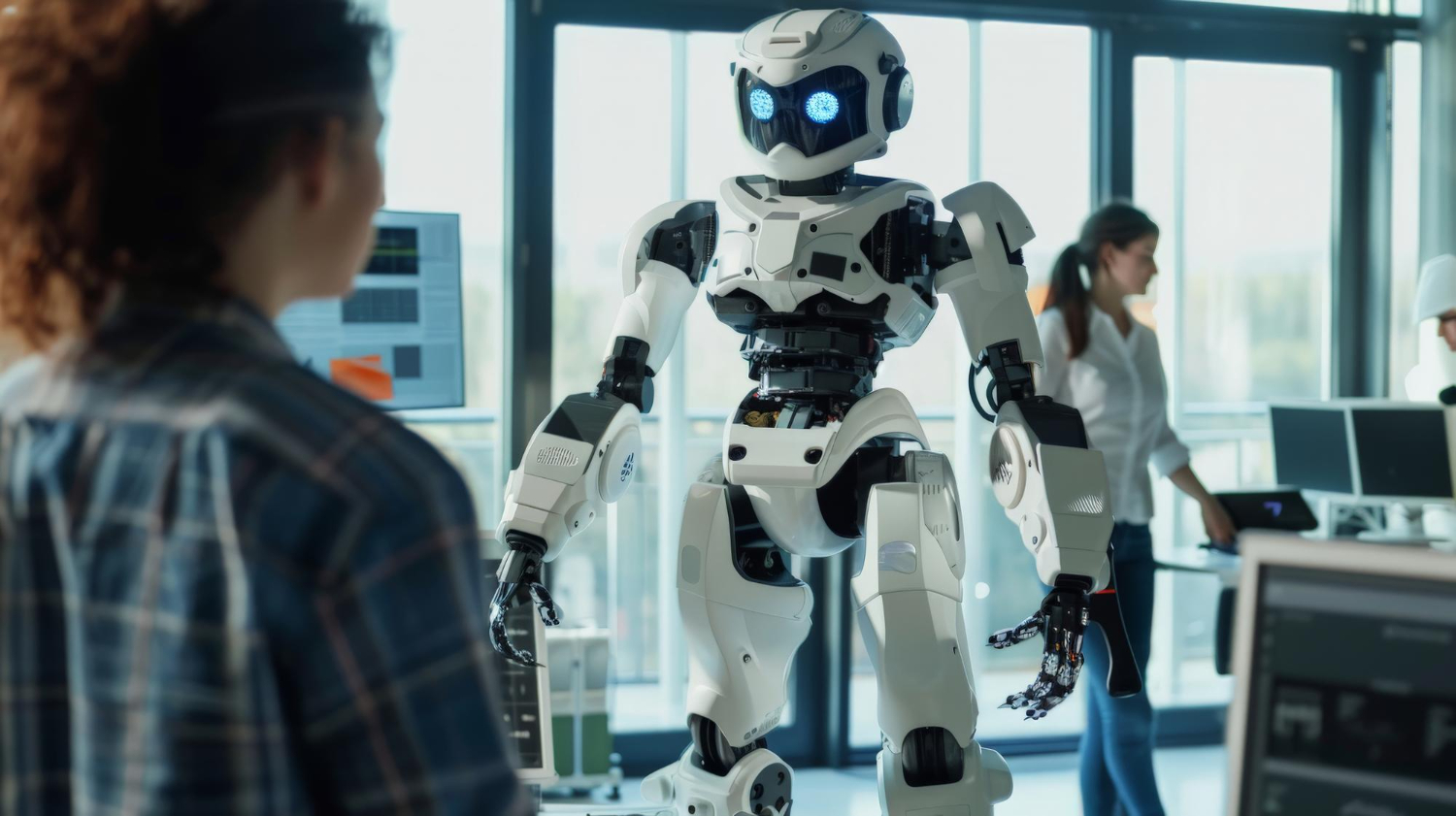
Robotics hiring rewards a strong core plus one deep specialty. Roles cluster around software, perception, controls, embedded systems and deployment.
iHub, for example, relies on NVIDIA Jetson computing and tools such as Isaac Sim. It describes its robots as running vision-language-action (VLA) models.
| Role | Core skills |
| Robotics Software Engineer | ROS 2, Python, C++, motion planning, simulation |
| Perception / Computer Vision Engineer | Cameras, LiDAR, sensor fusion, deep learning |
| Controls Engineer | Control theory, real-time systems, manipulator control |
| Embedded Systems Engineer | RTOS, microcontrollers, firmware, hardware bring-up |
| AI/ML Engineer for Robotics | Imitation learning, VLA fine-tuning, reinforcement learning |
| Deployment / Applications Engineer | On-site integration, troubleshooting, safety basics |
Beyond the code, industry voices expect new roles to appear, such as simulation dataset architects and robot behaviour auditors. The differentiator is deployment literacy:
- safety practices
- on-site integration
- data operations
How Much Do Robotics Engineers Earn in India?
Most robotics engineers in India earn between ₹4 and ₹11 LPA. The top packages go to a small group of AI and vision specialists. Salary aggregator data from early 2026 puts the average near ₹6.5 LPA.
The middle half of reported pay falling between roughly ₹3.8 and ₹10.7 LPA. Self-reported figures for experienced specialists run much higher. So treat them as the ceiling, not the norm.
| Level | Typical range (2026 signals) |
| Fresher (0–2 years) | ₹4–8 LPA, up to about ₹10 LPA at product firms |
| Average across all experience levels | About ₹6.5 LPA |
| Specialised mid-level (5–7 years, AI, vision, automation) | ₹25–40 LPA possible |
| Senior ML/robotics experts | Up to ₹60 LPA reported |
Master Robotics and AI!
Ready to build the future? Join our comprehensive robotics course to bridge the gap between complex code and physical motion. You’ll gain hands-on experience giving you the technical edge needed to lead in the age of automation.
Know MoreWhere are the Robotics Jobs in India?
The jobs sit in Delhi NCR, Bengaluru, Kochi, Chennai and Hyderabad. Noida hosts Addverb’s humanoid work, Bengaluru and Chennai host GreyOrange’s engineering teams, and Kochi is home to iHub.
Kerala has also named robotics among its priority industrial sectors, and Kochi and Thiruvananthapuram already host startups in underwater robotics, testing automation and sanitation robots.
How Can You Build a Career in Humanoid Robotics?
Start with a project portfolio, then move toward a specialty. Employers care more about what you have built than the course you took.
Fresher route:
- Build 2 to 3 ROS 2 projects (a mobile base, a manipulator, a perception pipeline) in simulation.
- Then apply for internships, hardware assembly or application-support roles.
- Plan on 6 to 12 months of focused practice.
Software or embedded switch:
Move into perception or controls through
- sensor-fusion projects
- control tuning on real hardware
- open-source contributions
Postgraduate route:
An M.Tech or PhD in robotics, vision or controls suits research roles in legged and humanoid systems.
Is the Humanoid Hype Justified?
Partly. Humanoid robotics is a genuine hiring story, yet most deployments are pilots. Addverb is rolling Elixis-W out in controlled settings before scaling, and iHub’s deployments number in the dozens, not thousands.
Watch for expanded R&D hiring at Addverb, new iHub facilities such as its planned Bengaluru R&D centre, and how the post-PLI automation market shapes demand.
New to Robotics? Start from the Basics. Join Now!
Conclusion
Humanoid robotics in India is a small but credible career field.
iHub Robotics proves a Kerala startup can build humanoids end to end. Addverb, on the other hand, shows how an established automation player is moving into Physical AI. GreyOrange shows where thousands of everyday robotics jobs already exist.
Build hands-on ROS 2 and simulation skills. Pick one specialty and aim for adjacent roles first. This works as they open the door to humanoid teams as those grow.
|
RELATED POSTS |
|
| Vibe Coding in Robotics Development | |
| How to Transition from Software Engineering to Robotics | |
| Countries with Highest Demand for Robotics Engineers (2026) | |
Master Robotics and AI!
Ready to build the future? Join our comprehensive robotics course to bridge the gap between complex code and physical motion. You’ll gain hands-on experience giving you the technical edge needed to lead in the age of automation.
Know MoreFrequently Asked Questions
Are there real humanoid robotics jobs in India?
Yes. iHub Robotics in Kochi and Addverb in Noida hire engineers for humanoid programmes, though teams are small and specialised.
Which Indian companies build humanoid robots?
iHub Robotics (Tara and Daksha) and Addverb (Elixis) are two prominent examples. Both are manufactured in India.
What skills do I need for humanoid robotics roles?
Learn ROS 2, Python, C++, Linux, Git and simulation, then specialise in perception, controls, embedded systems or AI for robotics. Safety and integration knowledge helps you stand out.
Can freshers get into humanoid robotics?
Yes, through internships, hardware assembly, embedded and application-support roles. A public portfolio of ROS 2 and simulation projects strengthens your case.
Which cities have the most robotics jobs?
Delhi NCR, Bengaluru, Chennai, Hyderabad and Kochi lead. Each city leans towards different company types.
Is a degree in robotics compulsory?
No. Companies list computer science, electrical, mechanical and robotics degrees, and demonstrable project work often carries weight.
Is Kerala a good place for a robotics career?
Kochi hosts iHub Robotics’ factory and R&D base, and the state lists robotics as a priority sector. Options are fewer than in Bengaluru or NCR, but they are growing.
How long does it take to land a first robotics role?
With focused learning and a portfolio, many candidates aim for 6–12 months. Internships can shorten the path.