

Table of Contents
MEP vs Core Electrical: Which Career Is Better?
MEP is suitable for building services and Gulf opportunities. Core electrical is suitable for power and manufacturing jobs.
Both fields offer different career opportunities. The right choice depends on career goals. Interest, skills, location, and salary also matter.
| Comparison | MEP Jobs | Core Electrical Jobs |
| Main field | Building services | Electrical power and systems |
| Work areas | Buildings and infrastructure | Power plants and industries |
| Main skills | Electrical design, HVAC, BIM | Power systems, machines, control |
| Software | AutoCAD, Revit MEP | ETAP, MATLAB, AutoCAD |
| Gulf opportunities | Building and infrastructure projects | Power, energy, and industrial projects |
| Career focus | MEP design and project management | Power engineering and industrial systems |
Get Career oriented MEP training with Expert Mentors! Get Free Demo Here!
Introduction: Choosing a Career After B.Tech
A B.Tech degree opens several career paths. Electrical and mechanical graduates have many options. However, choosing the right field can feel difficult.
Some graduates prefer technical design work. Others prefer industrial and site-based jobs. Some want opportunities in Gulf countries. Others prefer government jobs and PSUs.
Two popular options deserve attention. These are MEP and core electrical engineering.
Both fields use engineering knowledge. However, their daily work differs.
MEP focuses on building services. Core electrical on electrical systems. Each field offers different career.
The choice should depend on following factors:
- Interest:
- Preferred engineering work.
- Skills:
- Existing technical knowledge.
- Location:
- India or overseas employment.
- Salary:
- Expected starting and future income.
- Growth:
- Long-term career opportunities.
- Work style:
- Office, factory, or site work.
Both fields can be entered after B.Tech. Suitable training is required. The career options to be understood first.
Master MEP Design with Industry-Leading Training!
Gain in-depth knowledge of Mechanical, Electrical, and Plumbing (MEP) Design with expert-led courses. Learn HVAC, fire safety, sustainable building strategies, and BIM applications to excel in the construction industry.
Know MoreWhat Are MEP Jobs?
MEP stands for Mechanical, Electrical, and Plumbing. It covers essential building service systems.
They make buildings safe. It also make them functional. They support comfort and daily operations.
Following projects are handled by them.
- Residential apartments.
- Commercial buildings.
- Shopping malls.
- Hospitals.
- Airports.
- Hotels.
- Factories.
- Data centres.
Main MEP Engineering Roles
MEP offers several specialised job roles. Each role handles a specific building system.
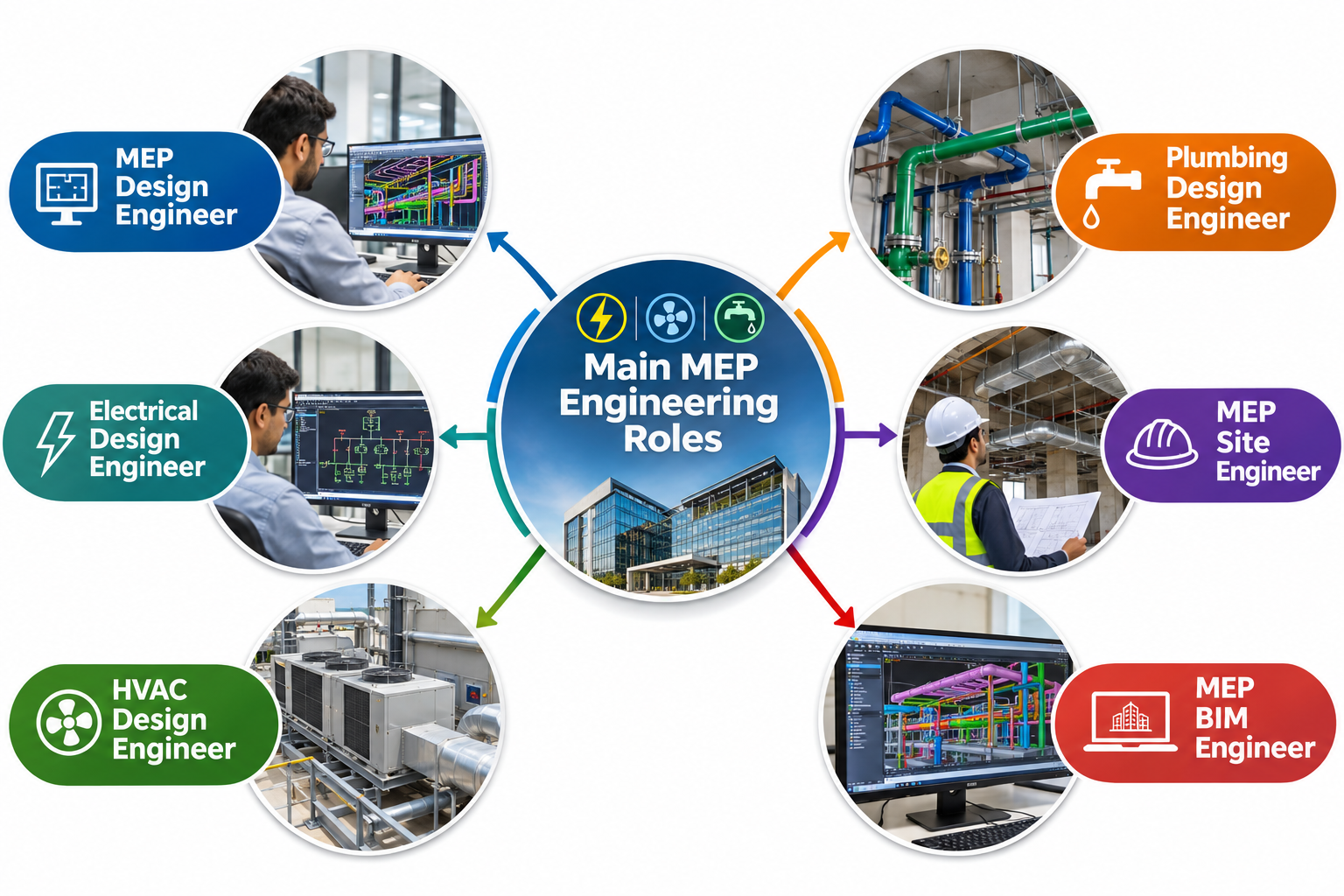
- MEP Design Engineer
- Building systems are planned.
- Electrical layouts are prepared.
- Equipment requirements are calculated.
- Technical drawings are developed.
- Design standards are followed.
- Electrical Design Engineer
- Lighting layouts are prepared.
- Power distribution systems are designed.
- Cable sizes are calculated.
- Load schedules are developed.
- Electrical safety is checked.
- HVAC Design Engineer
Heating and cooling systems are designed.
- Cooling loads are calculated.
- Air-conditioning equipment is selected.
- Duct layouts are prepared.
- Ventilation systems are planned.
- Airflow requirements are checked.
- Plumbing Design Engineer
- Water supply layouts are prepared.
- Drainage systems are designed.
- Pipe sizes are calculated.
- Pump requirements are checked.
- MEP Site Engineer
- Installation work is supervised.
- Drawings are checked.
- Material requirements are monitored.
- Site progress is recorded.
- Rules for safety are followed
- MEP BIM Engineer
- Building systems are modelled.
- Three-dimensional layouts are prepared.
- System clashes are identified.
- Construction drawings are generated.
MEP offers opportunities for both graduates. Electrical graduates can enter electrical design. Mechanical graduates can enter HVAC design.
What Are Core Electrical Jobs?
Core electrical jobs focus on electrical engineering systems. These systems generate and distribute electricity. They also power machines and industrial equipment.
Core electrical engineers work across several industries. Their work supports essential electrical operations.
These jobs are available across different industries.
- Power generation plants.
- Electricity distribution companies.
- Manufacturing industries.
- Renewable energy companies.
- Electrical equipment manufacturers.
- Oil and gas companies.
- Government departments.
- Public Sector Undertakings (PSUs).
Main Core Electrical Job Roles
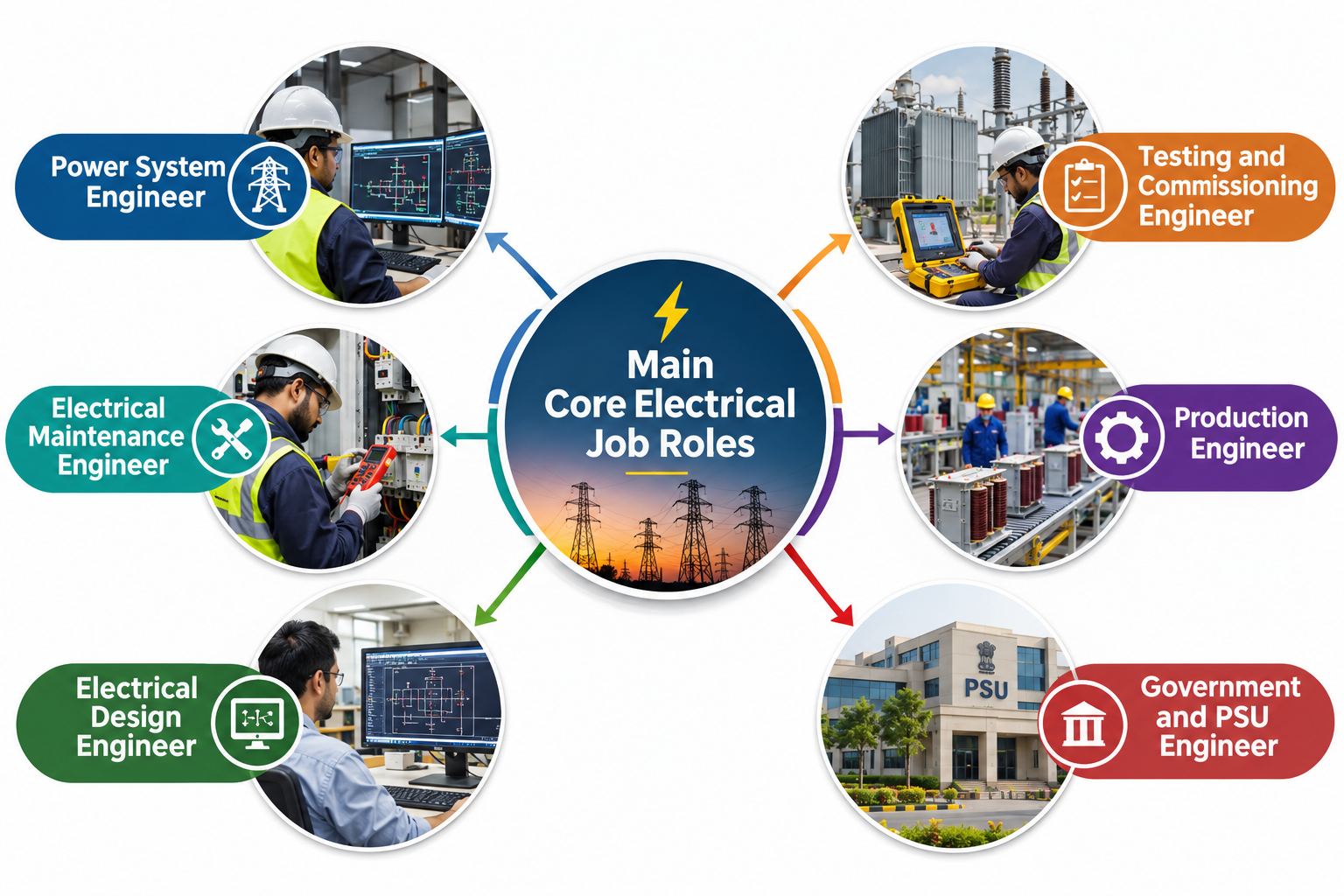
- Power System Engineer
- Power networks are studied.
- Load flow studies are performed.
- Fault conditions are analysed.
- Protection systems are checked.
- Grid performance is monitored.
- Electrical Maintenance Engineer
- Machines are inspected.
- Electrical faults are identified.
- Equipment maintenance is performed.
- Breakdown problems are solved.
- Safety procedures are followed.
- Electrical Design Engineer
- Electrical circuits are designed.
- Equipment specifications are prepared.
- Wiring diagrams are developed.
- Electrical calculations are performed.
- Design standards are followed.
- Testing and Commissioning Engineer
- Electrical equipment is tested.
- Protection relays are checked.
- Transformers are inspected.
- Testing reports are prepared.
- Systems are made operational.
- Production Engineer
- Electrical equipment is manufactured.
- Production activities are monitored.
- Quality checks are performed.
- Machine performance is evaluated.
- Government and PSU Engineer
- Power infrastructure projects are handled.
- Electrical operations are monitored.
- Equipment performance is checked.
- Technical responsibilities are managed.
Core electrical jobs offer different specialisations. Graduates can choose based on their interests.
MEP vs Core Electrical: Main Differences
Both fields use electrical engineering knowledge. However, their applications are different.
MEP work is mainly connected with buildings. Core electrical work covers wider electrical systems.
The following comparison explains the differences.
| Factor | MEP Engineering | Core Electrical Engineering |
| Work type | Building service design | Power and industrial systems |
| Main projects | Buildings and infrastructure | Plants, grids, and factories |
| Employers | Consultants, contractors, EPC firms | Utilities, manufacturers, PSUs |
| Technical focus | Lighting, power, HVAC, plumbing | Machines, power, protection |
| Main skills | Design, coordination, calculations | Electrical analysis, testing, maintenance |
| Software | AutoCAD, Revit, Navisworks | ETAP, MATLAB, PLC tools |
| Work environment | Offices and construction sites | Plants, factories, and sites |
| Career growth | Senior, lead, and MEP manager | Senior, specialist, and project manager |
| Overseas scope | Building and infrastructure projects | Energy and industrial projects |
Which Field Offers More Job Options?
Both fields offer several career options. However, their opportunities differ by industry.
MEP opportunities include:
- Building design.
- Electrical consultancy.
- Construction projects.
- BIM modelling.
- MEP coordination.
- Facility management.
Core electrical opportunities include:
- Power generation.
- Transmission and distribution.
- Industrial automation.
- Electrical manufacturing.
- Renewable energy.
- Testing and commissioning.
MEP suits building-focused careers. Core electrical suits power-focused careers.
Master MEP Design with Industry-Leading Training!
Gain in-depth knowledge of Mechanical, Electrical, and Plumbing (MEP) Design with expert-led courses. Learn HVAC, fire safety, sustainable building strategies, and BIM applications to excel in the construction industry.
Know MoreSalary Comparison in India and the Gulf
Salary is an important career factor. Both fields offer different salary levels. Experience and technical skills affect earnings.
Location also influences salary packages. Large companies may offer higher salaries.
MEP Salary in India and the Gulf
MEP salaries depend on specialisation. Electrical, HVAC, and BIM roles differ.
The following figures provide indicative ranges. They are not guaranteed starting packages.
Core Electrical Salary in India and the Gulf
Core electrical salaries depend on industry. Power, manufacturing, and energy roles differ. Government and PSU packages follow separate structures.
The following table provides broad estimates.
| Career Level | MEP India | Core Electrical India | MEP Gulf | Core Electrical Gulf |
| Fresher | ₹2.5–4.5 LPA | ₹2.5–4.5 LPA | AED 3,500–6,500/month | AED 3,500–6,500/month |
| 3–5 years | ₹5–9 LPA | ₹4–8 LPA | AED 7,000–13,000/month | AED 6,000–12,000/month |
| 6–10 years | ₹9–16 LPA | ₹7–13 LPA | AED 12,000–20,000/month | AED 10,000–18,000/month |
| Senior level | ₹16–25+ LPA | ₹12–20+ LPA | AED 20,000–30,000+ | AED 17,000–28,000+ |
Salary figures are indicative estimates for comparison. Actual offers depend on location, employer, experience, and specialisation. Gulf figures are monthly amounts in UAE dirhams. Benefits and allowances may differ.
Factors That Affect Salary
Several factors influence engineering salaries.
Experience
- Freshers usually receive lower packages.
- Experienced engineers handle larger projects.
- Senior engineers manage teams.
Technical Skills
- Specialised skills improve job prospects.
- Software knowledge supports technical roles.
- Practical experience improves job opportunities.
Location
- Metro cities offer different salary levels.
- Gulf countries offer varied packages.
- Large projects may offer higher packages.
Company Type
- Consultancies recruit design engineers.
- Contractors recruit site engineers.
- Manufacturers recruit production engineers.
- Utilities recruit power engineers.
Salary growth is influenced by several factors. Career experience should also be considered.
Skills and Software Needed for Each Career
Different technical skills are required in both fields. Software knowledge is also important.
MEP requires building service design skills. Core electrical requires power and industrial knowledge.
| MEP Engineering | Core Electrical Engineering |
| Electrical load calculations | Power system analysis |
| Lighting design | Electrical machine knowledge |
| Cable sizing | Transformer knowledge |
| Voltage drop calculations | Protection systems |
| HVAC fundamentals | Control systems |
| Plumbing fundamentals | Electrical maintenance |
| Electrical codes and standards | Electrical safety standards |
| AutoCAD | AutoCAD |
| Revit MEP | ETAP |
| Navisworks | MATLAB |
| DIALux | PLC and SCADA tools |
| Excel | Electrical testing tools |
Important Skills for MEP Engineers
Electrical Design
- Load calculations.
- Cable sizing.
- Lighting layouts.
- Panel schedules.
- Earthing design.
Building Knowledge
- HVAC basics.
- Plumbing systems.
- Fire protection.
- Building codes.
- Site coordination.
Software Skills
- AutoCAD.
- Revit MEP.
- Navisworks.
- DIALux.
- Excel.
Important Skills for Core Electrical Engineers
Electrical Fundamentals
- Power systems.
- Electrical machines.
- Circuit theory.
- Protection systems.
- Power electronics.
Industrial Knowledge
- Motors.
- Transformers.
- Switchgear.
- Control panels.
- Electrical maintenance.
Software Skills
- ETAP.
- MATLAB.
- AutoCAD.
- PLC programming.
- SCADA systems.
Software requirements depend on job roles. Not every engineer needs every tool.
Job Demand and Hiring Trends
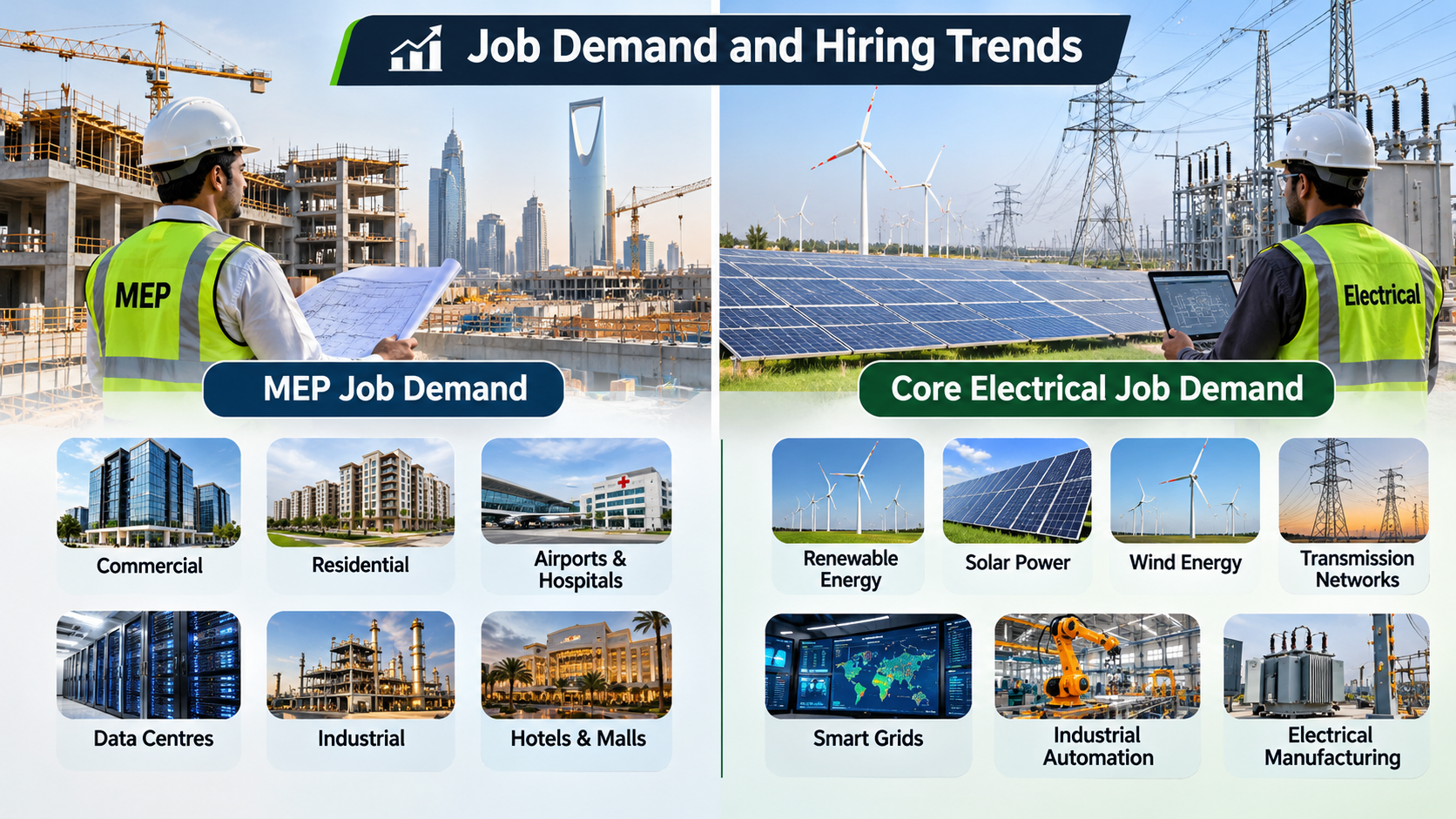
Both career paths have employment opportunities. Demand depends on industry growth and projects.
MEP Job Demand
MEP demand is linked with construction. New buildings need electrical and mechanical systems. Large projects also require design coordination.
Demand comes from several sectors:
- Commercial construction.
- Residential developments.
- Airports and hospitals.
- Data centres.
- Industrial buildings.
- Hotels and shopping centres.
Gulf countries also have construction opportunities. The UAE and Saudi Arabia attract engineers. Large infrastructure projects support this demand.
UAE recruitment reports show strong engineering hiring. Construction and real estate remain active sectors. HVAC skills also support candidate demand.
Core Electrical Job Demand
Core electrical demand is linked with energy. Industries need reliable electrical systems. Power infrastructure also requires skilled engineers.
Important growth areas include:
- Renewable energy.
- Solar power projects.
- Wind energy projects.
- Transmission networks.
- Smart electricity grids.
- Industrial automation.
- Electrical equipment manufacturing.
India’s electrical equipment industry recorded growth. IEEMA reported 12.6% growth in FY 2025–26. Power infrastructure expansion supported this performance.
Renewable energy also supports new jobs. Hiring includes installation and commissioning roles. Testing and grid connection skills matter.
Which Field Has Better Demand?
Both fields have promising opportunities. MEP connects closely with construction growth. Core electrical connects with energy expansion.
The better option depends on specialisation. Location and experience also influence hiring.
Pros and Challenges of Each Career
Every engineering career has advantages. Each field also has certain challenges.
Advantages of MEP Engineering
- Multiple specialisations are available.
- Building projects offer varied experience.
- Gulf opportunities are available.
- BIM skills support career growth.
- Design and site roles are available.
- Mechanical and electrical graduates can apply.
Challenges of MEP Engineering
- Project deadlines can be demanding.
- Site work may involve long hours.
- Design changes happen frequently.
- Coordination requires clear communication.
- Standards and codes require regular learning.
Advantages of Core Electrical Engineering
- Strong technical specialisations are available.
- Power sector careers offer variety.
- Manufacturing jobs are available.
- Renewable energy creates opportunities.
- PSU careers may offer stability.
- Industrial experience builds practical skills.
Challenges of Core Electrical Engineering
- Some roles require shift work.
- Plant locations may be remote.
- Safety responsibilities are high.
- Certain roles need specialised experience.
- Government recruitment can be competitive.
The right choice depends on preferences. Work conditions should also be considered.
Get Career oriented MEP training with Expert Mentors! Get Free Demo Here!
Which Career Should You Choose?
The best career depends on personal goals. Your preferred work environment also matters.
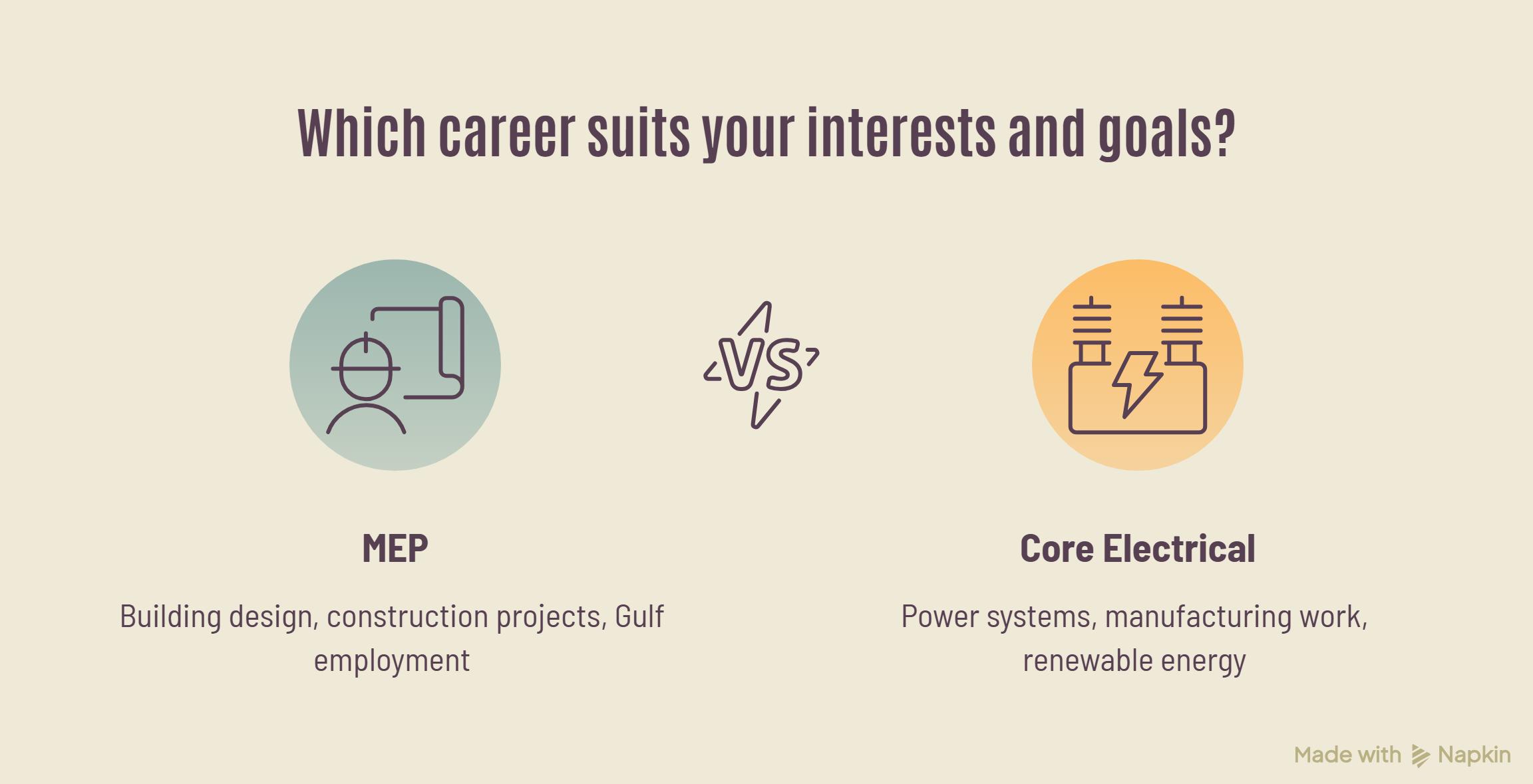
Use the following guide before deciding.
Choose MEP If:
- Building design interests you.
- Construction projects attract you.
- Gulf employment is a priority.
- BIM modelling interests you.
- Electrical or HVAC design sounds suitable.
- You prefer consultancy-based work.
- You enjoy project coordination.
Choose Core Electrical If:
- Power systems interest you.
- Electrical machines attract you.
- Manufacturing work suits you.
- Renewable energy interests you.
- PSU employment is your goal.
- Industrial automation attracts you.
- Testing and maintenance suit you.
What About Mechanical Graduates?
Mechanical graduates can enter MEP. HVAC design is a common career option. Plumbing and fire protection are other options.
Core electrical roles usually require electrical qualifications. Mechanical graduates may need different training. Their core options include thermal and manufacturing roles.
What About Electrical Graduates?
Electrical graduates can enter both fields. Their choice depends on technical interests.
For example:
- Choose MEP for building electrical design.
- Choose core for power system engineering.
- Choose MEP for Revit-based design.
- Choose core for industrial automation.
- Choose MEP for construction projects.
- Choose core for energy infrastructure.
A clear career goal helps. Suitable training can then be selected.
Courses to Get Started
Additional training can improve job readiness. Practical skills are important for fresh graduates.
The right course depends on career goals.
Courses for MEP Careers
- MEP Design Course
This course covers building service systems.
Important topics include:
- Electrical system design.
- HVAC system basics.
- Plumbing design basics.
- Firefighting systems.
- Electrical load calculations.
- Cable sizing.
- Building layouts.
- Design standards.
- Revit MEP Course
Revit MEP supports building modelling.
Important topics include:
- Electrical modelling.
- HVAC modelling.
- Plumbing modelling.
- Equipment placement.
- Model coordination.
- Construction documentation.
- Electrical Design Course
This course develops electrical design skills.
Important topics include:
- Lighting design.
- Power distribution.
- Panel schedules.
- Earthing systems.
- Cable calculations.
- Electrical drawings.
Courses for Core Electrical Careers
- Power System Design Course
- Load flow analysis.
- Short circuit analysis.
- Protection systems.
- Power distribution.
- Substation basics.
- Industrial Automation Course
- PLC programming.
- SCADA systems.
- Control panels.
- Motor control.
- Industrial sensors.
- Electrical Testing Course
- Transformer testing.
- Relay testing.
- Cable testing.
- Equipment inspection.
- Safety procedures.
How to Select the Right Course
Check these points before enrolling.
- Course syllabus.
- Practical training.
- Software coverage.
- Trainer experience.
- Project assignments.
- Placement support.
- Industry relevance.
A suitable course builds practical knowledge. It also helps prepare for interviews.
Conclusion
MEP and core electrical offer different careers. Both use important engineering knowledge. Both provide opportunities in India and abroad.
MEP suits building services and construction. It also offers opportunities in Gulf markets. Core electrical suits power and manufacturing. Renewable energy creates further career options.
The final choice depends on interests. Skills and career goals also matter. Choose a field with clear direction. Build the required technical knowledge.
For graduates interested in building services, MEP training can help. An MEP Design Course covers essential systems. It also supports practical design skills.
Explore the MEP Design Course and start building your career in MEP engineering.
Master MEP Design with Industry-Leading Training!
Gain in-depth knowledge of Mechanical, Electrical, and Plumbing (MEP) Design with expert-led courses. Learn HVAC, fire safety, sustainable building strategies, and BIM applications to excel in the construction industry.
Know MoreFrequently Asked Questions
Is MEP better than core electrical after B.Tech?
Both fields offer different opportunities. MEP suits building services and construction. Core suits power and industrial engineering. The better choice depends on career goals.
Can electrical engineers work in MEP?
Yes, electrical graduates can enter MEP. Electrical design is a major specialisation. Training in Revit and AutoCAD helps.
Can mechanical engineers work in MEP?
Yes, mechanical graduates can enter MEP. HVAC design is a common option. Plumbing and firefighting are other specialisations.
Which field offers better Gulf opportunities?
MEP offers opportunities in building projects. Core electrical also has Gulf openings. Energy and industrial projects recruit electrical engineers.
Which software should an MEP fresher learn?
AutoCAD is a useful starting point. Revit MEP supports building modelling. DIALux supports lighting design. Navisworks helps with coordination.
Is MEP a good career for freshers?
Yes, MEP offers entry-level opportunities. Freshers can start with design or site roles. Practical training improves job readiness.