Table of Contents
Quantity Surveyor (QS) handles measurement, estimation, planning and monitoring of expenses in large building projects such infrastructure projects such as roads, highways, metro rails, bridges etc. Their key roles include preparing invoices of Quantities (BOQ), checking contractor invoices, monitoring project expenses, managing adjustments and preparing final accounts. The entry level QS professionals in India normally earn from ₹ 2.5 to 4.5 LPA. The more experienced individuals may make anywhere between ₹10 to 18 LPA or more depending on their talents, their company and the nature of the project they are working on.
Study Quantity Surveying With Professional Mentors! Join Now!
Key Takeaways
- The Infrastructure Quantity Surveyor is responsible for controlling the cost of roads, highways, metro trains and bridges.
- Some of the most significant jobs include the preparation of the BOQ, measurement of quantities, billing, cost estimation and the handling of variances.
- Important to know about EPC, HAM, BOT, Item Rate contracts.
- Some useful tools for people in building operations are Excel, AutoCAD, Primavera P6 and SAP.
- In India, the salary of an infrastructure QS rises up with experience, specialist knowledge and exposure to projects.
Introduction: India’s Infrastructure Push and Demand for QS Professionals
1: What is the main purpose of a Bill of Quantities (BoQ)?

India is also investing heavily in building up its infrastructure to make movement easier and spur economic growth. Government schemes and large investments on national highways, expressways, metro rail networks, bridges and smart cities have given jobs to construction workers.
There are enormous budgets, complex contracts, tons of materials and a lot of contractors working on these projects. This is why it is crucial to know the costs correctly and to monitor the finances.
Quantity surveyors’ role in this situation is highly essential. They help infrastructure corporations maintain project expenses under control, ensure sure construction work stays in budget, negotiate amendments to contracts and send out payments.
QS workers may get opportunities with construction businesses, engineering firms, government and metro corporations if they have experience in infrastructure projects.
Master Quantity Surveying – Build a Rewarding Career Today!
Gain in-demand skills in cost estimation, project budgeting, and contract management with our Quantity Surveying Course. Learn from industry experts and boost your career in construction and infrastructure. Enroll now and take the first step toward success!
Know MoreTypes of Infrastructure Projects and QS Responsibilities
Quantity surveyors work on several kinds of infrastructure projects. Each project has various measurements, materials and financial aspects to consider.
| Project type | Main QS focus |
|---|---|
| Roads | Includes the base, pavement, drainage, and road markings. |
| Highways | Land development and Road construction, toll booths, highway buildings |
| Metro rail | Tunnels, elevated viaducts, tracks, and station buildings. |
| Bridges | Concrete, reinforcing steel, structural parts, foundations, and building work |
Infrastructure QS professionals must understand the particular technical aspects and measurement requirements of each project to be able to provide accurate cost estimates and payment records.
What Does a Quantity Surveyor Do on Infrastructure Projects?
A Quantity Surveyor is responsible for a range of financial and legal activities in an infrastructure project.
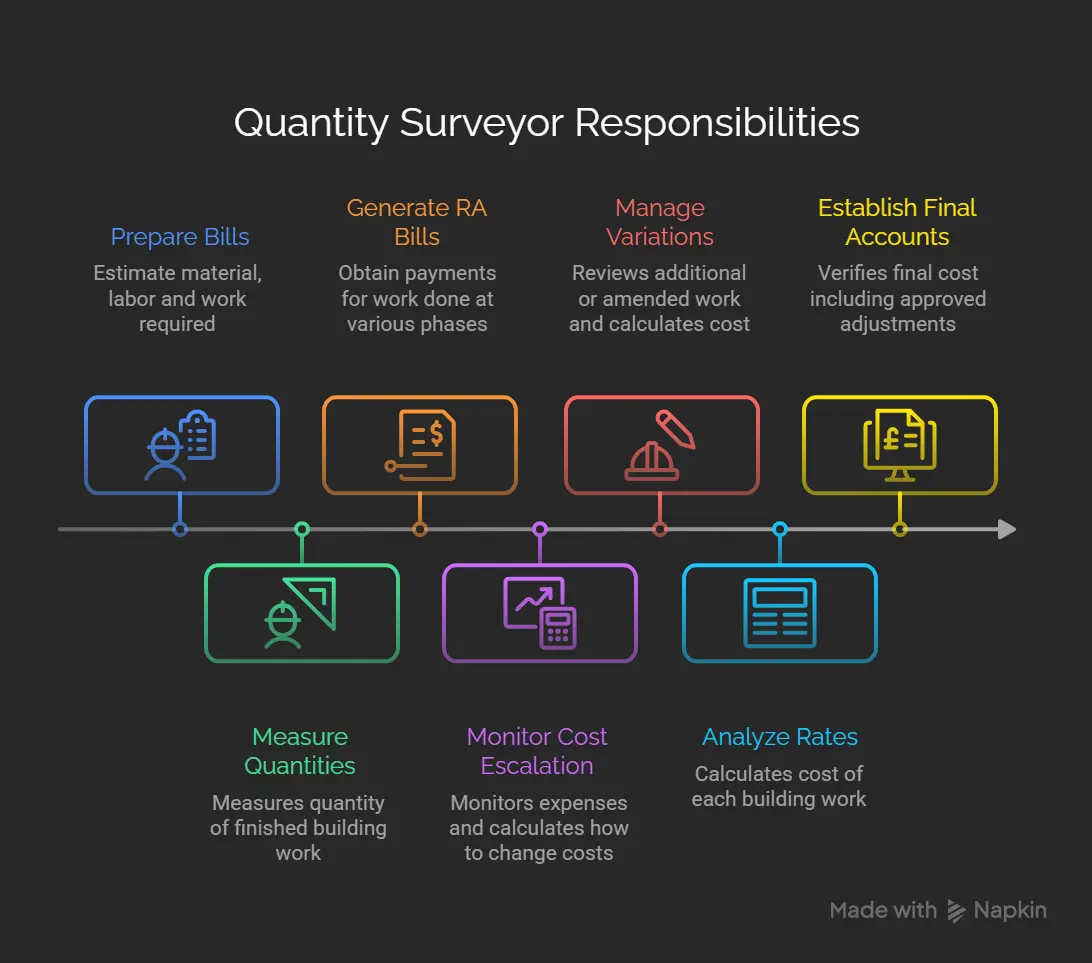
Key Responsibilities
To prepare Bills of Quantities, you need to estimate the material, labor and work required for projects like roads, bridges, metros etc.
- Quantity measurement: measures the quantity of finished building work such as excavation, concrete, reinforcement steel, sidewalk and drainage.
- Creation of RA Bills : Generates Running Account (RA) bills to obtain payments for work done at various phases of a job.
- Cost Escalation: Monitors the expenses of materials, labor and equipment and calculates how to change costs according to the contract requirements.
- Reviews any additional or amended work, and calculates the cost to the project. Managing Variations
- Rate Analysis : Calculates the cost of each building work by summing the price of materials, labor, equipment and other elements.
- Final Accounts: Establishes and verifies the final cost of the project including approved adjustments, payments and outstanding claims.
Contract Models in Infrastructure Projects
In India, the contract models for infrastructure projects varies based on who finances, owns and is responsible for the upkeep of the project.
These are the primary kinds of contracts:
1. Engineering, Procurement and Construction (EPC)
The EPC model defines that the contractor is responsible for engineering, procurement and construction of the project according to the contract terms. The project is normally funded by the government or the project authority.
The QS is responsible for cost estimating, cost control, quantity checking, changes management and ensuring contractors are paid.
2. Hybrid Annuity Model (HAM)
The HAM model takes parts from both EPC and BOT models. The most utilized NHAI highway model is one where the authority pays 40% of the project cost during the construction and the concessionaire pays the remaining 60%. The private partner receives payment during the operation time, as set out in the contract.
As a QS you will be monitoring building costs, ensuring payment deadlines are fulfilled, checking quantities and assisting with financial and contractual reporting.
3. Build, Operate and Transfer (BOT)
In a BOT, a private concessionaire finances and develops the infrastructure project, then operates and maintains it for a specified period before handing it back to the government or authority.
The two methods you often do it are:
- BOT (Toll) – Concessionaire gets their money back via tolls.
- BOT (Annuity): The authority pays the concessionaire fixed amounts of money every month.
The QS’s function is to monitor the costs of the project, to assess financial claims, and to assist with contract administration.
4. Item-Rate Contract
If contractors have an item-rate contract they have to provide separate prices for each type of building work. Normally payments are based on actual measured quantities multiplied by the stipulated rates in the contract.
QS is responsible for checking the quantity of work done, preparing RA invoices and ensuring that payments are made.
Master Quantity Surveying – Build a Rewarding Career Today!
Gain in-demand skills in cost estimation, project budgeting, and contract management with our Quantity Surveying Course. Learn from industry experts and boost your career in construction and infrastructure. Enroll now and take the first step toward success!
Know MoreMeasurement Standards and Schedules Used in Infrastructure Projects
Surveyors are required to comply with technical specifications and accepted measurement standards to ensure correct amount calculations and payment certification.
Some of the key sources that are used in Indian building projects are given below.
1. MoRTH Specifications
The Ministry of Road Transport and Highways (MoRTH) publishes plans for constructing roads and bridges. They include guidelines concerning what materials to use, how to conduct the work, what standards of quality to meet and how to take measurements.
QS specialists use these standards to prepare BOQs, check measurements and ensure construction work is done properly.
2. State Schedule of Rates (SOR)
State governments and their respective Public Works Departments (PWDs) are responsible for putting together and publishing Schedules of Rates for various kinds of construction projects.
Quantity Surveyors were able to make use of these schedules in order to:
- Calculate the costs of both the items and the labor.
- Carry out a survey of the rates.
- Determine the total cost of the construction.
- The prices were compared to the usual rates.
3. Standard Data Books
Standard Data Books include information on the required amount of material, labor and cost of equipment. The data is used to create building rates and estimations.
4. Contract BOQ and Method of Measurement
The project contract sets the criteria for measuring and valuing final work. QS professionals have to follow the BOQ descriptions and the measurement regulations and payment rules that are in force.
For example, the size of roads and bridges is determined by NHAI tender documents using MoRTH criteria and related IRC publications.
Infrastructure QS vs Building QS
Quantity surveyors are engaged in a variety of environments, including the development of buildings and different types of infrastructure. In contrast, the specific nature and scope of their obligations are determined by the nature and scope of the project that they are being responsible for.
| Comparison | Infrastructure QS | Building QS |
|---|---|---|
| Project type | Roads, highways, bridges and metro | Residential, commercial and industrial buildings |
| Main measurements | Earthwork, pavement, concrete and structures | Flooring, walls, roofing and finishes |
| Project scale | Often large-scale and spread across long distances | Usually focused on individual buildings or developments |
| Technical knowledge | Road specifications, bridges and civil infrastructure | Building materials, structural and finishing works |
| Contracts | EPC, HAM, BOT and item-rate | Lump-sum, item-rate and other building contracts |
| Cost focus | Large-scale construction and infrastructure costs | Building materials, labour and finishing costs |
Skills and Software Required for an Infrastructure QS
To adequately run even the most complicated construction projects, Infrastructure Quantity Surveyors need to have knowledge in technology, finance and software fields.
| Technical and professional skills | Software and tools |
|---|---|
| Quantity estimation and measurement | Microsoft Excel |
| BOQ preparation and billing | AutoCAD |
| Rate analysis and cost estimation | Primavera P6 |
| Contract administration | SAP |
| Variation and claims management | ERP and billing software |
| Communication and negotiation | Microsoft Word |
| Cost control and reporting | Microsoft Project |
Quantity Surveyor Salary in India
There are a number of factors that will determine the compensation that an infrastructure quantity surveyor receives. These factors include their level of experience, their professional ability, the size of the project, the location of the project, and the organization that employs them. What follows is a table that provides a range of possible annual salaries in India for the year 2026.
| Experience | Job position | Annual salary |
|---|---|---|
| 0–2 years | Junior Quantity Surveyor | ₹2.5–4.5 LPA |
| 2–5 years | Quantity Surveyor | ₹4–7 LPA |
| 5–8 years | Senior Quantity Surveyor | ₹6–12 LPA |
| 8–15 years | Lead Quantity Surveyor | ₹10–18 LPA |
| 15+ years | QS Manager / Commercial Manager | ₹15–28 LPA+ |
Top Employers for Infrastructure Quantity Surveyors in India
Opportunities for Infrastructure Quantity Surveyors are available in construction businesses, engineering consultants, government bodies and metro train corporations.
A. Major Infrastructure Contracting Companies
CONSTRUCTION AND EPC COMPANIES
- Larsen & Toubro (L&T): Works in highways, metro rail, bridges and major infrastructure projects.
- Afcons Infrastructure : Specializes in highways, bridges, tunnels, metro and maritime infrastructure.
- Tata Projects: Covers large scale engineering, building and infrastructure projects.
- NCC Limited: Involved in roads, highways, bridges and transport infrastructure.
- IRCON International: Develops projects in Railroad, Metro and Transportation infrastructure.
- KEC International: Engaged in transportation, civil infrastructure and other engineering areas.
- J. Kumar Infraprojects: It is specialized in metro rail, highways, flyovers & bridges.
B. Engineering and Project Management Consultants
Alternatively, Quantity Surveyors may be employed by consulting businesses that provide engineering, project management and cost management.
Some examples include
- AECOM
- Réal Atkins
- Jacobs WSP Turner and Townsend
C. Metro Rail Corporations and Government Agencies
Here are some of the prominent players working on metro and transit systems of India:
- Delhi Metro Rail Corporation DMRC
- The Bangalore Metro Rail Corporation Ltd.
- CMRL is an abbreviation for Chennai Metro Rail Limited.
- Mumbai Metro Rail Corp.
- The Maharashtra Metro Rail Corporation is known as Maha Metro.
- National Highways Authority of India (NHAI)
Career Path of an Infrastructure Quantity Surveyor
With experience, a Quantity Surveyor can progress to senior commercial and project management responsibilities, developing a career.
| Career stage | Job position | Main responsibilities |
|---|---|---|
| Beginner | Junior QS / Billing Engineer | The process of fixing amounts and making bills |
| Intermediate | Quantity Surveyor | Price quotations, cost estimates and billing at intermediate level |
| Experienced | Senior QS | Seasoned with responsibility for expense management, modifications and contracts |
| Advanced | Lead QS / Commercial Engineer | Responsible for the finance and quality assurance teams on the project |
| Leadership | QS Manager / Commercial Manager | Responsible for all elements of business and contract management. |
| Senior leadership | Head of Commercial / Project Director | strategic cost and project management. |
How to Become an Infrastructure Quantity Surveyor
If you want to work as an infrastructure quantity surveyor the following measures should be taken.
Step 1: Obtain an appropriate qualification.
At least a high school diploma or a bachelor’s degree in civil engineering or a construction-related area. Please ensure that you meet the entry requirements for the jobs and courses that interest you.
Step 2: Learn the basics of quantity surveying.
Understand the fundamentals such as Quantity Estimating, BOQ, Measuring, Rate Analysis, and Estimating Cost.
Step 3: Discover infrastructure specific things
Learn about the construction of roads, metro rail, highways, bridges, pavement and drainage systems.
Step 4: Get comfortable with software in your field
Learn important facts about:
- Microsoft Excel Advanced
- AutoCAD
- Primavera P6.
- Billings and SAP software.
Step 5: Understand contracts for infrastructure
Review Item Rate, EPC, HAM and BOT contracts. Learn about several versions, “escalation clauses”, ways of paying and final invoices.
6. Get hands-on experience in the field
If you wish to be a Junior Quantity Surveyor, Estimation Engineer or Billing Engineer you should look for internships or entry-level work with infrastructure contractors and consultancies.
Step 7: Perfect your Craft
Technical abilities and employment opportunities can be enhanced by professional training programs and surveying courses.
Conclusion
Quantity Surveyors are finding employment on India’s roads, highways, metro rails and bridge development as infrastructure improves. These professionals are highly necessary to keep the project costs down and to manage the contracts and to ensure that the financial reports are proper.
If you are looking to create a career in this business, then you need to know how to prepare a BOQ, measure quantities, estimate costs, negotiate infrastructure contracts and use industry software.
If you’re a Civil engineering graduate or a construction professional wishing to specialize, learning Quantity Surveying can provide you the hands-on experience you need to work on large infrastructure projects.
Are you ready to get your career started as a Quantity Surveyor?
Our Quantity Surveying Course covers the basic principles of QS, practical estimation methods, how to prepare a Bill of Quantities (BOQ), billing and cost control. Take the next step of your career in the infrastructure and construction industry.
Study Quantity Surveying With Professional Mentors! Join Now!
Master Quantity Surveying – Build a Rewarding Career Today!
Gain in-demand skills in cost estimation, project budgeting, and contract management with our Quantity Surveying Course. Learn from industry experts and boost your career in construction and infrastructure. Enroll now and take the first step toward success!
Know MoreFrequently Asked Questions
What is the role of a Quantity Surveyor in highway projects?
A Quantity Surveyor manages project costs, prepares BOQs, measures completed work, verifies contractor bills and handles variations and final accounts in highway construction projects.
Is Quantity Surveying a good career in infrastructure projects?
Yes. India’s growing road, highway, metro and bridge infrastructure creates opportunities for QS professionals in construction companies, government organisations and engineering consultancies.
Which software should an infrastructure Quantity Surveyor learn?
Microsoft Excel, AutoCAD, Primavera P6, SAP and construction billing software are useful tools for infrastructure QS professionals.
Can a Quantity Surveyor work in metro rail projects?
Yes. QS professionals can work on metro stations, underground tunnels, elevated viaducts, railway tracks and associated infrastructure projects.
What is the difference between a Building QS and an Infrastructure QS?
A Building QS mainly handles residential, commercial and industrial construction costs, while an Infrastructure QS focuses on roads, highways, bridges, metro railways and large transportation projects.
What qualifications are required to become an infrastructure Quantity Surveyor?
A Diploma or Bachelor’s degree in Civil Engineering is a common educational route. Specialised Quantity Surveying training can help candidates develop the measurement, estimation, billing and contract management skills required for the role. Individual employers may have different eligibility criteria.