Table of Contents
Technology is the key axis around which the entire world revolves. Embedded systems play a major role in the industries which dominate the technology sector. In short, an embedded system combines software and hardware in devices to achieve specific performance.
-3D printing is most suitable for quicker and affordable prototyping for embedded systems
-Creation of custom enclosures, mechanical components, sensor mounts and rapid prototyping is easier.
-Robotics, healthcare, automotive, aerospace, and IoT fields use the integration for product development and testing.
-Learning CAD design and 3D printing fundamentals can help engineers secure their future.
Compared with traditional systems, embedded systems are even smarter. The embedded system is customised and easy to modify. The hardware and software in devices are specifically combined in industrial machines, medical equipment, automotive equipment and appliances for smooth operation. The engineers need to test and evaluate the physical hardware in more advanced ways.
What Is the Role of 3D Printing in Embedded Systems?
Embedded systems are regarded as the core element of modern technologies. All technological innovations work on the basis of the embedded system. Since embedded systems work more efficiently, engineers need more advanced ways to refine the physical components in the system.
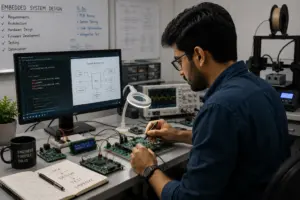
3D printing in embedded systems thus comes into the picture. 3D printing has become popular, as it helps the engineers to create for the embedded devices the structures, functional prototypes, custom-made enclosures, and mechanical components.
The traditional manufacturing method is long forgotten. The modern method of manufacturing is where engineers create a digital CAD model along with the physical prototype in a relatively short time period.
3D printing helps in evaluating the size and functionality of the embedded product before committing to the massive production of the system.
Kickstart your embedded systems career and turn your tech passion into high-demand skills!
3D printing combines PCBs, actuators, sensors, batteries, communication modules, microcontrollers, and displays that help in easy diagnosis of the system’s performance and potential.
The product development will become easier with the advent of 3D printing in embedded systems. The product development in recent times has become more efficient, smooth and faster with the support of embedded systems.
In order to quickly produce the components and prototypes around the embedded electronics, 3D printing plays a key role. Traditional manufacturing methods are often regarded as expensive and time-consuming since the system needs frequent maintenance and modifications.
With the advent of 3D printing, engineers can develop digital designs to print, test, and modify them as much as they need for the testing of the system. Embedded system engineers often make use of control panels, robotic structures, brackets, sensor mounts, and protective enclosures for more efficient modifications.
3D printing can be effectively used for
- Robotic structure development
- Sensor design
- Mounting of actuator
- Development of customised enclosures for PCBs and microcontrollers
- Ergonomics and product dimensions testing
- Prototype creation for IoT devices
- Integration of electronics into structures that are mechanical in function
- Enclosure design testing
- Prototype development time reduction
- Customised component production in relatively small quantities
Why Embedded Systems Need Rapid Hardware Prototyping
Since multiple designs are required for the final model moulding from physical components, hardware prototyping can be time-consuming. The circuit seemingly working fine may require more space for the fitting inside the given enclosure. Precise placement is an essential requirement for the buttons and displays as well.
Rapid prototyping helps the engineers to analyse the problems in their budding stage itself.
Rapid prototyping is possible in embedded systems, and it is necessary for CAD model development and physical component printing. System integration, prototype testing, modification of the design, improved version printing and final product analysis.
Kickstart your embedded systems career and turn your tech passion into high-demand skills!
Master Embedded Systems Programming!
Launch your tech career with our Embedded Systems Course, designed for hands-on learning and industry readiness.
Know MoreHow 3D Printing Supports Embedded System Development
Based on the dimensions, sensors, display and battery of the PCB of a temperature monitoring IoT device, an engineer can develop the enclosure. The developed enclosure can now be printed in 3D and can be easily assembled with the electronics and tested to check the efficiency.
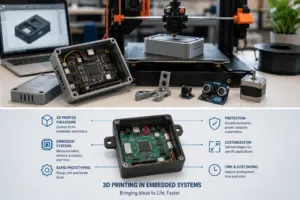
The CAD model can be modified in multiple ways and at any time for further changes in dimensions or sensor position, and immediately a new prototype can be easily prepared and printed.
Component Mounting
Cameras, sensors, batteries, motors and displays will be secured in the 3D-printed holders and brackets.
Integration of Mechanical and Electronic Components
The mechanical and electronic components are well integrated in the embedded systems. The 3D printing helps in the creation of the mechanical parts.
Testing of User Interface
Switches, displays, knobs, and control panel prototypes can be developed and applied before the product finalisation.
Iteration of Design
If the enclosure does not fit in properly, the CAD model can be easily modified, and production of another prototype is possible.
Demonstration of Products
The 3D-printed structure helps the developers to demonstrate the embedded product and its function.
Key Applications Across Industries
The application of the embedded system with 3D printing has several levels of industry-specific applications.
| Industry | Applications |
| Robotics | Sensor mounts Robot frames Grippers |
| IoT | PCB cases Rapid prototyping Device enclosure |
| Automotive | Dashboard prototyping Component testing Housing sensors |
| Healthcare | Wearable devices Medical device prototyping |
| Aerospace | Component testing Structural prototypes |
| Education | STEM learning models Embedded systems| Projects |
| Consumer Electronics | Protective casing Control panels |
| Industrial Automation | Sensor fixtures Custom mounting brackets Machine components |
Robotics is the key application area where engineers can 3D print the ideas and frames and use microcontrollers for system control.
IoT devices
3D printing makes customised designs for IoT products. Sensors, batteries and circuits can be easily designed and tested.
Health care
Wearable health monitoring devices can be designed and developed with the aid of 3D printing models.
Typical Embedded Product Development Workflow with 3D Printing
The workflow of the embedded system looks similar to this:
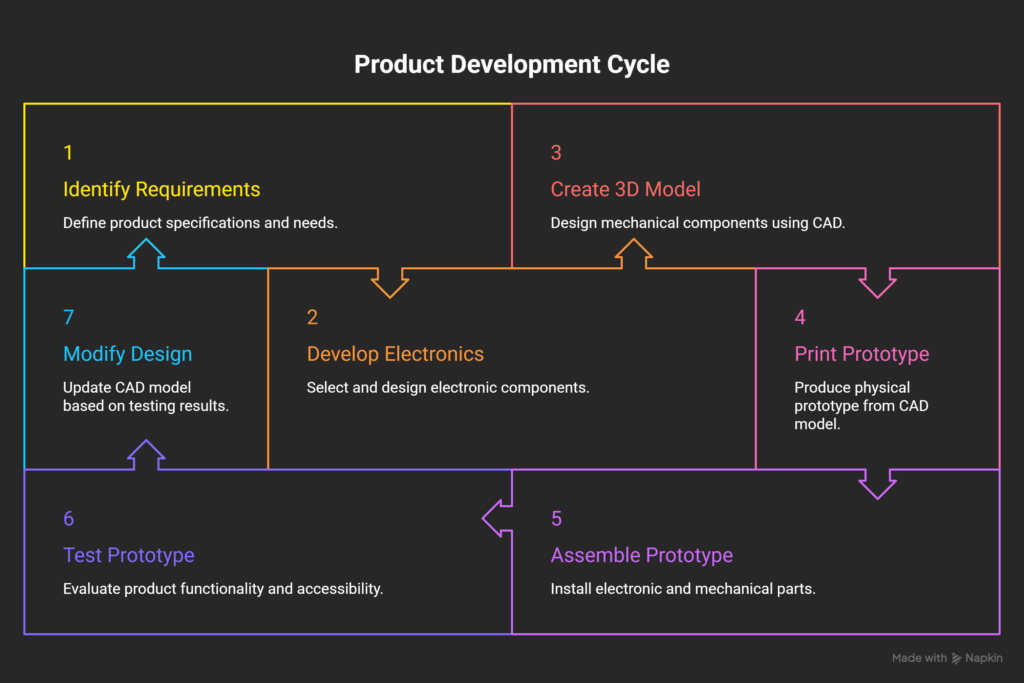
- Firstly, the engineers should identify the functionality, size, sensors, processing requirements, and operating environment of the product.
- Now develop the electronics by selecting the microcontroller, modules and power supply and designing it.
- A 3D model of the mechanical component can be developed with the aid of CAD software.
- CAD design can be easily converted and printed
- Prototype
- Then, the sensors, PCB, batteries, and displays shall be installed on the printed structure.
- Test the physical product for its accessibility and functionality
- The CAD model can now be modified, and another model can be produced
Traditional Prototyping vs 3D Printing
Here is the key difference between traditional prototyping and 3D printing
| Features | Traditional Prototyping | 3D Printing |
| Initial Cost | Higher | Lower |
| Design changes | Expensive | Affordable |
| Production time | Longer | Faster |
| Customisation | Limited | Flexible |
| Complex shapes | Time consuming | Quick production |
| Small-batch production | Less Economical | Well-suited |
| Iteration | Slower | Efficient |
Kickstart your embedded systems career and turn your tech passion into high-demand skills!
Benefits of Combining 3D Printing and Embedded Systems
The combination and integration of 3D printing and embedded systems have their own benefits. The key advantages are as follows. Lower cost of development
- Prototyping is rapid
- Customisation is easy and accessible
- Design Iteration is quick
- Visualisation of the product is much better
- Complex and complicated designs can be supported
- Collaboration with different parts of the system has improved
Master Embedded Systems Programming!
Launch your tech career with our Embedded Systems Course, designed for hands-on learning and industry readiness.
Know MoreChallenges and Limitations
The benefits are also followed by challenges.
The key challenges are as follows:
- Not all 3D printing materials are available all the time
- The strength and durability desired for the final products may not be met
- The low surface quality affects the desired appearance of the product
- Adequate thermal management solutions shall be provided
- An electromagnetic shield is not always provided for the design.
- Manufacturing scale should be considered in each production
Skills Engineers Should Learn
Developing skills is of utmost importance while considering the career growth of the engineers who wish to combine 3D printing with embedded systems. Important skills required include the following:
- CAD modelling
- PCB designing
- Embedded C++ programming
- Microcontrollers
- Sensors and actuators
- 3D printing fundamentals
- Mechanical design
- Rapid prototyping
- Product testing
Future of 3D Printing in Embedded Systems
The growth of robotics, IoT, smart devices and other technologies reflects the future of 3D printing in embedded systems. The electronic functionality can be directly integrated with the printed structures.
This gives more powerful prospects for the integration of embedded systems and 3D printing. More sophisticated prototypes can be developed with the aid of 3D printing.
AI-assisted designing is also gradually gaining traction. AI tools are widely aiding in optimising the structure for better performance.
During product development, more customised and rapid technologies are essential for future development.
Conclusion
The way and method by which embedded systems are developed is now long forgotten. 3D printing is bringing new light and technology to the design of embedded systems.
The customised enclosure creation, development of mounts, mechanical structures and product prototypes make the process of manufacturing physical devices more efficient.
Industries such as robotics, healthcare, industrial automation, etc., consider the integration of 3D printing with embedded printing a valuable contribution for future growth and development.
For aspiring embedded systems engineers, learning both the nuances of 3D printing along with microcontrollers, PCB designing, programming, and CAD software can enrich their career prospects even further. If your aim is a better career with smarter skills, learning the core elements and principles of 3D printing along with embedded systems can aid you in the long run.
Master Embedded Systems Programming!
Launch your tech career with our Embedded Systems Course, designed for hands-on learning and industry readiness.
Know MoreFrequently Asked Questions
What is 3D printing in embedded systems?
3D printing helps the engineers to create for the embedded devices the structures, functional prototypes, custom-made enclosures, and mechanical components.
What is component mounting?
Component mounting is the process by which cameras, sensors, batteries, motors and displays will be secured in the 3D-printed holders and brackets.
Which is the key application area of 3D printing?
Robotics is the key application area where engineers can 3D print the ideas and frames and use microcontrollers for system control.
Which software is useful for the development of 3D model mechancial component?
A 3D model of the mechanical component can be developed with the aid of CAD software.
What is the application of 3D printing in IoT devices?
3D printing makes customised designs for IoT products. Sensors, batteries and circuits can be easily designed and tested.
What is the purpose of the rapid prototyping in embedded systems?
Rapid prototyping helps the engineers to analyse the problems in the integration of embedded system. Rapid prototyping is necessary for CAD model development and physical component printing
What is the core function of 3D printing in embedded system?
The product development will become easier with the advent of 3D printing in embedded systems. Product development in recent times has become more efficient, smoother, and faster with the support of embedded systems.