
Table of Contents
Master Embedded Systems Programming!
Launch your tech career with our Embedded Systems Course, designed for hands-on learning and industry readiness.
Know MoreKey Challenges in Embedded Software Testing
Embedded software testing can be technically demanding. The software depends closely on physical hardware. Testing must therefore consider multiple system conditions.
1. Hardware Dependency
Embedded software depends on specific hardware components.
- Hardware faults can affect test results.
- Different boards may behave differently.
- Component availability can delay testing.
- Hardware changes may require retesting.
2. Limited Resources
Embedded devices often have limited resources.
Testers must consider:
- Memory limitations
- Processing capacity
- Storage limitations
- Power consumption
- Communication bandwidth
Software must perform efficiently within these limits.
3. Real-Time Constraints
Many embedded systems require immediate responses. Testing must verify strict timing requirements.
Even small delays can cause failures. This makes timing validation particularly important.
4. Difficult Debugging
Embedded failures can have multiple causes. Problems may originate from hardware or software.
For example, incorrect sensor readings may involve:
- Sensor faults
- Driver errors
- Communication problems
- Firmware defects
- Hardware connections
Finding the exact cause can require extensive debugging.
5. Multiple Hardware Configurations
Products may use different hardware versions. Each configuration can require additional testing.
Testing teams must verify software compatibility carefully.
6. Safety Requirements
Safety-critical systems require extensive validation. Automotive and medical products are examples.
Testing must confirm safe behavior during failures. This can significantly increase testing complexity.
Tools and Techniques Used in Embedded Software Testing
Embedded testing uses specialized tools and techniques. The exact tools depend on the project requirements.
Common Testing Tools
- Debuggers: Examine program execution.
- Simulators: Recreate system behavior.
- Emulators: Imitate target hardware.
- Logic analyzers: Examine digital signals.
- Oscilloscopes: Analyze electrical signals.
- Static analysis tools: Detect code issues.
- Test automation tools: Run repeated test cases.
- Hardware-in-the-loop systems: Test real hardware.
Common Testing Techniques
Testing teams combine several approaches.
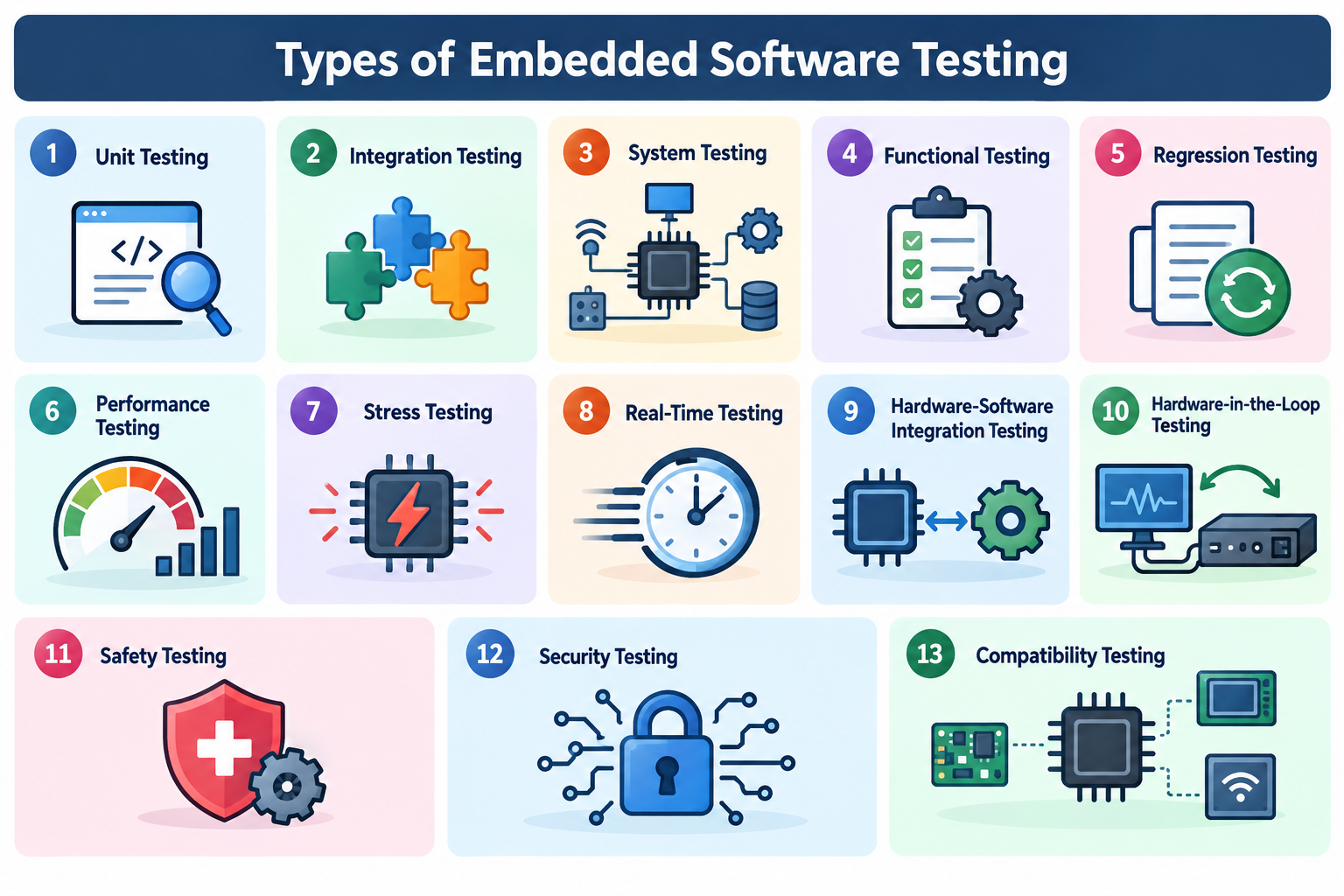
- Unit testing checks individual functions.
- Integration testing checks connected modules.
- System testing evaluates complete devices.
- Regression testing checks software changes.
- Stress testing examines extreme conditions.
- Performance testing measures system behavior.
Automation can reduce repetitive testing work. It can also improve consistency across test cycles.
Why is Embedded Software Testing Important?
Embedded software controls important device functions. Software failures can affect complete products.
Testing provides several important benefits.
Improved Reliability
Testing identifies software defects before deployment. This can reduce unexpected device failures.
Better Performance
Performance testing identifies resource problems. Engineers can optimize software accordingly.
Improved Safety
Safety testing verifies critical system responses. This is especially important for medical and automotive devices.
Better Hardware Interaction
Testing verifies communication with physical components. It ensures sensors and actuators respond correctly.
Earlier Defect Detection
Finding problems early reduces correction effort. Developers can address defects before final deployment.
Reduced Development Risks
Thorough testing reduces product-related risks. It also supports more predictable development.
Advantages and Limitations of Embedded Software Testing
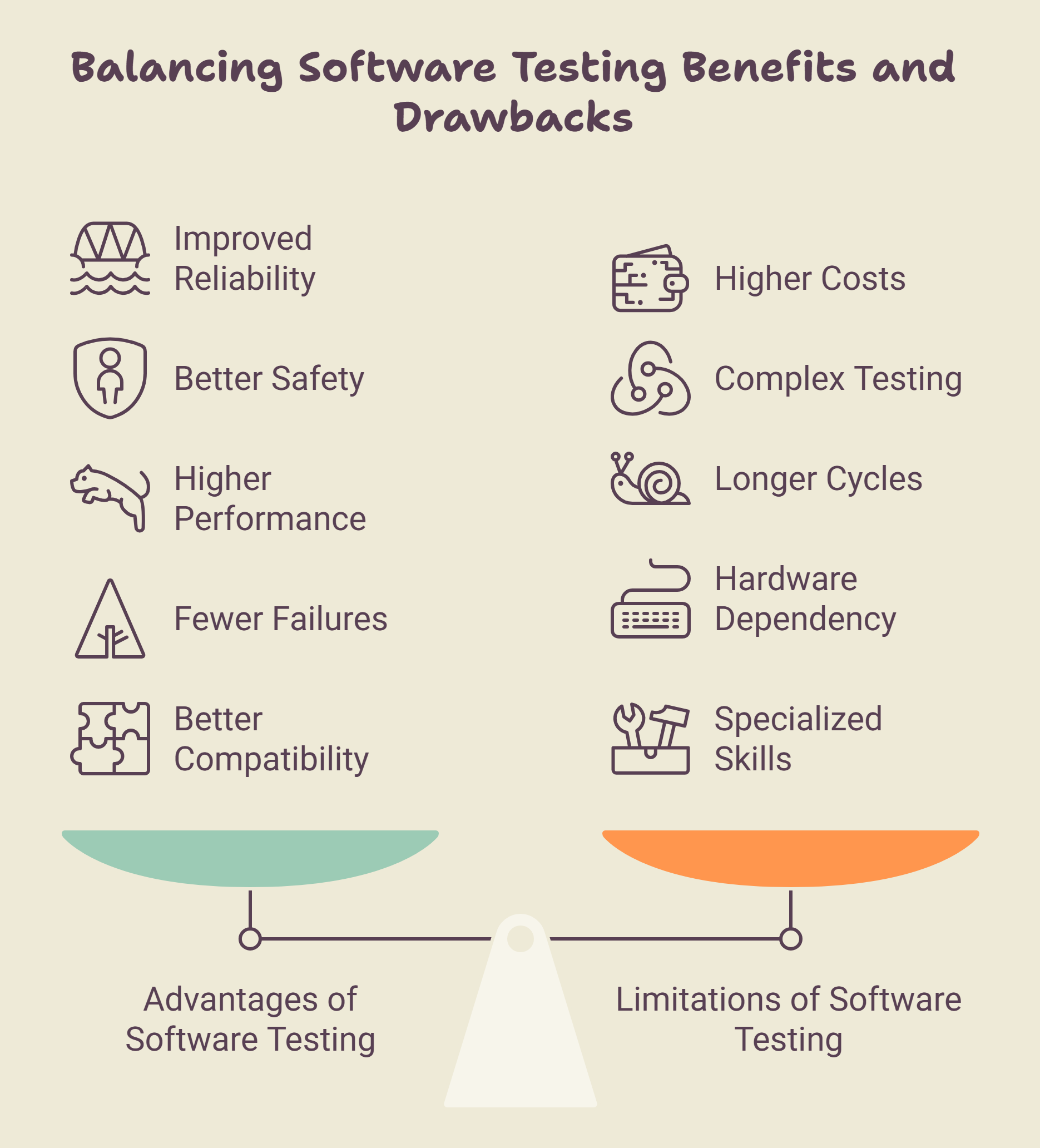
Embedded testing provides several important advantages. However, it also requires significant resources.
Advantages
- Improved reliability: Finds defects before deployment.
- Better safety: Verifies critical system behavior.
- Higher performance: Identifies resource bottlenecks.
- Fewer failures: Reduces potential field problems.
- Better compatibility: Checks hardware-software interaction.
- Early detection: Finds defects during development.
Limitations
- Higher costs: Specialized equipment can be expensive.
- Complex testing: Hardware adds testing requirements.
- Longer cycles: Multiple test stages take time.
- Hardware dependency: Physical devices may be necessary.
- Specialized skills: Testing requires technical expertise.
Proper planning can reduce these limitations. Automated testing can also improve testing efficiency.
What Skills are Needed for Embedded Software Testing?
Embedded testers need both software and hardware knowledge. Strong analytical skills are equally important.
Technical Skills
- C and C++ programming
- Embedded systems fundamentals
- Firmware knowledge
- Debugging techniques
- Test case development
- Communication protocols
- Operating systems
- Testing automation
- Hardware fundamentals
Practical Skills
Testers should understand system behavior. They should also analyze failures systematically.
Useful abilities include:
- Problem-solving
- Logical thinking
- Documentation
- Attention to detail
- Technical communication
- Root-cause analysis
Knowledge of electronics provides an additional advantage. It helps testers understand hardware-related failures.
Kickstart your embedded systems career and turn your tech passion into high-demand skills!
Embedded Software Testing in Real-World Applications
Embedded testing supports many real-world products. Testing requirements depend on each application’s purpose.
Automotive Systems
Automotive software requires extensive testing. Engineers test braking, engine, safety, and driver-assistance systems.
Medical Devices
Medical devices require reliable software operation. Testing checks monitoring, control, and safety functions.
Consumer Electronics
Smart devices require functional and performance testing. Examples include smartphones, televisions, and appliances.
Industrial Automation
Industrial controllers require accurate and reliable operation. Testing verifies machine control and communication.
Aerospace Systems
Aerospace software requires strict validation. Testing examines navigation, monitoring, and control functions.
IoT Devices
Connected devices require functional and security testing. Engineers also evaluate network communication and power usage.
Testing requirements become stricter for critical applications. Reliability remains important across every embedded industry.
Conclusion
Embedded software testing validates software within physical systems. It checks functionality, reliability, performance, safety, and hardware interaction. Different testing methods address different system requirements.
As embedded technology continues expanding, testing remains essential. Effective testing reduces failures and supports safer, reliable products. It also ensures embedded devices perform correctly.
Master Embedded Systems Programming!
Launch your tech career with our Embedded Systems Course, designed for hands-on learning and industry readiness.
Know MoreFrequently Asked Questions
What is embedded software testing?
Embedded software testing checks software inside embedded devices. It verifies functionality, performance, reliability, and hardware interaction.
Why is embedded software testing important?
It helps identify software defects before deployment. Testing also improves device safety, reliability, and performance.
What are the main types of embedded software testing?
Common types include unit, integration, and system testing. Performance, regression, security, and hardware testing are also used.
How is embedded testing different from software testing?
Embedded testing involves physical hardware and resource limits. It also considers timing, memory, power, and hardware interactions.
What is Hardware-in-the-Loop testing?
Hardware-in-the-Loop testing connects software with real hardware. It evaluates system behavior under controlled conditions.
Which tools are used for embedded software testing?
Testers use debuggers, simulators, and emulators frequently. Oscilloscopes and logic analyzers also support testing.
What challenges occur during embedded software testing?
Hardware dependency can make testing more complex. Limited resources and real-time requirements add further challenges.
Is embedded software testing used in automotive systems?
Yes, automotive systems rely heavily on embedded testing. It helps validate safety-critical vehicle functions.
What skills are needed for embedded software testing?
Testers need embedded programming and debugging skills. Knowledge of hardware, protocols, and automation also helps.
Can embedded software testing be automated?
Yes, many embedded tests can be automated. Automation improves test coverage, consistency, and regression testing.