Table of Contents
Building Information Modeling has changed construction workflows. BIM supports design, coordination, construction, and management. However, BIM projects require specialized technical skills.
Companies may not have enough internal professionals. Hiring a complete BIM team can be expensive. Maintaining software and hardware also increases costs.
BIM outsourcing offers an alternative approach. Companies can work with external BIM specialists. The external team handles defined project requirements. Internal teams can then focus on core responsibilities.
Key Takeaways:
- BIM outsourcing means hiring external BIM specialists.
- Companies can outsource modeling, coordination, and documentation.
- Outsourcing can reduce costs and increase flexibility.
- It provides access to specialized BIM expertise.
- Clear requirements help ensure successful project delivery.
- Choosing a reliable partner is essential for quality.
What is BIM Outsourcing?
BIM outsourcing means hiring external BIM specialists. These specialists handle selected BIM tasks remotely. Companies outsource work to reduce costs. They also access specialized BIM skills.
Key Points
- Architects can outsource BIM modeling.
- Contractors can outsource coordination and documentation.
- Engineers can outsource MEP and structural modeling.
- Scan to BIM can also be outsourced.
- Companies can outsource entire BIM projects.
Get Career-Oriented BIM Certification Course with Expert Mentors! Get a free demo here!
What does BIM outsourcing mean?
BIM outsourcing means assigning BIM work externally. An outside team completes the agreed project tasks.
What BIM services can be outsourced?
Companies can outsource modeling, coordination, documentation, and visualization. They can also outsource Scan to BIM services.
Why do companies outsource BIM services?
Companies outsource to access specialized expertise. Outsourcing can also improve flexibility and cost control.
Is BIM outsourcing cost-effective?
It can be cost-effective for many projects. Costs depend on scope, complexity, and service requirements.
How do companies choose a BIM outsourcing partner?
Companies should assess expertise, quality, technology, and experience. Communication and data security also matter.

Why is BIM Outsourcing Becoming Popular?
Several factors encourage companies to outsource BIM work.
- Increasing BIM adoption
- Growing project complexity
- Shorter project deadlines
- Limited internal BIM expertise
- Rising technology costs
- Demand for specialized services
- Need for flexible project teams
Outsourcing can support both small projects. It can also support large construction programs.
Master BIM and Elevate Your Career – Enroll Today!
Stay ahead in the construction and design industry with our comprehensive BIM Course! Learn Building Information Modeling (BIM) from experts, gain hands-on experience with top software, and boost your career prospects. Join now and become a certified BIM professional!
Know MoreWhat is BIM Outsourcing?
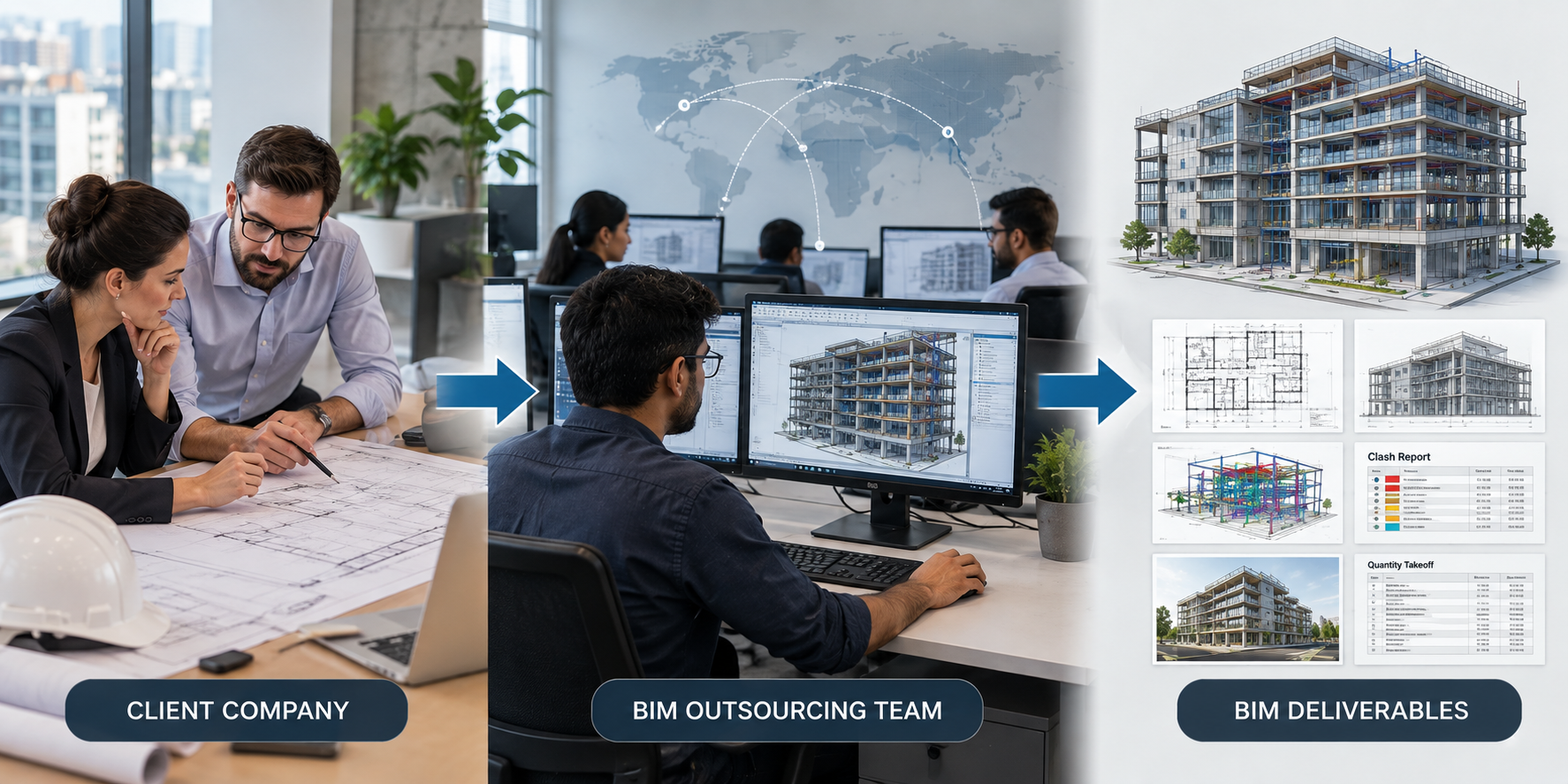
BIM outsourcing involves external BIM service providers. These providers complete specific BIM-related project tasks. The client provides project requirements and information. The provider then develops the required BIM deliverables.
The arrangement can vary between projects. Some companies outsource individual services. Others outsource complete BIM workflows.
How does BIM Outsourcing Work?
A typical arrangement follows several stages:
- The client defines project requirements.
- The outsourcing partner reviews the scope.
- Both parties agree on deliverables.
- Project information gets shared securely.
- The BIM team begins development.
- Internal reviews identify required changes.
- The provider completes revisions.
- Final BIM deliverables are submitted.
Who Typically Uses BIM Outsourcing?
Different construction organizations use outsourcing.
These include:
- Architectural firms
- Engineering consultancies
- Construction companies
- General contractors
- MEP contractors
- Real estate developers
- Facility management companies
- Infrastructure companies
Small firms may lack dedicated BIM departments. Larger companies may outsource during busy periods.
What can Companies Outsource?
Companies can outsource individual BIM activities. They can also outsource complete project requirements.
For example:
- Architectural BIM modeling
- Structural BIM modeling
- MEP modeling
- Clash detection
- BIM coordination
- Scan to BIM
- Construction documentation
- As-built modeling
This flexibility makes outsourcing adaptable. Companies can select services based on needs.
What BIM Services can be Outsourced?
BIM outsourcing covers many technical services. The selected services depend on project requirements.
1. BIM Modeling
BIM modeling converts design information into models. Models can represent detailed building components.
Services may include:
- Architectural modeling
- Structural modeling
- MEP modeling
- Interior modeling
- Landscape modeling
Modeling requirements depend on project scope. Level of Development also affects the work.
2. Architectural BIM Modeling
Architectural models represent building design elements.
These can include:
- Walls
- Floors
- Doors
- Windows
- Roofs
- Stairs
- Furniture
- Interior elements
Architectural BIM supports design coordination. It can also support construction documentation.
3. Structural BIM Modeling
Structural modeling represents building structures digitally.
Common elements include:
- Columns
- Beams
- Slabs
- Foundations
- Structural walls
- Steel components
Structural models support engineering coordination. They can also improve construction planning.
4. MEP BIM Modeling
MEP modeling covers building service systems.
These include:
- Mechanical systems
- Electrical systems
- Plumbing systems
- HVAC systems
- Fire protection systems
MEP models help identify spatial conflicts. They also support coordinated construction.
5. Scan to BIM
Scan to BIM converts scan data into models. Laser scanners capture existing building conditions. The resulting point cloud guides modeling. This service suits renovation and refurbishment projects.
It can also support accurate as-built documentation.
6. BIM Coordination
BIM coordination combines multiple discipline models. Teams review models for potential conflicts.
Coordination can identify:
- Pipe clashes
- Duct conflicts
- Structural intersections
- Equipment clearance issues
- Spatial coordination problems
Early detection can reduce construction rework.
7. Clash Detection
Clash detection identifies conflicting building elements. Specialized software compares different models.
Typical clashes involve MEP and structural elements. Detecting them early can improve project efficiency.
8. Construction Documentation
BIM teams can produce construction-related documents. These documents support project execution.
Services may include:
- Plans
- Elevations
- Sections
- Details
- Schedules
- Shop drawings
Requirements depend on project standards.
9. Quantity Takeoffs
BIM models can support quantity extraction. Teams can obtain information about modeled elements.
Quantity takeoffs may support:
- Material planning
- Cost estimation
- Procurement
- Budget preparation
Accuracy depends on model quality.
10. As-Built Modeling
As-built models represent completed construction. They document actual building conditions.
These models can support future maintenance. They can also assist renovation projects.
11. BIM Family Creation
BIM families represent reusable building components. Manufacturers and project teams often need custom families.
Examples include:
- Doors
- Windows
- Furniture
- Equipment
- MEP components
Outsourcing can provide specialized family development.
Why do Companies Outsource BIM Services?
BIM outsourcing offers several business advantages. Companies can choose outsourcing for different reasons.
1. Access to Specialized Expertise
BIM requires trained professionals and software knowledge. External providers often maintain specialized teams. Companies can access expertise without permanent hiring. This can support technically demanding projects.
2. Better Cost Control
Maintaining internal BIM teams requires regular investment.
Costs can include:
- Salaries
- Recruitment
- Software licenses
- Hardware
- Training
- Infrastructure
Outsourcing converts some costs into project expenses.
3. Faster Project Delivery
External teams can increase available project capacity. This can help companies meet demanding deadlines.
Outsourcing can be especially useful during workload peaks.
4. Flexible Workforce
Project workloads can change quickly. Permanent teams may become underutilized afterward. Outsourcing provides greater workforce flexibility. Companies can scale support according to project needs.
5. Access to Advanced Technology
BIM providers often use specialized software. They may also maintain modern technical infrastructure. Companies can benefit from these resources. They may avoid purchasing additional systems themselves.
6. Reduced Recruitment Pressure
Building an internal BIM team takes time. Finding experienced professionals can also be challenging. Outsourcing provides access to established teams. This can reduce recruitment and onboarding requirements.
7. Support for Large Projects
Large projects require substantial BIM resources. Internal teams may become overloaded. External specialists can provide additional project capacity. They can support specific disciplines or entire workflows.
Master BIM and Elevate Your Career – Enroll Today!
Stay ahead in the construction and design industry with our comprehensive BIM Course! Learn Building Information Modeling (BIM) from experts, gain hands-on experience with top software, and boost your career prospects. Join now and become a certified BIM professional!
Know MoreBIM Outsourcing vs In-House BIM: What is the Difference?
Both approaches can support successful BIM delivery. However, they differ in cost, control, and flexibility.
| Factor | BIM Outsourcing | In-House BIM |
|---|---|---|
| Team | External specialists | Internal employees |
| Cost | Project-based | Ongoing operational |
| Scalability | Highly flexible | Limited by team size |
| Expertise | Access to specialists | Depends on internal skills |
| Software | Provider infrastructure | Company investment |
| Control | Shared | Direct |
| Hiring | Minimal | Required |
| Workload | Easy to scale | Harder during peaks |
When is Outsourcing Useful?
Outsourcing can suit companies with limited BIM resources. It can also help during high-demand periods. It may be useful when projects require specialized skills. Companies can also outsource specific technical tasks.
When is In-House BIM Better?
In-house teams can provide greater direct control. They may also understand company standards better. This approach can suit companies with continuous BIM workloads. It can also support long-term BIM capability development.
Can Companies Combine Both Approaches?
Yes, hybrid BIM workflows are possible. Companies can retain core BIM functions internally. External teams can handle additional workloads. They can also provide specialized technical support.
This approach balances control and flexibility. It can work well for growing organizations.
How does the BIM Outsourcing Process Work?
BIM outsourcing follows a structured project workflow. Clear communication is important throughout the process.
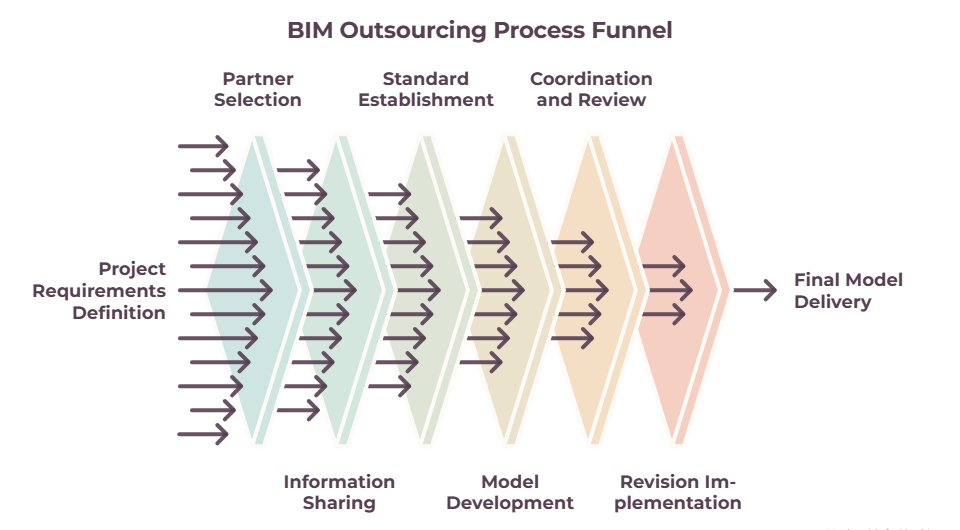
Step 1: Define Project Requirements
The client first identifies project requirements.
These may include:
- Project type
- Required BIM services
- Model requirements
- Level of Development
- Delivery format
- Project deadlines
- Required software
- Quality standards
Clear requirements prevent confusion later.
Step 2: Select an Outsourcing Partner
Companies then evaluate potential BIM providers.
Important factors include:
- BIM experience
- Technical expertise
- Industry experience
- Previous projects
- Software capabilities
- Quality processes
- Communication practices
- Data security
Companies should compare providers carefully.
Step 3: Share Project Information
The client provides required project information.
This may include:
- Architectural drawings
- Structural drawings
- MEP drawings
- Point clouds
- Specifications
- Existing BIM models
- Project standards
Secure file-sharing systems should be used.
Step 4: Establish BIM Standards
Both teams agree on project standards. These standards guide model development.
They can cover:
- Naming conventions
- File structures
- Model coordinates
- LOD requirements
- Modeling standards
- Revision procedures
- Quality requirements
Step 5: Develop the BIM Model
The outsourcing team begins modeling. Professionals follow the agreed project standards. Models are developed according to requirements. Different disciplines may work simultaneously.
Step 6: Coordinate and Review
The team checks models for errors. Clash detection may also be performed.
Review processes can identify:
- Modeling errors
- Missing elements
- Coordination issues
- Incorrect dimensions
- File inconsistencies
Step 7: Make Revisions
The outsourcing team addresses review comments. Revisions continue until requirements are satisfied.
Step 8: Deliver the Final Model
The completed BIM files are delivered. Additional drawings or reports may accompany them. The client then reviews final deliverables. The project can proceed to its next stage.
Advantages of BIM Outsourcing
BIM outsourcing provides several practical advantages. These benefits can vary between companies.
1. Lower Operational Costs
Companies can reduce permanent staffing costs. They can also avoid some infrastructure expenses.
2. Access to Specialized Expertise
External teams often have trained BIM professionals. They may offer specialized technical capabilities.
3. Faster Project Delivery
Additional resources can increase project capacity. This can help meet demanding deadlines.
4. Easy Workforce Scaling
Companies can increase support during busy periods. They can reduce outsourced work afterward.
5. Reduced Hiring Burden
Companies avoid recruiting every required specialist. External providers already have established teams.
6. Access to BIM Technology
Outsourcing partners often maintain advanced software. They may also use specialized hardware.
7. Greater Project Flexibility
Companies can outsource selected services. They do not need to outsource everything.
Challenges and Risks of BIM Outsourcing
BIM outsourcing also involves potential challenges. Proper planning can reduce many of these risks.
1. Communication Gaps
Different teams may misunderstand project requirements. Clear documentation can reduce communication problems.
2. Quality Inconsistencies
External work may not always meet expectations. Quality control should therefore remain consistent.
3. Data Security
BIM projects contain valuable project information. Secure data-sharing practices are essential.
Companies should consider:
- Access controls
- Secure file transfers
- Data protection policies
- User permissions
- Backup procedures
4. Coordination Issues
Multiple teams can create coordination challenges. Clear responsibilities can improve collaboration.
5. Time-Zone Differences
International providers may work different hours. This can slow urgent communication.
6. External Provider Dependence
Companies may become dependent on external teams. Backup plans can reduce this risk.
7. Intellectual Property Concerns
Project models can contain proprietary information. Ownership terms should be clearly established.
How Much does BIM Outsourcing Cost?
BIM outsourcing costs vary between projects. There is no single standard price.
Several factors influence overall costs.
Major Cost Factors
- Project size
- Project complexity
- BIM service type
- Required LOD
- Number of disciplines
- Project duration
- Required software
- Geographic location
- Revision requirements
- Delivery deadlines
Get Career-Oriented BIM Certification Course with Expert Mentors! Get a free demo here!
Common Pricing Approaches
Providers may use different pricing models.
These can include:
- Hourly pricing
- Fixed project pricing
- Per-square-foot pricing
- Milestone-based pricing
- Dedicated team pricing
Simple modeling usually costs less. Complex coordination requires more resources. Companies should compare complete project quotes. The cheapest option may not provide quality.
Quality, expertise, communication, and security matter. These factors should influence the final decision.
Conclusion
Master BIM and Elevate Your Career – Enroll Today!
Stay ahead in the construction and design industry with our comprehensive BIM Course! Learn Building Information Modeling (BIM) from experts, gain hands-on experience with top software, and boost your career prospects. Join now and become a certified BIM professional!
Know MoreFrequently Asked Questions
What does BIM outsourcing mean?
BIM outsourcing means hiring an external team for BIM-related work. The external team completes agreed tasks based on project requirements and standards.
What BIM services can be outsourced?
Companies can outsource BIM modeling, coordination, clash detection, and documentation. Other services include Scan to BIM, MEP modeling, quantity takeoffs, and as-built modeling.
Why do companies outsource BIM services?
Companies often outsource to access specialized BIM professionals. Outsourcing can also reduce operational costs and provide flexible project support.
Is BIM outsourcing cost-effective?
BIM outsourcing can be cost-effective for many companies. The final cost depends on project size, complexity, LOD requirements, services, and delivery timelines.
How do companies choose a BIM outsourcing partner?
Companies should evaluate technical expertise, project experience, software capabilities, and quality processes. Communication, data security, pricing, and previous work should also be considered.
Is BIM outsourcing suitable for small companies?
Yes, small companies can outsource BIM services when maintaining an internal team is difficult. It allows them to access specialized skills without building a large permanent BIM department.
Can BIM outsourcing include MEP services?
Yes, MEP modeling is commonly outsourced by construction and engineering companies. External teams can handle mechanical, electrical, plumbing, HVAC, and fire protection modeling.
How is quality controlled in outsourced BIM projects?
Quality is usually controlled through regular model reviews and coordination checks. Companies can also establish BIM standards, review procedures, and defined deliverables before work begins.
How much does BIM outsourcing cost?
BIM outsourcing costs vary based on project requirements. Factors include project size, modeling complexity, LOD, number of disciplines, revisions, and pricing method.
What are the main risks of BIM outsourcing?
Common risks include communication gaps, quality issues, data security concerns, and coordination problems. Clear contracts, secure data practices, defined responsibilities, and regular reviews can reduce these risks.