Table of Contents
A DevOps interview can cover many tools and daily work situations. You can get questions from different parts of DevOps. Git, Jenkins, Docker, Kubernetes, Terraform, cloud, and Linux are worth going through before the interview.
There may also be questions based on a small problem. For example, you may be asked what you would do when a container stops, a server has a problem, or a deployment fails.
The questions can change based on the job and your experience. A fresher may get basic questions. An experienced candidate may need to explain project work or solve a real problem.
This blog covers some important questions that you can study before a Capgemini DevOps interview. The answers are kept simple so you can understand the idea and explain it in your own words.
Key Takeaways
- Know the main DevOps tools.
- Go through Git, Jenkins, Docker, and Kubernetes.
- Revise AWS, Azure, and Terraform.
- Go over common Linux commands.
- Be ready for simple troubleshooting questions.
- Know the projects on your resume.
Capgemini DevOps Interview Process
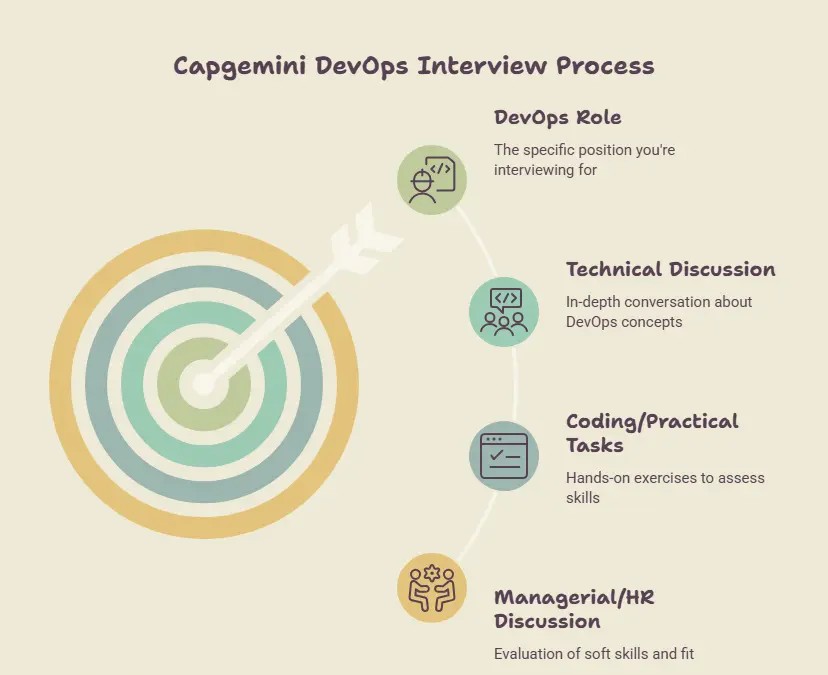
The interview process can be different for each DevOps role. Recent candidate experiences from India show technical rounds followed by a managerial or HR discussion in some cases. Some candidates have also reported coding or practical tasks during the technical round.
The technical discussion can move from basic concepts to tools you have used in your work.
You may be asked about:
- Git and version control
- Jenkins and CI/CD
- Docker
- Kubernetes
- AWS or Azure
- Terraform
- Linux and shell scripting
- Project work and troubleshooting
If you have work experience, your projects can come up during the interview. You may be asked about a problem you had while working on a project.
Just explain what went wrong, what you looked at, and what you did next. So, do not study only definitions. Know how the tools are used in actual work.
DevOps Interview Questions for Freshers
1. What is a DevOps culture?
Answer:
DevOps is not only about tools. It also involves the way development and operations teams work together.
Developers work on the code. The operations team takes care of running the application.
DevOps connects both sides. Tools and automation are used to make the work easier.
For example, code can be tested and sent for deployment without doing each step manually.
2. What is a build in DevOps?
Answer:
A build is the process of turning source code into something that can be tested or used.
For example, a Java project may be compiled and packaged into a JAR or WAR file.
A build can run automatically through a CI/CD tool such as Jenkins.
3. What is an artifact in a CI/CD pipeline?
Answer:
An artifact is a file created during the build process.
It can be a JAR file, Docker image, ZIP file, or another package.
The pipeline can store this file and use it during the deployment step.
4. Why is automation used in DevOps?
Answer:
Automation reduces repeated manual work.
For example, instead of manually running the same build and test commands every time, Jenkins can run them automatically.
This also makes the process easier to repeat.
Learn & Master DevOps with Entri. Enrol now!
DevOps Interview Questions for Experienced Professionals
Git & GitHub Questions
1. What is the difference between git pull and git fetch?
Answer:
git fetch downloads the latest changes from the remote repository. It does not change your current branch.
git pull downloads the changes and also updates your current branch.
I would use fetch when I want to check remote changes before bringing them into my branch.
2. What is a Git fork?
Answer:
A fork is a copy of a repository under another account or organisation.
It is often used when a developer wants to work on a project without directly changing the original repository.
The developer can make changes in the fork and later send them for review.
3. What is a Git tag?
Answer:
A tag gives a name to a specific commit.
Teams often use tags for important versions such as v1.0 or v2.0.
It makes it easier to identify the code used for a particular release.
4. What is a protected branch?
Answer:
A protected branch has rules that control who can make changes to it.
For example, the main branch may require a review before code is merged.
This reduces the chance of unwanted changes reaching important branches.
CI/CD & Jenkins Questions
1. How can you pass information from one Jenkins stage to another?
Answer:
A pipeline can save the required value and use it in a later stage.
For example, a build stage may create a version number. The deployment stage can then use that version.
Jenkins also allows environment variables and other pipeline features for sharing values.
2. What is a Jenkins agent?
Answer:
A Jenkins agent is a machine that runs the work given by Jenkins.
The Jenkins controller manages the jobs. The agent can run tasks such as building code, running tests, or creating Docker images.
This also allows work to run on different machines.
3. How do you automate tests in Jenkins?
Answer:
First, the test command is added to the pipeline.
When the pipeline runs, Jenkins starts the tests after the build step.
If the tests fail, the pipeline can stop before deployment.
4. How do you connect Jenkins with a Git repository?
Answer:
The Git repository details are added to the Jenkins job or pipeline.
Jenkins can then download the code and run the required steps.
A webhook can also be used so that Jenkins starts a job when new code is pushed.
Docker Interview Questions
1. What is a Docker volume?
Answer:
A Docker volume is used to keep data outside the container’s writable layer.
This is useful when data should remain available even after a container is removed.
For example, a database container can use a volume to keep its data.
2. What is a Docker network?
Answer:
A Docker network allows containers to communicate with each other.
For example, a web application container may need to connect to a database container.
A suitable Docker network allows these containers to communicate.
3. What is the difference between COPY and ADD in a Dockerfile?
Answer:
Both commands can put files into a Docker image.
COPY is mainly used to copy files and folders from the build location.
ADD has some extra features, such as handling local archives.
For simple file copying, COPY is commonly used.
4. Why should Docker images be kept small?
Answer:
A smaller image takes less time to build and download.
It also uses less storage.
Removing unnecessary files and packages can help keep the image smaller.
Kubernetes Interview Questions
1. What is a Kubernetes Deployment?
Answer:
A Deployment manages the running copies of an application in Kubernetes.
It can create Pods and maintain the required number of copies.
It also supports updates and rollbacks.
2. What is a StatefulSet?
Answer:
A StatefulSet is used for applications that need stable names or storage.
Databases are one common example.
Unlike a simple stateless application, each Pod managed by a StatefulSet can keep its own identity.
3. What is a Persistent Volume?
Answer:
A Persistent Volume, or PV, provides storage to applications running in Kubernetes.
The storage can remain available even when a Pod is removed.
This is useful for applications that need to keep data.
4. What is a Persistent Volume Claim?
Answer:
A Persistent Volume Claim, or PVC, is a request for storage.
An application can use a PVC instead of directly dealing with the storage details.
Kubernetes can then connect the PVC to suitable storage.
AWS/Azure & Cloud Questions
1. What is IAM in AWS?
Answer:
IAM stands for Identity and Access Management.
It controls who can access AWS resources and what they are allowed to do.
For example, one user may be allowed to view an S3 bucket while another user may also be allowed to upload files.
2. What is a security group in AWS?
Answer:
A security group controls network traffic for resources such as EC2 instances.
It contains rules for allowed incoming and outgoing traffic.
For example, an SSH rule may allow access through port 22.
3. What is an availability zone?
Answer:
An Availability Zone is an isolated location inside an AWS Region.
A region can have multiple Availability Zones.
Running important services across more than one zone can reduce the effect of a problem in one zone.
4. What is an AWS load balancer?
Answer:
A load balancer receives incoming requests and sends them to available servers.
This can prevent one server from handling all the traffic.
It is also useful when an application has more than one running server.
Terraform & Infrastructure as Code Questions
1. What is Terraform state locking?
Answer:
Terraform uses a state file to track the resources it manages.
State locking prevents two people from changing the same state at the same time.
This is important when several team members work on the same infrastructure.
2. What is the difference between count and for_each in Terraform?
Answer:
Both can create more than one resource.
count is useful when resources can be created using a number.
for_each is useful when each resource needs a different value from a set or map.
3. What is a Terraform module?
Answer:
A module is a group of Terraform files kept together for a specific purpose.
It can contain reusable infrastructure code.
For example, a team can create one module for an application server and use it in different environments.
4. What happens if the Terraform state file is lost?
Answer:
Terraform may no longer know the current state of the resources it manages.
The first step is to check whether a backup or remote state copy is available.
The state should not be recreated blindly because it can cause problems with existing resources.
Linux & Shell Scripting Questions
1. How do you check CPU usage in Linux?
Answer:
Commands such as top can show running processes and CPU usage.
ps can also be used to check process details.
If a server becomes slow, I would check CPU usage along with memory and running processes.
2. How do you check disk usage in Linux?
Answer:
The df -h command shows disk usage in a readable format.
To find large folders or files, commands such as du can be useful.
This is helpful when a server is running out of disk space.
3. What does chmod do?
Answer:
chmod changes file or folder permissions in Linux.
It can control whether a user can read, write, or run a file.
For example, a script may need execute permission before it can be run.
4. What is a cron job?
Answer:
A cron job runs a command or script at a set time.
It can be used for repeated tasks.
For example, a script can run every night to clean old log files.
DevOps Scenario-Based Questions
1. A Kubernetes Pod keeps restarting. What would you check?
Answer:
I would first check the Pod status and logs.
Commands such as kubectl describe pod and kubectl logs can show useful details.
I would then check the application error, configuration, resource limits, and health checks.
2. A Terraform plan shows changes that you did not expect. What would you do?
Answer:
I would not apply the plan immediately.
First, I would check the Terraform code and state file.
I would also look at the plan carefully to find which resource is changing and why.
3. An EC2 server cannot be reached through SSH. How would you check it?
Answer:
I would check the instance status first.
Then I would check the security group, network settings, route table, and whether port 22 is allowed.
I would also check whether the correct key and user are being used.
4. A Docker container stops soon after it starts. What would you check?
Answer:
I would check the container logs first.
The application may have stopped because of a configuration error or missing environment variable.
I would also check the container command and its exit status.
5. A Kubernetes application is running but users cannot access it. What would you check?
Answer:
I would check the Service and its endpoints.
Then I would check the Ingress or load balancer if one is being used.
I would also check ports, DNS, network rules, and whether the Service is pointing to the correct Pods.
Monitoring, Security & DevSecOps Questions
1. What is Prometheus used for?
Answer:
Prometheus is used to collect and store monitoring data.
It can collect values such as CPU usage, memory usage, and application metrics.
Teams can use this data to understand what is happening in their systems.
2. What is Grafana used for?
Answer:
Grafana is used to display monitoring data in dashboards.
It can show graphs and other views from data sources such as Prometheus.
This makes it easier to check system performance.
3. Why should secrets not be stored directly in Git?
Answer:
Passwords, API keys, and tokens are sensitive information.
If they are pushed to a Git repository, someone with access to the repository may see them.
Secrets should be stored using a proper secret-management method.
4. What is DevSecOps?
Answer:
DevSecOps brings security checks into the DevOps process.
Security does not have to wait until the final stage.
For example, a CI/CD pipeline can run security scans before an application is released.
5. What is a vulnerability scan?
Answer:
A vulnerability scan checks software, images, or systems for known security problems.
For example, a Docker image may contain an old package with a known security issue.
Finding such problems early gives the team a chance to fix them before deployment.
Learn & Master DevOps with Entri. Enrol now!
Common Interview Mistakes
1. Giving only book answers
Do not stop with the definition. If possible, tell how you would use it in a real project.
2. Mentioning tools you have not used
Do not say you worked with a tool if you have not. Tell the interviewer what you actually know.
3. Leaving out Linux
Linux is used a lot in DevOps. So, do not ignore the basic commands.
4. Trying to fix a problem too quickly
First find out what went wrong. Then explain the steps you would take.
5. Not knowing your own project
Go through your project before the interview. Know the tools you used and the work you did.
6. Rushing through the answer
Listen to the full question first. Then answer what was asked.

How to Prepare for a Capgemini DevOps Interview
Start with the basics. Make sure you understand Git, Linux, CI/CD, Docker, Kubernetes, cloud, and Terraform.
Then spend some time on practical work. Create a small Docker image. Try a simple Jenkins pipeline. Run a few Kubernetes commands. Create a basic Terraform resource.
Also go through your own project.
Know:
- Which tools you used
- Why you used them
- What your role was
- What problem you faced
- How you fixed it
Practice troubleshooting questions too. Recent Capgemini interview reports show that candidates can face practical questions around Kubernetes, Docker, Terraform, AWS, Jenkins, and system problems.
Do not try to memorise every command. Understand what the command does and when you would use it.
Conclusion
A Capgemini DevOps interview can cover both tools and real work problems. The questions may be simple at first and become more practical as the discussion moves forward.
Revise the important areas such as Git, Jenkins, Docker, Kubernetes, Linux, cloud, and Terraform. Give extra attention to the tools listed in your resume.
Your project experience also matters. Be ready to explain what you worked on and how you handled problems.
| Related Articles | |||||
| DevOps Roadmap for Beginners | DevOps Engineer Roles and Responsibilities | Continuous Integration vs Continuous Delivery | |||
| Can I Learn DevOps in 3 Months? | DevOps Engineer Career Path | ||||
Frequently Asked Questions
What should I study for a Capgemini DevOps interview?
Go through Git, Linux, Jenkins, Docker, Kubernetes, cloud, Terraform, and CI/CD. Also revise basic troubleshooting.
Are DevOps questions asked to freshers at Capgemini?
Yes. Freshers may get questions on basic DevOps concepts, Linux, Git, cloud, and common DevOps tools.
Can project-based questions be asked in a Capgemini DevOps interview?
Yes. You may be asked about the project in your resume, the tools you used, your role, and problems you handled.
Is Kubernetes important for a Capgemini DevOps interview?
Kubernetes can be an important topic for DevOps roles. Revise Pods, Deployments, Services, storage, and basic commands.
What Docker topics should I revise?
Learn about images, containers, Dockerfiles, volumes, networks, environment variables, and common Docker commands.
Do I need to know Linux for a DevOps role?
Yes. Basic Linux skills are useful for working with servers, logs, files, processes, permissions, and system resources.
Can Capgemini ask troubleshooting questions?
Yes. You may be given a problem such as a failed deployment, stopped container, or slow server and asked what you would check.
How should I answer DevOps interview questions?
Keep your answer simple and explain what you know. For practical questions, explain what you would check and what steps you would take.