Table of Contents
Puma’s 2026 marketing strategy is a brand reset built on one idea. It made a statement that sport should feel joyful and not always competitive.
The idea arrived through “Go Wild”, the company’s biggest global campaign. It now runs alongside a sales turnaround that Puma itself calls a transition year.
The numbers show both sides. Sales fell 8.1% in 2025 to €7.3 billion, yet marketing investment rose 40% to fund the new positioning.
Unlock the Power of Digital Marketing! Join Our Free Trial Course Today
Key Takeaways
- The core idea: Go Wild shifts Puma to “performance meets joy,” away from elite-athlete messaging.
- The money: Marketing spend is up 40% vs 2024.
- The reality check: 2025 sales fell 8.1% to €7.3 billion. 2026 is a transition year, growth targeted from 2027.
- The big stage: Puma backs 11 teams at the 2026 FIFA World Cup, a 20-year high.
- The India play: #RCBEverywhere drove a 300% YoY jump in jersey sales.
- The lesson for marketers: One clear platform with local fan stories beats scattered campaigns.
Overview of Puma’s Brand Positioning
1: What is the primary goal of SEO (Search Engine Optimization)?
Puma has established itself as a performance, lifestyle, and sustainable sports fashion brand globally by striking a balance between these dimensions. As an early mover high-performance sports equipment player, the company has transformed to fashionable sports fashion to reach both users and mass consumers.
Sponsorship of sports legends such as Usain Bolt and Neymar Jr. ensures its leadership in the performance category, while endorsement with celebrity fashion icons such as Rihanna and Selena Gomez is establishing its lifestyle credentials.
Virat Kohli became the main Puma brand ambassador in 2017 when he signed a record-breaking ₹110 crore deal. His brand endorsement provides Puma with a higher bargaining power in India because it emphasizes performance and long-standingness.
Become an AI-powered Digital Marketing Expert
Master AI-Driven Digital Marketing: Learn Core Skills and Tools to Lead the Industry!
Explore CourseWhat is Puma’s Marketing Strategy in 2026?
Puma’s strategy is to own the space where sport meets self-expression, using one global platform (“Go Wild”) and adapting it by sport and market. This matters as Puma is not the biggest player. So, it competes on personality rather than budget.
Puma’s own launch release frames sport as self-expression, enjoyment and social connection.
The strategy has four working parts:
- A single brand platform: Go Wild, built with agency adam&eveDDB.
- Category spotlights: running, football, training and basketball each get their own chapter.
- Big cultural moments: the FIFA World Cup, HYROX and the IPL.
- Local fan culture: campaigns like #RCBEverywhere in India.
Puma’s Target Audience
Puma is aiming for sport athletes, millennials, and Gen Z customers interested in performance, fashion, and sustainability. It engages sport athletes with the highest performing equipment and engages the younger generations with fashion collections and social culture.
To reach millennials and Gen Z, Puma employs online media, social media, and influencer partnerships. Utilizing collaborations with fashion icons such as Rihanna allows Puma to reach these younger generations in style, with comfortable athleisurewear.
Aggressive ad campaigns and content highlighting the overlap of sport, fashion, and culture are strongest in reaching this audience.
Key Elements of Puma’s Marketing Strategy
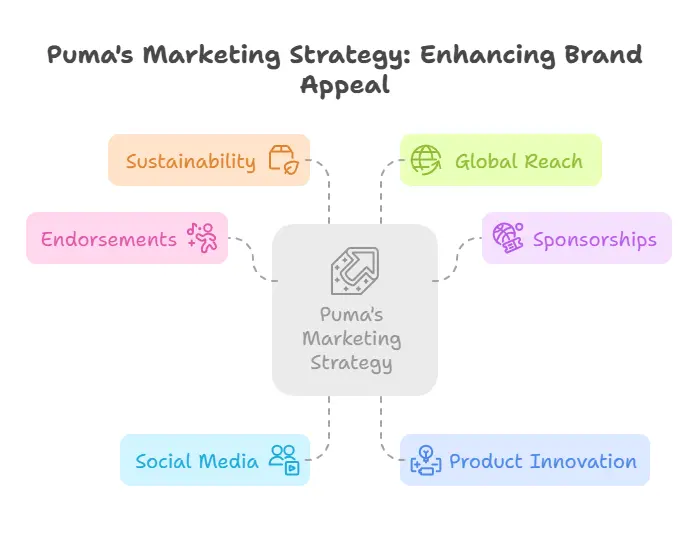
Puma’s brand strategy is based on a number of basic elements that render the brand competitive in the international sportswear industry. These elements are performance, lifestyle, innovation, and sustainability, which establish Puma as the preferred sportswear brand among fashion-conscious consumers as well as athletes.
- Sportsperson and Celebrity Endorsements
- Sponsorships and Partnerships
- Social Media and Influencer Marketing
- Product Innovation and Design
- Sustainability and Green Practices
- Global Reach and Local Relevance
Digital Marketing and Social Media Campaigns
To engage younger buyers, Puma’s social media and digital marketing are focused on Instagram, Tiktok, and YouTube. The brand is reached by consumers naturally and in a manner that they can relate to through viral challenges, influencer collaborations, and interactive content.
Through celebrity and sport star collaborations such as Rihanna, Dua Lipa, and Neymar Jr., Puma extends itself in both fashion and sport. To engage the audience further the company also employs short films and hashtag challenges.
Within a competitive market place of Nike and Adidas, Puma’s digital marketing strategy interweaves sports, lifestyle, and entertainment to stay relevant.
Puma’s viral ads and user-generated content (UGC) aim at interacting with the audience by sharing fun challenges and hashtags. #PumaFit and #RunTheStreets campaigns encourage users to share their fitness success, fashion style, and sporting experience, thereby promoting a great sense of belonging.
Through UGC, Puma promotes brand awareness and gets attention from the audience, thereby making its ad campaigns more genuine and interactive. These attempts enhance Puma’s visibility and have more brand touchpoints, particularly among millennials and Gen Z.
Become an AI-powered Digital Marketing Expert
Master AI-Driven Digital Marketing: Learn Core Skills and Tools to Lead the Industry!
Explore CourseWhy did Puma Reset its Brand?
Puma reset primarily because
- its brand momentum had weakened
- its inventory had piled up
- too much of its distribution was low quality
Company reports describe these three problems directly. CEO Arthur Hoeld, who joined in July 2025, also said the brand had become “too commercial” in pricing and promotion.
The financial cost of that reset is visible in the results:
| Metric | Figure |
| FY 2025 sales | €7,296.2 million (down 8.1% currency-adjusted) |
| FY 2025 net loss | €643.6 million |
| H1 2026 sales | €3,554.4 million (down 5.2% currency-adjusted) |
| Q2 2026 EBIT | €-53.1 million, up from €-109.1 million a year earlier |
| 2026 outlook | Low- to mid-single-digit sales decline; EBIT between €-50 million and €-150 million |
The signal here is direction, not size. Losses are narrowing while sales are still shrinking, which matches the plan.
Puma expects healthy growth to resume from 2027, and Hoeld has said brand heat should reach its stride by the spring/summer 2027 collection.
What is the Puma “Go Wild” Campaign?
“Go Wild” is Puma’s largest global campaign to date, launched on 20 March 2025 around the “runner’s high”, the rush of happy chemicals that running can trigger. It deliberately steps away from celebrity-led ads and shows everyday runners instead:
- an early riser
- a new mum
- someone running with their dog
Puma says it was built on the largest consumer research in the brand’s history. Pre-tests by System1 placed the ad in the top 5% for driving sales in the USA, China and Germany.
The campaign was designed to run through 2025 and 2026, moving from running into basketball, football and major sporting events. Puma also ran the film as-is across markets rather than localising it, betting that the joy of running is a universal story. India, Mexico and Saudi Arabia were among the markets where it was tested.
Launch your career in digital marketing with our comprehensive course. Enroll now!
How does Puma Use Big Sporting Moments?
Puma uses global events as proof points, so the “joy” message is backed by performance credibility. The 2026 FIFA World Cup is the clearest case.
Puma supplied 11 national teams, the most in 20 years, and more than 70 individual players wore its boots.
| Brand | National teams supplied at World Cup 2026 |
| adidas | 14 |
| Nike | 12 |
| Puma | 11 |
Together, the three brands supplied 37 of the 48 teams. Puma’s line-up spans Austria, Czech Republic, Egypt, Ghana, Ivory Coast, Morocco, New Zealand, Paraguay, Portugal, Senegal and Switzerland.
Its “Showtime” boot pack in bright, mismatched colours gave players like Neymar Jr. and Christian Pulisic a look built for TV and social feeds.
In training, Puma is the official apparel and footwear partner of HYROX, the fitness racing series, through 2027. The 2023/24 season alone drew about 175,000 participants across more than 65 races, so the deal puts Puma inside a fast-growing community rather than just in front of it.
How does Puma Win in India?
Puma wins in India by attaching itself to cricket fandom through its long partnership with Royal Challengers Bengaluru (RCB). The tie-up is more than five years old, and RCB is one of the most-followed IPL franchises, with over 42 million followers across social platforms.
The 2026 playbook had three steps:
1. #RCBEverywhere (April 2026):
Virat Kohli, Rajat Patidar and Krunal Pandya urged fans to wear the jersey beyond stadiums, with rewards like matchday tickets and signed merchandise.
Puma reported jersey sales up 300% versus the previous year and said it became Puma’s top-selling apparel globally in its first week.
2. Global crossovers:
The campaign expanded through partnerships with AC Milan and sprinter Usain Bolt, using Puma’s position as kit partner to both RCB and the Italian club.
3. “Good Things Come in Pairs” (May 2026):
After RCB’s back-to-back IPL titles, Puma launched a campaign and a special Champions Tee within a day.
One nuance matters. Kohli’s personal endorsement deal with Puma, reportedly worth ₹110 crore, ended in 2025. He still appears in Puma x RCB campaigns, which shows that the brand’s India strategy now rests on the team and its fans, not one star.
Puma’s Advertising Campaigns
In order to create a broad base, Puma Ad campaigns are based on a mix of sport, lifestyle, and empowerment. “Forever Faster” is about sports greatness and velocity through the likes of Usain Bolt and Neymar Jr., while “She Moves Us” is based on the liberation of women. Emotional storytelling and rapid cuts are the cornerstones of Puma Ad campaigns.
Puma Ad campaigns penetrate global markets through social media, online advertisements, and influencer partnerships. The company establishes a competitive advantage over other competitors such as Nike and Adidas through the combination of sport performance and fashion, thereby constructing its brand in both disciplines.
Through Puma’s advertising campaigns, the company establishes an emotional bond with its customers through a mix of sport, fashion, and motivation to remain in vogue with the competitive market of sportswear.
Results and Impact of Puma’s Marketing Strategy
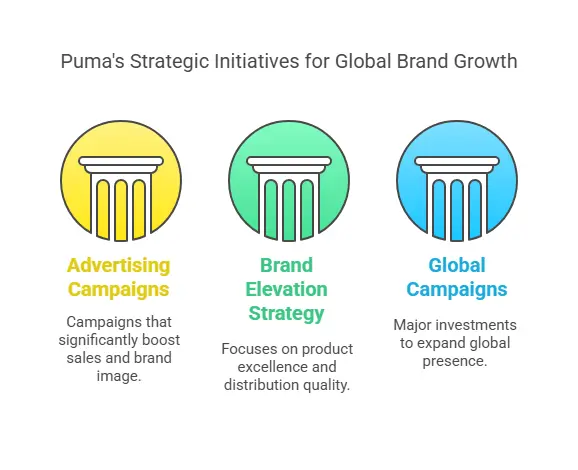
- Puma’s advertising campaigns have been a major contributor to its financial performance and brand image. In 2024, it recorded a 4.4% rise in currency-adjusted sales, an indication of the success of its advertising campaigns in generating revenues.
- The execution of Puma’s Brand Elevation Strategy has mirrored significant brand perceptions improvement among the customers. It is product excellence uplift and distribution quality improvement focused, further leading to enhanced market presence.
- In order to further consolidate its market position, Puma launched its first global campaign in a decade, coupled with a 40% increase in marketing spend. This major investment is a testament to Puma’s efforts to establish its brand identity and expand its global presence.
How does Puma Approach Sustainability?
Puma treats sustainability as product proof, not a separate campaign. It’s FOREVER. BETTER. strategy reported reaching its goal of 9 in 10 products made with recycled or certified materials in April 2025, a year ahead of schedule.
Its RE:FIBRE programme turns textile waste into new polyester. It already accounted for 13.9% of polyester in Puma apparel in 2024. The 2030 goal is 100% recycled polyester fabric, with 30% of apparel polyester coming from fibre-to-fibre recycling.
How does Puma Compare with Nike and Adidas?
Puma competes on tone and accessibility, while Nike has leaned on elite performance and Adidas is the largest of the three at the 2026 World Cup by teams supplied.
Marketing Dive described Go Wild as a break from the “performance at any cost” mindset of industry leader Nike. Puma is smaller than both, so its edge is a clearer, friendlier identity.
| Factor | Puma’s approach |
| Positioning | Performance meets joy and self-expression |
| Creative style | Everyday people, humour, fan culture |
| Signature moments | Go Wild, World Cup “Showtime”, #RCBEverywhere |
| Main challenge | Rebuilding brand heat and lifestyle footwear while sales are still declining |
What can Marketers Learn from Puma?
Marketers can learn that a brand reset works best when the message, the media plan and the product all point the same way. Puma funded one platform instead of many short campaigns.
It then fed that platform with sport-specific content and local fan culture. The caution is equally useful: strong campaigns do not fix distribution and inventory problems overnight, and Puma’s own results show that.
Launch your career in digital marketing with our comprehensive course. Enroll now!
Conclusion
Puma’s marketing strategy in 2026 is a patient bet on emotion backed by performance. Go Wild gave the brand a joyful, human voice, the World Cup and HYROX gave it credibility, and #RCBEverywhere showed how a single jersey can become everyday fashion in India.
The financial recovery is still in progress, with growth targeted from 2027, so the real test will be whether this brand heat turns into sustained sales. For marketers, the takeaway is simple: pick one clear idea, back it consistently and let local culture carry it.
Frequently Asked Questions
How does Puma position itself in the market?
Puma balances affordable sportswear with fashion-forward designs, appealing to both athletes and casual consumers.
How has Puma’s marketing strategy impacted its growth?
Puma’s marketing has driven increased sales, global brand recognition, and stronger consumer engagement, making it a major player in the sportswear industry.
What can other brands learn from Puma’s strategy?
Brands can learn to combine sports, fashion, and digital marketing while staying innovative and eco-conscious to connect with modern consumers.
Why did Puma's sales fall in 2025?
Sales fell 8.1% (currency-adjusted) to €7.3 billion because of a strategic reset. Puma cited weak brand momentum, high inventory and low-quality distribution.
Which celebrities and athletes endorse Puma?
Puma collaborates with Usain Bolt, Neymar Jr., Rihanna, Selena Gomez, Dua Lipa, and Virat Kohli, among others.
What sports does Puma sponsor?
Puma sponsors football (Manchester City, AC Milan), motorsports (Ferrari, Mercedes-AMG), athletics (Usain Bolt), basketball, and cricket (Virat Kohli).
What can businesses learn from Puma's marketing?
Businesses can learn to build around one clear brand idea and adapt it to each audience. They should also match marketing promises with product and distribution quality.
How is Puma different from Nike and Adidas?
Puma leads with joy, humour and everyday athletes, while Nike has been associated with elite performance. At the 2026 World Cup, Puma supplied 11 teams against Nike’s 12 and adidas’s 14.