
Table of Contents
In oil and gas projects, a Quantity Surveyor (QS) is responsible for project cost monitoring, cost estimating, measuring quantities, adjudging subcontractors’ payments and dealing with amendments to the contract. They assist keep large projects such as oil refineries, pipelines and offshore platforms under budget. In India the salary of entry level professionals is usually between ₹3-6 LPA while more experienced QS professionals are able to earn a lot more. Depending on the project and experience, earnings in the Gulf can be greater.
Key Takeaways
- Oil and gas quantity surveyors are responsible for budgets, contracts and project pricing.
- Their key roles include estimating prices, preparing BOQs and handling deviations.
- EPC companies and oil and gas industries are recruiting.
- It is useful to know how to use Excel, CostX, Primavera P6 and to be able to handle contracts.
- Relevant qualifications, certifications and work experience in the sector can help you land a job in India and Gulf.
Introduction: Why Do Oil and Gas Projects Need Specialised Cost Control?
1: What is the main purpose of a Bill of Quantities (BoQ)?
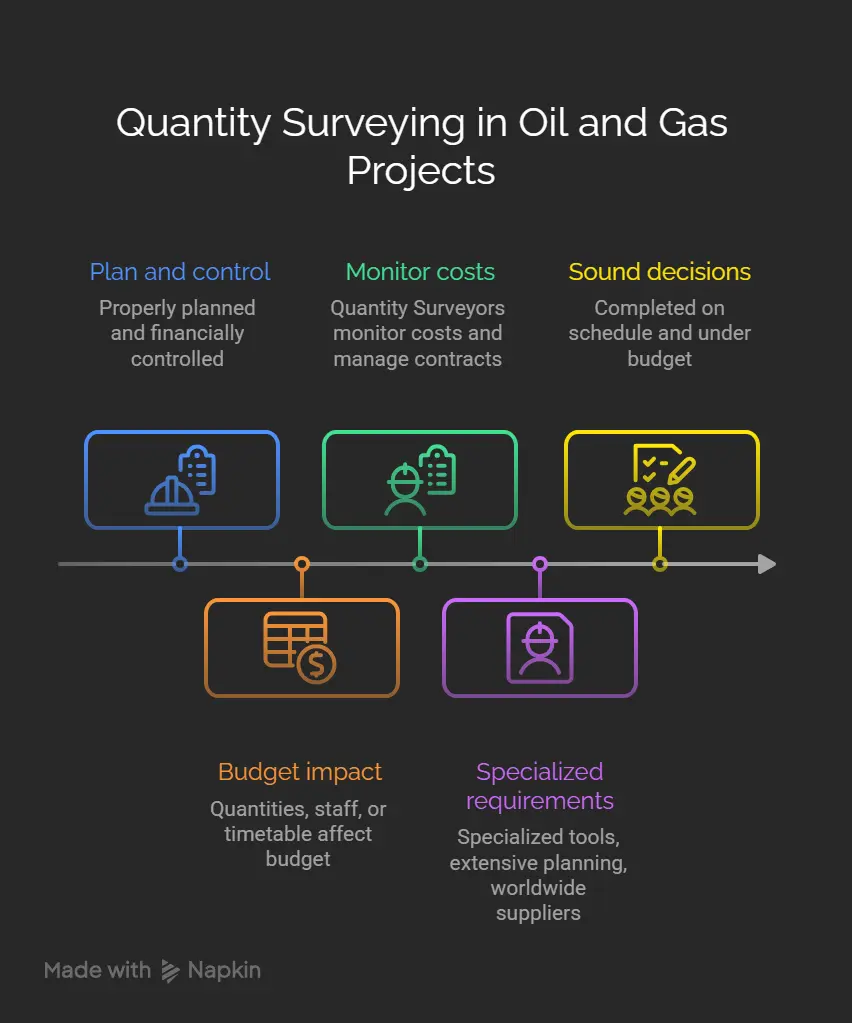
Oil and gas projects take a lot of money, a lot of hard technical effort, and a lot of pricey materials. Every stage in establishing a refinery, offshore installation or pipeline must be properly planned and financially controlled.
Small variations in the quantities of goods, numbers of staff, or project timetable can have a major impact on the budget as a whole. So oil and gas firms require experienced Quantity Surveyors to monitor costs, manage contracts and reduce financial risks.
The oil and gas industry requires specialized tools, extensive planning, worldwide suppliers and intricate Engineering, Procurement and Construction (EPC) contracts which is unlike building construction.
Quantity surveyors help project owners and contractors make sound financial decisions and ensure that projects are completed on schedule and under budget.
Study Quantity Surveying With Professional Mentors! Join Now!
Master Quantity Surveying – Build a Rewarding Career Today!
Gain in-demand skills in cost estimation, project budgeting, and contract management with our Quantity Surveying Course. Learn from industry experts and boost your career in construction and infrastructure. Enroll now and take the first step toward success!
Know MoreOil and Gas Project Phases and the Role of a QS
A Quantity Surveyor is involved in many aspects of an oil and gas project, from the early planning stages to the final handover.
| Project phase | QS responsibilities |
|---|---|
| FEED (Front-End Engineering Design) | Responsible for the production of ballpark cost estimates, quantity projections and project budgets.
|
| Procurement | Reviews the bids presented by the vendors, helps in preparation of the bids and decides the prices of various commodities.
|
| Construction | Maintains strict control over the total cost of the project, the work performed and the payments made to the contractor.
|
| Commissioning | Evaluation of unpaid charges, the administration of final adjustments and the generation of final accounts. |
What Does a Quantity Surveyor Do in Oil and Gas Projects?

An oil and gas quantity surveyor undertakes several business and money-related activities to keep project costs low.
- Cost estimate: Part of this task is to find out the cost of things like supplies, labor, tools and building activities.
- Bill of Quantities (BOQ): Prepare and check the lists of how much of various project activities like pipelines, structural steel and concrete works are needed.
- Variation management: Considers the effect on the project’s prices of modifications to the plan, extra work etc.
- Subcontract value: The work done by subcontractors is reviewed and confirmed that they are qualified for payment.
- Contract management: looks at the terms of contracts, monitors financial commitments and assists with business negotiations.
- The entire cost of a project is calculated by means of an analysis of the final accounts, including payments, variations, completed works and claims still under consideration.
EPC and Lump-Sum Contracts Explained
As a Quantity Surveyor you need to know about oil and gas contracts because the contract terms influence how the project costs and risks are managed.
- EPC (Engineering, Procurement and Construction):An EPC contractor designs the task, acquires the materials and tools, and builds it. Handover and commissioning can also be part of the arrangement depending on the contract.
- Lump-Sum Contract: This is a contract in which the worker agrees to accomplish a certain quantity of work for a certain fee. The contractor generally bears the risk of cost increases within the scope of the contract, as long as adjustments are permitted in the contract.
Quantity Surveyors monitor payments, value variations and ensure the work is in accordance with the contract criteria.
Master Quantity Surveying – Build a Rewarding Career Today!
Gain in-demand skills in cost estimation, project budgeting, and contract management with our Quantity Surveying Course. Learn from industry experts and boost your career in construction and infrastructure. Enroll now and take the first step toward success!
Know MoreOil and Gas QS vs Building QS
Both experts are responsible for monitoring building expenses, but they work in distinct environments and have different responsibilities.
| Comparison | Oil and Gas QS | Building QS |
|---|---|---|
| Project types | Processing plants, offshore platforms, pipelines, refineries | Houses, flats, offices and commercial properties |
| Materials | Pipelines, specialty steel, industrial equipment, and valves | Materials for concrete, brick, tile & finish |
| Contracts | EPC, lump-sum and specialist industrial contracts | Traditional, Design/Bid/Build and Construction Contracts |
| Cost management | Large-scale industrial project budgets | Budgets for building and infrastructure |
| Work environment | Offshore, industrial sites and project offices | Consulting offices and construction sites |
| Technical knowledge | Oil and gas requirements, industrial construction | Construction processes and architectural details |
Skills and Tools Required for an Oil and Gas QS
To do their job well on oil and gas projects, Quantity Surveyors need to know how to utilize tools, handle money, read contracts, and do technical work.
| Skills | Tools and software |
|---|---|
| Cost estimation and budgeting | Microsoft Excel |
| Quantity take-off and BOQ preparation | CostX |
| Cost planning and cost reporting | SAP and Oracle |
| Project scheduling knowledge | Primavera P6 |
| Contract and variation management | Contract management systems |
| Cost coding and financial tracking | ERP and project cost-control systems |
| Communication and negotiation | Microsoft Word and PowerPoint |
Qualifications and Certifications
If you want to go into oil and gas as a Quantity Surveyor, generally you need to have the proper education and job experience on a construction or industrial project.
Education Qualification
The following are generally regarded qualifications:
- B.Sc. in Quantity Surveying.
- A BTech or BE in civil engineering at least.
- Bachelor’s Degree in Construction Project Management.
- Essential: Post-graduate qualification in Quantity Surveying or Commercial Management
Background in civil engineering or quantity survey is very helpful to comprehend construction plans, measurement and project needs.
Professional certifications
Two popular professional organizations provide useful qualifications for professionals in cost management and quantity surveying.
1. RICS (Royal Institution of Chartered Surveyors)
RICS provides a variety of professional memberships from Associate (AssocRICS) to Chartered Member (MRICS).
- AssocRICS offers a pathway to professional membership for suitable individuals at the graduate level.
- MRICS is a recognized chartered qualification for experienced workers.
- The Quantity Surveying and Construction course covers business management, buying things, contract law and managing the project’s finances.
To be eligible, you must have certain academic credentials and relevant professional experience.
2. AACE International
AACE International offers credentials in project cost management and estimating.
Some of the key certifications are :
- Certified Cost Professional (CCP) This qualification is intended for experienced professionals who estimate prices, establish budgets and control project expenses.
- The Certified Estimating Professional (CEP) is geared for estimating project costs, developing budgets and evaluating the economic impact of a project.
Most persons need to have eight years of experience in the industry or four years of experience plus a four-year degree in the field to sit for the CCP exam.
These qualifications can improve your career but real world experience working on oil and gas projects is still highly vital.
Quantity Surveyor Salary in India and the Gulf
In the oil and gas business, the salary of quality assurance specialists are determined by a variety of factors, including experience, employer, project size, location, and technical knowledge. To put that into perspective, specialists who are hired on large EPC and offshore projects may receive significantly higher salaries than those who work in the conventional construction industry.
Despite the fact that the following are market estimates that are indicative for the year 2026, it is important to note that they are not guarantyd oil and gas hiring opportunities.
Salary in India
| Experience | Estimated annual salary |
|---|---|
| Entry-level (0–2 years) | ₹3–6 lakh |
| Mid-level (3–7 years) | ₹6–12 lakh |
| Experienced (8–12 years) | ₹12–18 lakh |
| Senior (12+ years) | ₹18–25 lakh+ |
Salary in the Gulf
The following are are some indicative monthly pay ranges expressed in the local currency of Gulf countries.
| Experience | UAE (AED) | Saudi Arabia (SAR) |
|---|---|---|
| Entry-level (0–2 years) | 6,000–9,000 | 6,000–10,000 |
| Mid-level (3–7 years) | 9,000–15,000 | 10,000–16,000 |
| Experienced (8–12 years) | 15,000–22,000 | 16,000–24,000 |
| Senior (12+ years) | 20,000–30,000+ | 22,000–32,000+ |
Career Path of a Quantity Surveyor in Oil and Gas
On-the-job training and professional development can help a Quantity Surveyor rise from an entry level function to leading commercial and project management roles.
| Career level | Typical position | Main responsibilities |
|---|---|---|
| Beginner | Junior Quantity Surveyor |
An inventory of the materials, an estimate of the costs, and a fundamental quantity take-off |
| Early career | Quantity Surveyor | Cost estimates, appraisals of subcontracts, and receipts for payments are all included. |
| Experienced | Senior Quantity Surveyor | Managing the expenditures, claims, and contracts that are involved |
| Advanced | Commercial Manager | Dealing with the costs of projects, contracts, and the hazards that businesses face |
| Leadership | Commercial Director | Accountable for the management of business groupings and large project budgets |
How to Enter the Oil and Gas Industry as a Quantity Surveyor
To become an oil and gas quantity surveyor, accomplish the following:
- Earn a degree in a related field.: You might be able to earn a degree in civil engineering, building management or quantity surveying for example.
- Learn essential QS skills: Learn how to cost anything, how to prepare a Bill of Quantities (BOQ), measure quantities, value subcontracts and manage contracts.
- Know what software you will need: You will have to learn how to utilize Excel, CostX, Primavera P6 and other ERP and cost management tools.
- Acquire Construction Experience: To gain hands-on experience, begin working as a junior QS with a construction business or engineering contractor
- .Watch oil and gas projects such EPC contracts, FEED, sourcing, industrial building and the specific needs of each.
- Search for job openings in your field: India and Gulf countries are fantastic areas to get jobs with EPC contractors, engineering services, and oil and gas industries.
- Find out the work requirements: As you have more experience, you could choose to join RICS or get AACE certification.
Challenges of Working as a Quantity Surveyor in Oil and Gas
Some of the issues that those who desire to work in oil and gas have to face.
- Where are the initiatives that are not near? Some projects are located in industrial areas where there is no one else or areas far from coast.
- Schedule modifications: Depending on the company, employment that are overseas or work from home may have schedule modifications.
- Tips for Safety Professionals are required to adhere to strict safety standards and procedures on the job site.
- International EPC contracts, claims and revisions are quite complex and require a lot of business understanding to deal with.
- Fluctuations in material cost, labor, and tool cost might impact project finances.
- Due dates of projects: Big industrial projects sometimes have hard due dates and reporting obligations.
Conclusion
Quantity surveying in the oil and gas industry is a specialist profession that needs knowledge of construction, business management and financial management. Quantity Surveyors are very vital for the success of industrial projects since they do a lot of various things including cost estimating, contract management and adjustments to the project.
If you have the proper education, know how to utilize software and have real world experience, qualified individuals may look for job with big EPC contractors and oil and gas businesses in India and the Gulf.
You must have understanding of the basics of quantity surveying if you wish to operate in this industry.
Looking to start your career as a Quantity Surveyor?
Visit our Quantity Surveying Course and learn how to estimate prices, produce a bill of quantities (BOQ), take off measurements and manage construction expenditures.
Study Quantity Surveying With Professional Mentors! Join Now!
Master Quantity Surveying – Build a Rewarding Career Today!
Gain in-demand skills in cost estimation, project budgeting, and contract management with our Quantity Surveying Course. Learn from industry experts and boost your career in construction and infrastructure. Enroll now and take the first step toward success!
Know MoreFrequently Asked Questions
Can a Quantity Surveyor work in the oil and gas industry?
Yes. Quantity Surveyors can work with oil and gas operators, EPC contractors and engineering consultancies. They manage project costs, prepare BOQs, evaluate subcontractor payments and handle contract variations.
Is oil and gas quantity surveying different from building quantity surveying?
Yes. Oil and gas QS professionals work on industrial projects such as refineries, pipelines and offshore platforms. They also deal with specialised equipment, complex procurement packages and EPC contracts.
Which degree is required to become an oil and gas Quantity Surveyor?
A bachelor’s degree in Quantity Surveying, Civil Engineering or Construction Management is a common starting qualification. Employers may have specific academic requirements for different positions.
Which software should an oil and gas QS learn?
Important tools include Microsoft Excel, CostX, Primavera P6, SAP and other project cost-control systems. Knowledge of these tools helps with cost estimation, quantity measurement, scheduling and reporting.
Can freshers get jobs in oil and gas companies?
Yes, although direct entry into major oil and gas projects can be competitive. Freshers can start with junior QS roles, construction contractors or engineering companies before moving into specialised industrial projects.
Is oil and gas quantity surveying a good career in the Gulf?
It can be a rewarding career because the Gulf has major energy infrastructure and industrial development projects. Professionals with EPC experience, contract management knowledge and cost-control skills can access opportunities with international contractors and energy companies.