Table of Contents
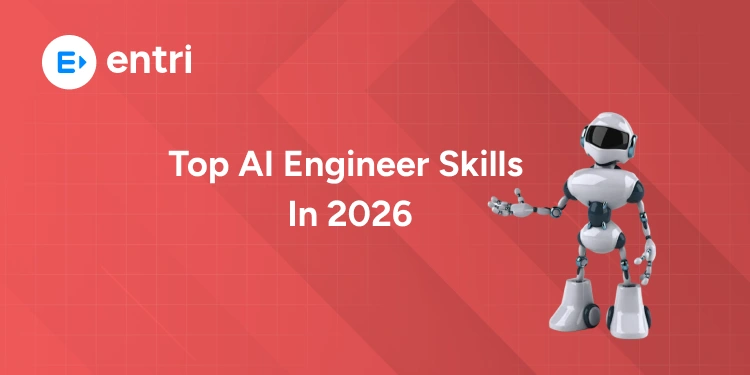
In 2026, the top AI engineer skills range from Python, machine learning, through computer vision, cloud deployment, MLOps, to robotics AI, generative AI, and responsible AI.
Companies currently are not looking for people who only train models in notebooks. They want engineers who can build, deploy and monitor complete AI systems. This applies to factories, warehouses, hospitals, and robots.
New to Robotics? Start from the Basics. Join Now!
Key Takeaways
- AI engineering in 2026 needs two skill sets – modelling and production engineering.
- Python, PyTorch or TensorFlow, computer vision and MLOps form the core technical stack.
- Robotics AI roles add ROS 2, C++, sensors, control systems and simulation.
- Docker, Kubernetes, CI/CD and one major cloud platform are now hiring basics.
- LLMs, RAG and AI agents are the fastest-growing specialisations.
- Deployed projects and a clean GitHub portfolio carry as much weight as certificates.
- Responsible AI, including privacy compliance under India’s DPDP Rules, is now part of the job.
Why are AI Engineer Skills in High Demand in 2026?
India’s companies are moving AI from pilots to production. This makes AI engineer skills on increasing demand. Also, the talent pool has not kept pace.
ManpowerGroup’s 2026 survey reports that 82% of Indian employers struggle to fill roles. However, the biggest shortages are not in basic model building, but in
- Deployment
- Governance
- MLOps
Robotics adds another layer to this. Robots are supposed to turn real-time sensor data into safe physical actions. This makes perception, planning and control stand over machine learning.
Master Robotics and AI!
Ready to build the future? Join our comprehensive robotics course to bridge the gap between complex code and physical motion. You’ll gain hands-on experience giving you the technical edge needed to lead in the age of automation.
Know MoreCore Technical Skills for AI Engineers in 2026
| Skill area | What to learn | Why it matters |
| Programming | Python, C++, SQL, Git | Python drives AI work; C++ supports real-time robotics; SQL and Git support data work and teamwork |
| Machine learning | scikit-learn, evaluation metrics, feature engineering | Base for prediction, classification and anomaly detection |
| Deep learning | PyTorch, TensorFlow, CNNs, transformers | Powers vision, speech, language and robotics |
| Computer vision | OpenCV, detection, segmentation, calibration | Lets machines understand images and environments |
| MLOps | Docker, Kubernetes, MLflow, CI/CD, monitoring | Keeps models stable after launch |
| Cloud and APIs | AWS, Azure, Google Cloud, FastAPI | Enables scalable, production-grade AI |
| Robotics AI | ROS 2, sensor fusion, SLAM, path planning | Helps robots perceive and act on their own |
| Generative AI | LLMs, RAG, vector databases, AI agents | Extends AI into language and automation |
1. Programming: Python, C++, SQL and Git
Python remains the foundation of AI engineering. NumPy, pandas, scikit-learn, PyTorch, TensorFlow and OpenCV all run through it.
SQL matters too. A 2026 job-market analysis found it in 82% of AI job postings in India.
C++ becomes essential for robotics. This is particularly for jobs where real-time control and low latency are non-negotiable. Learn Git and GitHub early on, as they can look impressive on your portfolio.
2. Mathematics and Statistics
Mathematics explains why models behave the way they do. You should know
- Linear algebra
- Calculus
- Probability
- Optimisation
Gradient descent is something that minimises model error. This depends directly on calculus.
Master Robotics and AI!
Ready to build the future? Join our comprehensive robotics course to bridge the gap between complex code and physical motion. You’ll gain hands-on experience giving you the technical edge needed to lead in the age of automation.
Know More3. Machine Learning Fundamentals
Machine learning lets systems learn patterns from data. Focus on:
- Supervised learning – regression, decision trees, random forests, XGBoost.
- Unsupervised learning – clustering and anomaly detection.
- Evaluation – precision, recall, F1 score, ROC-AUC, RMSE.
- Overfitting control – cross-validation and regularisation.
4. Deep Learning and Computer Vision
Deep learning handles images, video, audio, text and sensor streams. Learn CNNs, transformers, transfer learning and either PyTorch or TensorFlow. For edge devices, learn ONNX or TensorRT to speed up inference.
Computer vision is among the most valuable robotics skills. Study
- OpenCV
- Object detection
- Segmentation
- Camera calibration
- Depth estimation
- Visual SLAM
5. Robotics AI: ROS 2, Sensors and Control
Robotics AI engineers must connect AI decisions to physical hardware. ROS 2 is the standard middleware, and its latest long-term-support release, Lyrical Luth, arrived in May 2026.
Learn these building blocks:
- ROS 2 nodes, topics, services, actions and launch files.
- Sensors – cameras, LiDAR, IMUs, encoders and GPS.
- Sensor fusion, localisation, SLAM and obstacle avoidance.
- PID control, kinematics and feedback loops.
- Simulation in Gazebo, Webots or NVIDIA Isaac Sim.
- Reinforcement learning for motion and decision-making.
6. MLOps and Production AI
MLOps is the discipline of deploying, monitoring and improving models in production. It is one of the most valuable skills in the market with all the talent gap. Learn
- MLflow
- Docker
- Kubernetes
- CI/CD
- Drift detection
- Automated retraining
- A cloud ML platform (AWS SageMaker, Google Vertex AI or Azure Machine Learning)
Add data pipelines and versioning, as clean and well-synchronized data keeps both models and robots reliable.
7. Cloud, APIs and Edge AI
Employers expect hands-on knowledge of at least one cloud provider. Learn API development with
- FastAPI or Flask
- Authentication
- Model serving
- Cost control
Also understand edge versus cloud AI. Robotics firms often train in the cloud and run lightweight models on the robot to cut latency and work offline.
8. Generative AI, LLMs and AI Agents
Generative AI has widened the AI engineer’s role. Learn
- LLM fundamentals
- Prompt and context engineering
- Retrieval-augmented generation (RAG)
- Vector databases such as FAISS or Pinecone
- Frameworks like LangChain or LlamaIndex
- Tool calling and output evaluation
In robotics, agents can help technicians query maintenance records. But human approval must gate any physical action.
9. Responsible AI, Safety and Ethics
Responsible AI is now an engineering skill. In India, the MeitY AI Governance Guidelines (November 2025) rely on existing laws, and the DPDP Rules require full compliance by May 2027. This covers consent, purpose limits and security safeguards for personal data.
Learn
- Bias testing
- Explainability
- Privacy-by-design
- Human oversight
- Fail-safe design
For robots, add emergency stops and safety-standard awareness.
AI Engineer Skills by Career Stage
| Stage | Priority skills | Focus |
| Beginner | Python, statistics, Git, SQL, basic ML | Fundamentals and small projects |
| Intermediate | Deep learning, computer vision, APIs, cloud, MLOps basics | End-to-end deployed projects |
| Robotics-focused | ROS 2, C++, sensors, control, simulation | Autonomous or perception-based robots |
| Advanced | MLOps, distributed systems, LLM fine-tuning, responsible AI | Production platforms and system design |
12-Month Roadmap to Build these Skills
Months 1 to 3:
- Python
- Maths
- Git
- SQL
- Basic ML with pandas and scikit-learn
Months 4 to 6:
- Deep learning
- OpenCV
- FastAPI
- Pick up Docker and basic cloud deployment.
Months 7 to 9:
Specialize in robotics AI with
- ROS 2
- C++
- Sensors
- Simulation
Months 10 to 12:
- Publish three to five GitHub projects
- Deploy one model
- Add hackathons, internships or open-source work
Portfolio Projects that Prove Your Skills
| Project | Skills shown |
| Defect-detection image classifier | Python, CNNs, OpenCV, model evaluation |
| Object-detection robot simulation | ROS 2, Gazebo, PyTorch |
| End-to-end ML API | FastAPI, Docker, cloud deployment |
| Sensor-fusion navigation system | ROS 2, LiDAR, IMU, Kalman filters |
| RAG-based technical assistant | LLMs, vector database, LangChain |
AI Engineer Salary in India
Fresher AI engineers typically earn around ₹6-8 LPA, and Glassdoor’s average sits near ₹11 LPA to ₹12 LPA.
Pay climbs with specialization, and senior generative AI and MLOps engineers at product companies and global capability centres often reach ₹45 LPA to ₹60 LPA, with some roles going higher.
| Specialisation | Indicative premium over general AI roles |
| MLOps / LLMOps | +25% to +45% |
| Generative AI / LLMs | Around +35% |
| Computer vision | +20% to +35% |
Note: Figures are indicative and vary by city, employer and experience.
New to Robotics? Start from the Basics. Join Now!
Common Mistakes Beginners Should Avoid
- Building models only in notebooks, with no deployment.
- Chasing trends instead of building a portfolio.
- Neglecting privacy, bias and safety.
Conclusion
The best AI engineers in 2026 are those who connect models to real-world systems safely and reliably.
Build strong foundations in Python and machine learning, then add deep learning, computer vision, MLOps and cloud deployment.
If robotics is your goal, layer on ROS 2, C++ and control systems, and prove it all with deployed projects. Start small and ship often.
|
RELATED POSTS |
|
| Vibe Coding in Robotics Development | |
| How to Transition from Software Engineering to Robotics | |
| Countries with Highest Demand for Robotics Engineers (2026) | |
Master Robotics and AI!
Ready to build the future? Join our comprehensive robotics course to bridge the gap between complex code and physical motion. You’ll gain hands-on experience giving you the technical edge needed to lead in the age of automation.
Know MoreFrequently Asked Questions
What are the top AI engineer skills in 2026?
They are Python, machine learning, deep learning, computer vision, MLOps, cloud deployment, data engineering, generative AI and responsible AI. Robotics roles also need ROS 2, C++, sensors and control systems.
Which programming languages should an AI engineer learn?
Start with Python, then add SQL and Git. Learn C++ if you want robotics, embedded or other performance-critical work.
Do AI engineers need MLOps skills?
Yes, because MLOps keeps models accurate, versioned and scalable after launch. It is also one of India’s widest AI skill gaps, at 68% according to Quess Corp.
What skills are needed for AI in robotics?
You need Python, C++, ROS 2, computer vision, sensor fusion, control systems, path planning and simulation. Reinforcement learning is a useful addition.
Can a fresher become an AI engineer?
Yes. Build Python and ML fundamentals, finish practical projects, learn deployment basics and publish them on GitHub.
Which industries hire AI engineers in robotics?
Manufacturing, automotive, healthcare, logistics, warehousing, agriculture, defence and aerospace all hire them.
How much maths do AI engineers need?
You need linear algebra, calculus, probability and optimisation at a working level. This is enough to debug models and interpret results.
PyTorch or TensorFlow: which should I learn first?
PyTorch is a common starting point, but either one is fine. The concepts transfer between them, so pick one and build projects.
Are certifications necessary for AI jobs?
They help but rarely replace proof of skill. Employers prefer deployed projects with clear documentation.
Why does responsible AI matter for engineers?
AI systems affect real people, and India’s DPDP Rules set clear data-protection duties. Engineers who build for fairness, privacy and safety are more trusted and more hireable.