Table of Contents
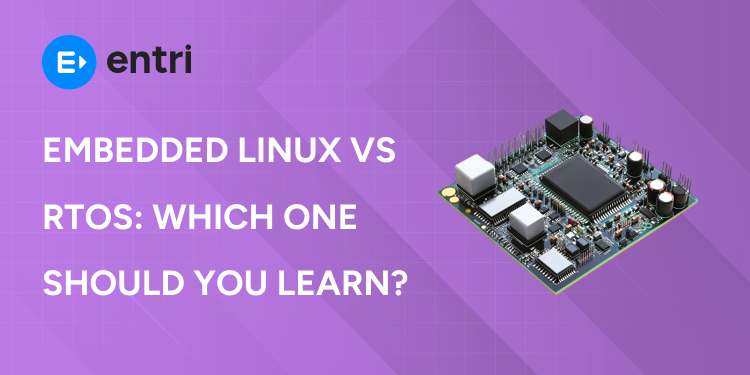
The choice between Embedded Linux and an RTOS is not about which one is better. It’s really about which one fits the device you’re working on. Whether you want to work on small, hard real-time devices like motor controllers or automotive ECUs, or if you want to work on a complex, connected product like a gateway – or even an edge AI device – understand the key differences. Learn Real-Time Operating Systems (RTOS) first if your career path is set on small, hard real-time devices. Learn Embedded Linux if you’re focused on complex, connected products. The most successful engineers to date have the knowledge of both.
KEY TAKEAWAYS
- RTOS is all about being deterministic and keeping things simple. FreeRTOS and Zephyr are the most used RTOS options for beginners – both can be run on microcontrollers with barely any RAM and still guarantee response times of a few microseconds.
- Embedded Linux is the go-to for a product with a lot of complexity and connectivity. Its going to require a microprocessor with a lot more RAM, full networking and user interfaces, and a lot of work to get it to run smoothly in real time.
- The hardware boundary is very real. RTOS runs on those tiny microcontrollers like Cortex-M; Linux runs on bigger microprocessors like Cortex-A with a memory management unit and external DRAM.
- Hybrid designs are super common. A lot of projects run Linux on the main processor and a separate RTOS on a companion microcontroller just for those real-time tasks.
- Embedded Linux engineers in India can earn a pretty penny – Senior BSP engineers with 8+ years of experience can earn between 18-25 LPA, and even principal roles can reach a staggering 37.5-50 LPA.
INTRODUCTION
At some point, embedded engineers all face this question: you’ve learned C, you can make an LED blink – but now you want to build real products. But the industry splits into two completely different worlds.
The RTOS world is a small, fast, predictable one. You work closely with the hardware, you manually manage tasks, you count every single byte of RAM. The Linux world is a whole different story – lots of networking stacks, driver code, processes – it feels like a different language altogether.
This guide aims to give you a basic understanding of both worlds, their trade-offs and why you might want to learn one first. For a lot of engineers the answer is: learn RTOS first then move on to Linux
Learn Embedded Systems Software Engineering
Master Embedded Systems Programming!
Launch your tech career with our Embedded Systems Course, designed for hands-on learning and industry readiness.
Know MoreWHAT IS AN RTOS?
An RTOS is a tiny kernel that runs on those tiny microcontrollers. It gives you preemptive multitasking, task prioritization, and inter-task comms – but the key feature is determinism: the scheduler guarantees that a high-priority task will run within a very small time frame.
FreeRTOS and Zephyr are the two most popular options for beginners. FreeRTOS is super minimal and used in every commercial product, while Zephyr is a bit more feature-rich and comes with built-in networking, Bluetooth, and security features.
An RTOS does not have a memory management unit, and all tasks share the same address space – which makes it super fast. However, a bug in one task can take down the entire system.
What is Embedded Linux?

Embedded Linux is a fully-fledged operating system built from the Linux kernel. It comes with virtual memory, user-space processes, device drivers, and a complete networking stack all rolled into one. But what really makes it tick is the use of build systems like Yocto and Buildroot, which let you create custom Linux images for your specific hardware – which can be a real game changer.
Linux, to function properly, needs a microprocessor that comes equipped with an MMU (Memory Management Unit) and some external DRAM (random access memory) to work with. In reality, a practical modern Linux system requires a decent chunk of RAM – we’re talking tens of megabytes as a bare minimum, with edge services typically needing a full 512 MB or more. And get this – Linux boots up in seconds, not milliseconds, so you don’t have to wait too long to get things up and running.
One thing to keep in mind about Linux is that it’s not designed to be a hard real-time system out of the box. Its scheduler is more geared towards ensuring fairness and good throughput, rather than iron-clad guaranteed latency. Now there are ways to improve the real-time behavior of Linux, like the PREEMPT_RT patch – but even then, the worst-case scenario still isn’t going to be as rock-solid as you might find with a traditional RTOS (Real-Time Operating System) on a microcontroller.
Key differences
| Factor | RTOS (FreeRTOS/Zephyr) | Embedded Linux |
|---|---|---|
| Real-time behaviour | Deterministic, microsecond latency | Non-deterministic; PREEMPT_RT improves it but not hard real-time |
| Memory footprint | Kilobytes of RAM | Tens to hundreds of MB of RAM |
| Boot time | Milliseconds | Seconds |
| Hardware | Microcontroller (Cortex-M) | Microprocessor (Cortex-A) with MMU |
| Process isolation | None (no MMU) | Full process isolation |
| Networking | Basic stacks (MQTT, CoAP) | Full TCP/IP, Wi-Fi, Bluetooth, VPN |
| User interface | None or simple LVGL | Full framebuffer, Wayland, Qt |
| Development effort | Lower for simple tasks; manual concurrency | Higher initial setup; easier application development |
Master Embedded Systems Programming!
Launch your tech career with our Embedded Systems Course, designed for hands-on learning and industry readiness.
Know MoreWHERE EACH IS USED
RTOS use cases: Motor control, sensor fusion, automotive ECUs, medical devices with hard timing requirements, industrial controllers, wearables with tight power budgets.
Embedded Linux use cases: Routers and gateways, infotainment systems, smart displays, edge AI devices, point-of-sale terminals, industrial HMIs.
HARDWARE NEEDS: MCU VS MPU
| Aspect | MCU (RTOS) | MPU (Linux) |
|---|---|---|
| Example | STM32, ESP32, nRF52 | Raspberry Pi, i.MX 8, Sitara |
| Memory | KB of RAM, integrated flash | MB of RAM, external DRAM |
| MMU | No | Yes |
| Power | Microamps in sleep | Watts during operation |
| Cost | Under €3 for some modules | Higher board cost |
The hardware dictates the software choice. You cannot run Linux on a €3 microcontroller. You do not need an RTOS for a touchscreen gateway.
LEARNING CURVE AND TOOLS
| RTOS Learning | Embedded Linux Learning |
|---|---|
| C and register-level programming | C plus shell scripting |
| Task scheduling and priorities | Bootloaders (U-Boot) and kernel |
| Semaphores, queues, mutexes | Device trees and kernel drivers |
| Debugging with JTAG | Yocto/Buildroot build systems |
| FreeRTOS or Zephyr APIs | Linux system calls and POSIX |
| No MMU to worry about | Process isolation and permissions |
The RTOS curve is gentler for beginners. You learn one small kernel and a few APIs. The Linux curve is steeper because you must learn the build system, boot process, and device model before you can do anything useful.
CAN YOU USE BOTH TOGETHER?
Yes, and this is increasingly common. A hybrid architecture uses Linux on the main application processor and an RTOS on a companion microcontroller or a real-time core within the same SoC .
Two common patterns:
-
Asymmetric multiprocessing (AMP): A multi-core SoC runs Linux on Cortex-A cores and Zephyr on a Cortex-M core. They communicate via shared memory and RPMsg.
-
Separate processors: A dedicated MCU handles real-time I/O, connected to the Linux processor via SPI or UART.
This hybrid model is common in automotive, industrial, and robotics products. Engineers who understand both sides are highly valuable.
Learn Embedded Systems Software Engineering
CAREER SCOPE AND SALARY
| Role | Experience | Typical Salary (India) |
|---|---|---|
| Embedded Linux Engineer (BSP) | 5–8 years | ₹4–7 LPA to ₹12–18 LPA |
| Senior Embedded Linux Engineer | 8+ years | ₹18–25 LPA |
| Principal Linux Engineer | 10–16 years | ₹37.5–50 LPA |
RTOS roles are more common in automotive and industrial sectors. Linux roles are more common in networking, consumer electronics, and edge computing. Both pay well at senior levels.
You’ve Got a Decision to Make
Choose RTOS First if:
- You’re working with motor control, sensors, or automotive systems – that’s where it’s really useful.
- You’re just starting out with a microcontroller (STM32, ESP32).
- You want to get a real feel for how an operating system actually works.
- You’re one of those people who likes working with your hands and getting a real feel for the hardware.
Choose Embedded Linux First if:
- You’re building gateways, displays, or connected devices.
- You’ve already got the basics of Linux under your belt.
- You’re interested in networking, edge AI, or other complex stuff.
- You like working at the application level rather than getting bogged down in firmware.
For most people, starting with RTOS is probably the way to go. Learning it first teaches you the fundamentals of concurrency and scheduling in a nice, simple environment. Linux builds on that but then adds a load of extra complexity that can obscure the basics.
Getting a Grip on Things
Phase 1: RTOS Fundamentals (2-3 months)
- Get a good grasp of C pointers, memory, and bit manipulation – they’re all crucial.
- Pick a microcontroller to work with (STM32 or ESP32).
- Learn FreeRTOS or Zephyr – get to know tasks, queues, semaphores, and mutexes.
- Build a project – something like a multi-task sensor logger that spits out data over UART.
Phase 2: Linux Fundamentals (2-3 months)
- Get familiar with the Linux command line and some basic shell scripting.
- Understand what’s going on with processes, permissions, and file systems.
- Brush up on your C programming skills on Linux (gcc, make, and all that other stuff).
- Build a simple Linux app – something to get you started.
Phase 3: Embedded Linux (3-4 months)
- Learn about bootloaders (U-Boot) and the kernel – it’s a lot to take in.
- Get to grips with Yocto or Buildroot for making custom images.
- Learn all about device trees and kernel drivers.
- Build a project – maybe a Linux gateway that reads in sensor data and spits it out to MQTT.
Learn Embedded Systems Software Engineering
The Bottom Line
Embedded Linux and RTOS aren’t like two opposing paths – they’re more like complementary skills for different bits of the embedded world. RTOS teaches you the value of determinism and being close to the hardware. Linux shows you how to deal with complexity and connectivity.
Just start with RTOS – it’s a lot simpler to learn, it’ll get you up and running faster, and it’ll give you a solid foundation in concurrency. Then when you’re ready to tackle something more complex like an embedded Linux system, you’ll be ready to go. And the people who can tackle both – that’s who’s going to be building the really clever hybrid systems.
Master Embedded Systems Programming!
Launch your tech career with our Embedded Systems Course, designed for hands-on learning and industry readiness.
Know MoreFrequently Asked Questions
What is the main difference between Embedded Linux and RTOS?
RTOS is designed for deterministic, hard real-time response on microcontrollers with kilobytes of RAM. Embedded Linux is a full operating system for complex, connected devices on microprocessors with megabytes of RAM. RTOS guarantees microsecond latency; Linux does not by default.
Which is easier to learn for beginners?
RTOS is easier to learn first. You work with one small kernel, a few APIs, and a microcontroller board. Embedded Linux requires learning bootloaders, kernel, device trees, and build systems before you can build anything useful. Start with RTOS.
Can I run Linux on a microcontroller?
No, not practical Linux. Linux requires a microprocessor with an MMU and external DRAM. Microcontrollers have kilobytes of RAM and no MMU. You need a processor like Cortex-A, not Cortex-M.
What hardware do I need to learn RTOS?
An STM32 or ESP32 development board is enough. These cost under ₹1,000 and support FreeRTOS or Zephyr. You also need a USB cable and a computer with the toolchain installed.
What hardware do I need to learn Embedded Linux?
A Raspberry Pi or BeagleBone board is a good starting point. These cost ₹3,000–₹6,000 and run full Linux. For professional work, you will eventually need an i.MX or Sitara board with Yocto support.
Which has better career scope in India?
Both have strong demand. RTOS roles are common in automotive and industrial sectors. Embedded Linux roles are common in networking, consumer electronics, and edge computing. Senior Linux BSP engineers earn ₹18–25 LPA, and principal roles reach ₹37.5–50 LPA.
Can I use both RTOS and Linux in the same product?
Yes. Hybrid designs use Linux on the main processor and an RTOS on a companion microcontroller or a real-time core. They communicate via shared memory, RPMsg, or SPI/UART. This is common in automotive and robotics products.
Is Embedded Linux real-time?
Not by default. The standard Linux scheduler is designed for fairness and throughput, not guaranteed latency. The PREEMPT_RT patch improves real-time behaviour, but worst-case latency is still higher than an RTOS on a microcontroller.
Which pays more: RTOS or Embedded Linux?
Senior Embedded Linux roles pay more in India, with BSP engineers reaching ₹18–25 LPA and principal roles ₹37.5–50 LPA. RTOS roles pay well in automotive and industrial sectors, but the highest salaries are in specialised Linux and BSP positions.
Should I learn RTOS or Linux first?
Learn RTOS first. It teaches concurrency, scheduling, and hardware interaction in a simpler environment. Then add Linux when you are ready to build connected, complex devices. The engineers who understand both are the most valuable.