Table of Contents
Yes, SEO still matters in 2026, arguably more than ever. This is because it now decides whether AI tools mention you at all.
SEO (Search Engine Optimization) is the practice of shaping your website’s content and technical structure so it ranks on Google, Bing, and increasingly, inside AI-generated answers, without paying for placement.
What has changed isn’t the goal. It is the scoreboard. Rankings alone no longer capture whether you are visible. A growing share of answers now appear directly on the results page.
Want to learn digital marketing from experts? Join the Entri Elevate online course now!
Key Takeaways
- SEO in 2026 still works the same way at its core. It is the tactics for AI visibility that have evolved.
- AI Overviews now appear on a large and rising share of searches, so being cited matters as much as ranking.
- SEO, AEO, and GEO aren’t separate strategies. One well-structured page can achieve all three.
- Fundamentals like crawlability, mobile-first design, Core Web Vitals, and E-E-A-T remain the backbone of good SEO.
- Fresh, direct, well-structured content wins in both classic search and AI-generated answers.
- Results take three to six months on average. SEO rewards consistency, not shortcuts.
The Evolution of SEO: What Has Changed by 2026?
1: What is the primary goal of SEO (Search Engine Optimization)?
Now, just a few years later, as we enter 2026, the world of SEO is utterly transformed. To abide by algorithms constantly being refined by search engines such as Google to cater to users with the best quality of content they might find. For digital marketers, understanding the latest SEO developments and tactics is a must for success in 2026.
Become an AI-powered Digital Marketing Expert
Master AI-Driven Digital Marketing: Learn Core Skills and Tools to Lead the Industry!
Explore CourseHow AI Search Changed the Game
Google’s AI Overviews now show up on a large, growing share of searches. This isn’t uniform but informational and how-to queries trigger AI Overviews far more often than transactional or local searches.
The practical takeaway for beginners is that you now need both classic SEO skills and an understanding of how AI systems select and cite sources.
What this means for you:
- Zero-click searches are rising – a meaningful share of queries never lead to a click because the AI answer already satisfies the user.
- Being cited matters as much as ranking – appearing inside an AI-generated answer can drive strong clicks per impression, but only when your content is clear, factual, and easy to extract.
- Freshness carries more weight – AI systems favour recently updated pages with current data over stale ones.
The upside: well-structured, genuinely useful content still gets surface. This often more prominently than before.
SEO vs AEO vs GEO: What’s the Real Difference?
You’ve probably seen new acronyms floating around — AEO (Answer Engine Optimization) and GEO (Generative Engine Optimization). Here’s the distinction, in plain terms:
| Term | Optimizes For | Success Metric | Best For |
| SEO | Ranked list of links | Organic rankings, traffic, conversions | All websites |
| AEO | Direct answers (featured snippets, AI Overviews, voice search) | Answer-box appearances, zero-click visibility | How-to guides, FAQs, definitions |
| GEO | AI citations inside generated answers (ChatGPT, Gemini, Perplexity) | Citation rate, brand mentions | Brands, thought leadership content |
Google has been clear that it doesn’t treat these as separate disciplines — AI Overviews run on the same core ranking systems as regular search. So you don’t need three different strategies. You need one page that’s built to rank, answer directly, and hold up as a citation-worthy source at the same time.
SEO Trends in 2026
To raise the rating of a piece of content and make a website more visible, SEO works by optimizing the content of the website, doing keyword research, and obtaining inbound links. SEO efforts might take months to fully bear fruit, even though you can usually see results on the SERP once a webpage has been crawled and indexed by a search engine. Here are some latest trends in SEO that can be useful.
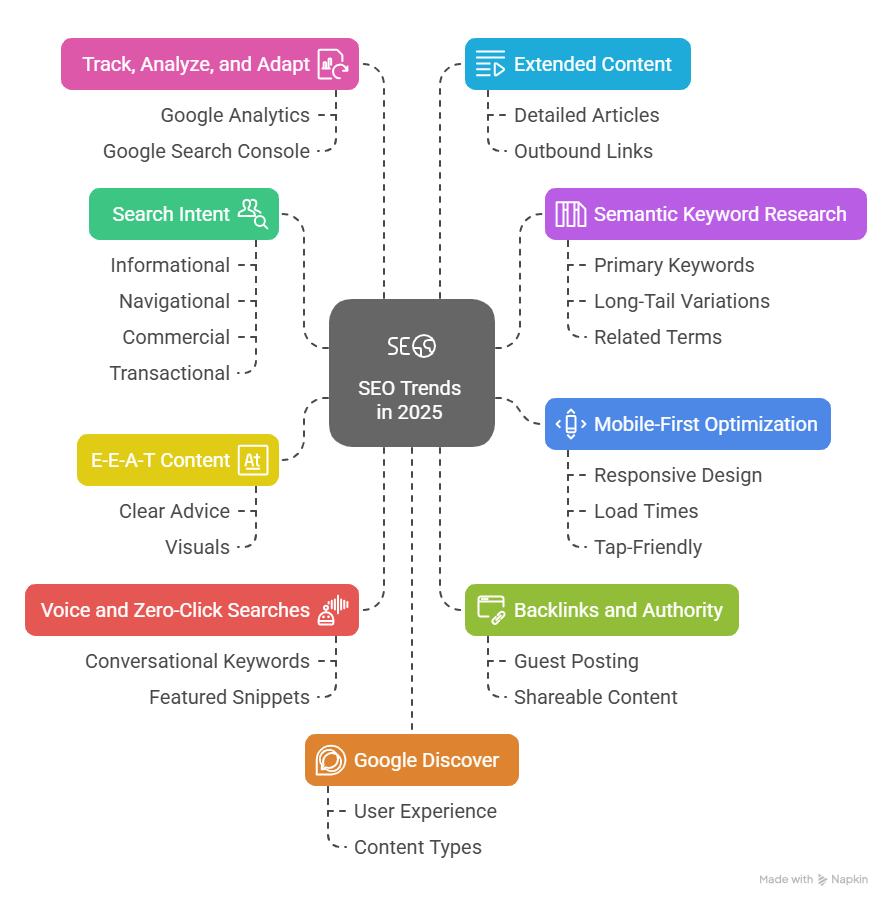
Greater Emphasis on Search Intent
In recent years, the significance of search intent has increased. Your content must match the user’s search intent if you want to succeed with today’s SEO tactics. The main objective of a user’s internet search is known as search intent. It explains what the searcher is looking for.
Search engines are updated frequently to improve user experience. Understanding the search intent and improving fundamental web requirements like page speed and accessibility are both parts of this user experience.
In 2026, Google’s AI algorithms prioritize content matching search intent: informational (“how to start SEO”), navigational (“YouTube login”), commercial (“best SEO tools”), or transactional (“buy website hosting”).
A 2024 study by Search Engine Journal found that almost 68% of users click results that directly solve their query. Match intent, and you’re golden.
Master Semantic Keyword Research
Keywords are evolving. In 2026, Google’s natural language processing (NLP) favours semantic clusters, groups of related terms, over single keywords. Think “SEO for beginners” plus “SEO tips 2026″ or “how to rank on Google.”
How to Do It:
-
Start with a primary keyword using Google Keyword Planner.
-
Add long-tail variations (e.g., “easy SEO for small businesses”) for niche wins.
-
Check “People Also Ask” on Google for related terms.
Key Highlights
AI search optimization (AEO + GEO): Lead each section with a direct 40–70 word answer, use question-style H2s, and add FAQ schema so AI systems can lift your answers cleanly.
Voice and conversational search: Voice queries tend to be longer and more natural. Write the way people speak, and answer questions in 40–60 words to compete for featured snippets.
Semantic keyword clusters: Google’s language models understand topics, not isolated keywords. Build around one primary keyword, then support it with related terms and “People Also Ask” queries.
Video SEO: Video content tends to earn more engagement and shares than text alone. Embedding relevant video and adding video schema both help visibility.
Local SEO: For India-focused content, an accurate Google Business Profile, location-specific keywords, and regional-language content improve hyperlocal visibility.
Become an AI-powered Digital Marketing Expert
Master AI-Driven Digital Marketing: Learn Core Skills and Tools to Lead the Industry!
Explore CourseCore SEO Fundamentals that Haven’t Changed
Even with all the AI-driven change, the foundation is unchanged:
- Crawlability and indexing – If Google can’t access a page, it can’t rank or cite it. Keep your site architecture clean, submit an XML sitemap via Search Console, and don’t accidentally block crawlers in robots.txt.
- Mobile-first indexing – Google evaluates your mobile version, not desktop, and the majority of web traffic in India now comes from mobile devices. Responsive design and fast mobile load times are non-negotiable.
- Core Web Vitals – Google’s page-experience metrics are:
- LCP (Largest Contentful Paint): under 2.5 seconds
- INP (Interaction to Next Paint): under 200 milliseconds. This replaced the older FID metric back in March 2024 and remains the current standard
- CLS (Cumulative Layout Shift): under 0.1
- E-E-A-T (Experience, Expertise, Authoritativeness, Trustworthiness) – This matters most for YMYL (Your Money, Your Life) topics like finance, health, and career guidance. Add real author bios, cite credible sources, and back claims with original data or first-hand experience wherever possible.
How to Start SEO in 2026: A Step-by-Step Checklist
Step 1 – Keyword research with intent mapping
Sort keywords by what the searcher actually wants: informational (“What is SEO?”), navigational (brand searches), commercial (“best SEO tools 2026”), or transactional (“buy SEO course”). Tools like Google Keyword Planner, Semrush, or Ubersuggest help here.
Step 2 – Create genuinely useful, E-E-A-T-aligned content
Answer the core question in the first 100 words, structure with H2/H3 headings, and credit real authors. Avoid generic, keyword-stuffed writing. Google’s recent updates specifically penalize it.
Step 3 – On-page optimization
Keep title tags under 60 characters with your primary keyword, write meta descriptions under 160 characters with a clear value proposition, use short descriptive URLs, and link internally to related content.
Step 4 – Technical SEO audit
Fix broken links, compress images (WebP/AVIF), confirm HTTPS is active, and resolve redirect chains.
Step 5 – Build authority through backlinks
Earn links by guest posting on credible industry sites, publishing original research, or creating genuinely shareable tools and data.
Step 6 – Track, analyze, and adapt
Watch organic traffic and rankings in Google Analytics 4 and Search Console, keep an eye on the newer AI Overview impression data where available, and refresh your best-performing pages every 30–60 days with updated facts.
Tools Every Beginner Should Know
| Tool | Purpose | Pricing |
| Google Search Console | Track rankings, indexing, AI Overview impressions | Free |
| Google Analytics 4 | Measure traffic and user behaviour | Free |
| Semrush / Ahrefs | Keyword research, competitor and backlink analysis | Paid |
| Screaming Frog | Technical SEO audits | Free tier / paid |
| Google PageSpeed Insights | Check Core Web Vitals | Free |
| Yoast SEO / RankMath | On-page SEO and schema for WordPress | Free / premium |
Start with the free tools for the first few months – Search Console, Analytics, and PageSpeed Insights cover most of what a beginner actually needs before it makes sense to pay for anything.
Benefits of SEO in 2026
- You could produce more high-quality leads.
- People Believe in Natural Results
- A long-term marketing strategy is SEO.
- Relationships Can Be Established With Other Websites
- Raises awareness of a brand
Common SEO Mistakes to Avoid
- Keyword stuffing – makes content unreadable and can trigger ranking penalties. Write for humans first.
- Ignoring mobile optimization – with mobile accounting for most web traffic in India, a poor mobile experience costs rankings and users alike.
- Buying backlinks — paid or low-quality links violate Google’s guidelines and risk manual penalties.
- Skipping technical SEO – page speed, HTTPS, and structured data all affect whether content gets crawled and cited at all.
- Letting content go stale – refresh top pages regularly with current data and an “Updated [Month Year]” label.
- Expecting instant results – SEO typically takes three to six months to show meaningful traction.
Discover the power of performance marketing! Join Free Demo Course Here!
Conclusion
SEO in 2026 isn’t dead, diminished, or replaced by AI. It is just wider in scope. The core discipline of understanding what people search for and building content that genuinely answers it hasn’t changed since Google’s earliest days.
What has changed is the destination: your content now needs to satisfy a human reader, a ranking algorithm, and an AI model summarizing an answer, often on the same page. For beginners, that’s less intimidating than it sounds.
Get the fundamentals right (crawlable, mobile-friendly, fast, genuinely useful), structure your answers clearly, and keep your data current, and you’re already ahead of most of the content competing for the same space.
Frequently Asked Questions
What is SEO?
SEO (search engine optimization) improves your website’s ranking on Google by focusing on user intent, mobile speed, and trusted, high-quality content.
Why should beginners learn SEO in 2026?
SEO drives 300% more traffic than social media, helping blogs or businesses attract customers with a 14.6% lead close rate.
How do I start SEO as a beginner in 2026?
Begin with semantic keyword research using Google Keyword Planner, then create content that answers user queries clearly and optimizes for mobile.
How can I optimize for voice search?
Use conversational keywords (e.g., “how to improve SEO?”) and provide short, snippet-friendly answers (40–60 words) for voice assistants.
What are the biggest SEO trends for 2026?
Trends include AI-driven search, Zero-Click Searches, voice optimization, E-E-A-T, semantic keyword clusters, and avoiding AI Over-Optimization Penalty.
How do I make my website mobile-friendly for SEO?
Use responsive design, keep load times under 2 seconds (PageSpeed Insights), and ensure tap-friendly buttons, tested with Google’s Mobile-Friendly Test.
What is E-E-A-T, and how does it impact SEO?
E-E-A-T (Experience, Expertise, Authoritativeness, Trustworthiness) ensures Google ranks trusted content higher, vital for finance or health topics.
What tools are best for beginner SEO?
Google Analytics 4 for traffic, Google Search Console for rankings, and SEMrush or Ahrefs for keyword and competitor analysis.
How long does SEO take to show results in 2026?
Expect 3 to 6 months for significant traffic growth, depending on content quality, keyword competition, and consistent optimization.
Can I learn SEO on my own in 2026?
Yes! Use free tools like Google Trends, follow blogs like Moz, or explore courses like Entri’s Digital Marketing Course for guidance.